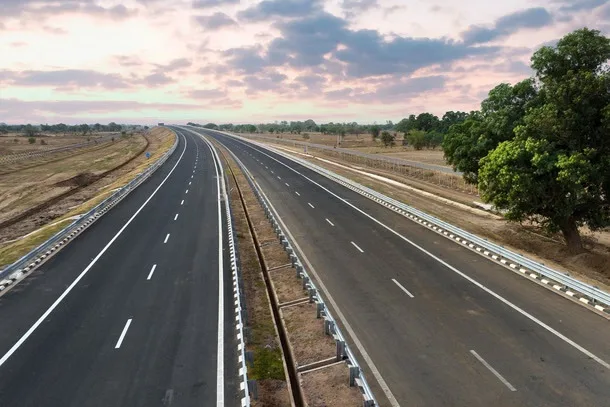
The Ganga Expressway, a flagship infrastructure project of the Uttar Pradesh government, has crossed a crucial milestone ahead of its expected inauguration next month. The expressway’s FASTag-based electronic toll collection system was successfully tested at a toll plaza in Badaun district, confirming the operational readiness of its contactless tolling infrastructure.
During the trial run, automatic boom barriers functioned smoothly, allowing vehicles to slow down and pass through without coming to a complete halt. FASTag scanners detected vehicle tags accurately, and toll payments were processed instantly, officials said, demonstrating seamless integration of the system.
According to reports, the successful test has strengthened expectations that the expressway will be opened to the public in the coming weeks.
The Uttar Pradesh Expressways Industrial Development Authority (UPEIDA), the nodal agency overseeing the project, said similar FASTag trials are being conducted at toll plazas across other construction packages of the expressway.
Officials noted that these parallel trials are aimed at ensuring uniform performance standards across the entire corridor before it is thrown open to traffic. Any technical issues detected during the tests are being addressed in real time, they added.
Senior state government officials said the expressway is in the final stages of completion, with last-mile works such as signage installation, safety audits, landscaping, and system integration progressing alongside tolling and surveillance checks.
Once operational, the six-lane, access-controlled Ganga Expressway will stretch over 594 kilometres, connecting Meerut in western Uttar Pradesh to Prayagraj in the east. The corridor passes through 12 districts, including Hapur, Bulandshahr, Amroha, Sambhal, Shahjahanpur, Hardoi, Unnao, Rae Bareli and Pratapgarh, significantly reducing travel time across the state.
Officials said the expressway is expected to boost regional connectivity, facilitate faster movement of goods and people, and support economic activity across agrarian and industrial belts along its route.
The scale of engineering involved in the Ganga Expressway is among the largest in India’s highway sector. The project spans 140 water bodies and incorporates an extensive network of bridges, flyovers, underpasses and culverts designed to ensure uninterrupted connectivity and minimal disruption to local traffic.
Infrastructure elements include seven road overbridges, 17 interchanges, 14 major bridges and 126 minor bridges. In addition, the expressway features 28 flyovers, 50 vehicle underpasses, 171 light vehicle underpasses, 160 small vehicle underpasses and as many as 946 culverts.
Officials said these structures have been planned to integrate the expressway with existing road networks while maintaining high-speed, access-controlled movement on the main carriageway.
The Uttar Pradesh government has partnered with Switzerland-based RTDT Laboratories AG and ETH Zurich University to deploy artificial intelligence and sensor-based systems for monitoring road quality and driving comfort.
Unlike conventional practices where surface quality is assessed after construction, the new system evaluates ride quality during the construction phase itself. This enables corrective measures to be taken immediately, improving long-term durability and safety.
A specially equipped Innova vehicle, fitted with vibration-based technology and seven accelerometer sensors, is being used to inspect all six lanes of the expressway in real time. The sensors measure surface undulations, elevation changes and ride comfort parameters, generating precise data for engineers.
Officials involved in the project said the AI-driven monitoring system ensures consistent construction quality across the length of the expressway. By identifying micro-level deviations in road surface smoothness, the technology helps maintain uniform driving conditions and enhances safety at high speeds.
The system is expected to be extended to other major projects, including the Gorakhpur Link Expressway, as part of the state’s broader push towards technology-driven infrastructure development.
With toll trials progressing successfully and construction nearing completion, authorities indicated that the Ganga Expressway is now in its final phase of readiness. Safety audits, emergency response planning and coordination with traffic and law enforcement agencies are also being undertaken ahead of the opening.
Once inaugurated, the Ganga Expressway is expected to emerge as a critical east–west corridor in Uttar Pradesh, setting new benchmarks in scale, technology and execution in India’s road infrastructure landscape.