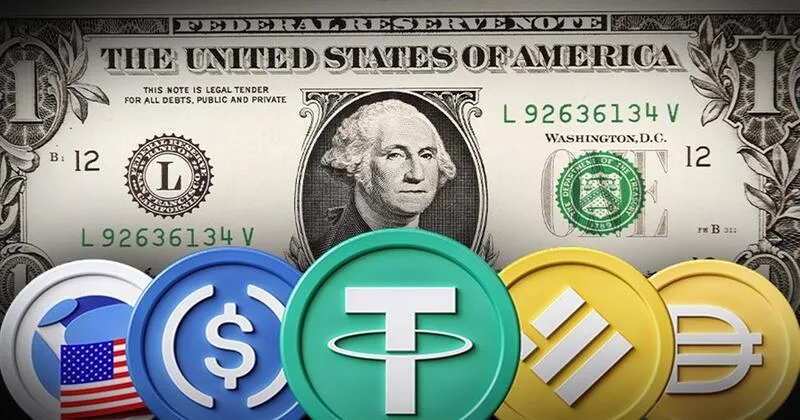
On July 17, the US President Donald Trump signed the GENIUS Act, marking a decisive moment in the evolution of digital finance. While Washington has projected the law as a milestone in the global digital currency revolution, several countries have received it with unease. In India, RBI Deputy Governor T. Rabi Sankar, in a recent cautionary speech, warned that stable coins could undermine the fundamentals of the regulated banking system. This suggests that Indian policymakers increasingly view stablecoins not merely as financial innovation, but as a potential systemic disruptor.
Stablecoins occupy a grey zone between sovereign money and private cryptocurrencies. Unlike Bitcoin or Ethereum, which have no backing, stablecoins are pegged to fiat currencies and supported by reserves. Yet this hybrid nature complicates regulation. The U.S. decision to prohibit a central bank digital currency (CBDC) while simultaneously promoting privately issued, dollar-pegged stablecoins presents a paradox—especially when countries like India and China are pursuing sovereign digital currencies.
Against the backdrop of U.S. financial sanctions, trade weaponisation and growing momentum toward de-dollarisation, the legal empowerment of stablecoins is widely interpreted as a strategic attempt to preserve dollar dominance through new technological rails.
What Are Stablecoins?
A stablecoin is a digital asset designed to function as a medium of exchange while maintaining price stability by being pegged—typically at a 1:1 ratio—to a fiat currency such as the U.S. dollar. Unlike bank money, which exists on centralised ledgers overseen by banks and central banks, stablecoins are usually issued by private entities, often technology firms.
The stablecoin market is dominated by Tether (USDT) and Circle’s USDC, both of which claim to be backed one-to-one by dollars or highly liquid dollar-denominated assets. In theory, every stablecoin in circulation corresponds to an equivalent dollar held in reserve and is redeemable at face value.
Why stablecoins gained traction
The roots of cryptocurrencies lie in the 2008 global financial crisis, which exposed deep vulnerabilities in the banking system. Bitcoin was conceived as an alternative form of money—decentralised, trust-minimised and independent of central banks. Stablecoins emerged later to address crypto’s Achilles’ heel: price volatility.
By combining blockchain efficiency with relative price stability, stablecoins enable 24×7 settlement, bypass cumbersome banking procedures and significantly reduce transaction costs—particularly for cross-border payments. For example, an Indian entrepreneur in the U.S. remitting USD 1 million to India through traditional banking channels may incur:
- 1–2% acquiring bank charges
- 1–3.5% card issuing fees
- 2–4% currency conversion margins
Using stablecoins, the same transfer can be completed within minutes at a fraction of the cost.
This has made stablecoins especially popular among migrant workers and diasporas. In economies facing currency instability—such as Argentina and Türkiye—dollar-pegged stablecoins are increasingly used as a hedge against inflation and capital controls.
Another growing use case is collateralisation. Because stablecoins can be quickly liquidated, they are becoming attractive collateral in private lending markets. A borrower holding stablecoins presents a lower perceived risk, expanding credit access outside the formal banking system.
Structural fault lines in the monetary system
Currency issuance has traditionally been a sovereign function. Fiat money derives legitimacy from state backing, regulatory oversight and the principle of singleness—the assurance that all money in an economy ultimately settles in central bank money at par value. This principle underpins trust, financial stability and seamless commerce.
Stablecoins disrupt this architecture. Although pegged to fiat currencies, they lack sovereign guarantees. Under the GENIUS Act, stablecoin issuers are explicitly prohibited from paying interest or yield to holders. More critically, there is no deposit insurance or explicit bailout mechanism. In the event of issuer insolvency, stablecoin holders are treated as unsecured creditors and must seek recovery through insolvency proceedings.
This creates a fundamental asymmetry: stablecoins resemble money in daily use, but not in protection. A widespread loss of confidence in a major stablecoin could therefore trigger runs and contagion without the safety nets that underpin traditional banking.
The strategic logic behind U.S. stablecoin policy
The U.S. has historical experience with private currencies prior to the establishment of the Federal Reserve—an era marked by instability and fragmentation. The revival of privately issued currency today is therefore not accidental.
First, stablecoins act as a counterweight to de-dollarisation. As countries promote trade in local currencies and shift reserves toward gold, dollar-backed stablecoins create renewed demand for U.S. Treasury assets. Stablecoin issuers become structural buyers of U.S. government debt, currently exceeding USD 37 trillion.
Second, stablecoins allow the U.S. to outpace global CBDC initiatives. While many sovereign digital currency projects remain experimental, U.S.-based stablecoins already enjoy massive network effects. Early dominance could marginalise foreign CBDCs before they reach scale.
Third, President Trump and his family have reportedly earned over USD 800 million from crypto-related ventures in the first half of 2025. In this context, the expansion of privately issued stablecoins may facilitate alternative payment channels for sanctioned jurisdictions, effectively allowing private crypto markets to bypass formal U.S. sanctions regimes.
What India should do
India must engage with stablecoins pragmatically rather than ideologically. A clear regulatory framework—similar in scope but not in intent to the GENIUS Act—is essential to protect national interests while enabling innovation.
Key policy priorities should include:
- Regulating private stablecoins with strong safeguards against money laundering, terrorism financing, and consumer harm.
- Leveraging UPI with blockchain infrastructure, allowing India’s dominant digital payments ecosystem to evolve rather than be disrupted.
- Accelerating rupee-backed stablecoins, such as Asset Reserve Certificates (ARCs), designed to coexist with the RBI’s CBDC.
- Building indigenous blockchain infrastructure to avoid dependence on Western-dominated crypto ecosystems.
India’s lukewarm public response to the CBDC highlights a critical lesson: adoption follows utility. With UPI already ubiquitous, digital currency innovation must offer clear advantages. Carefully regulated private crypto innovation may provide that missing incentive.
Stablecoins are not merely a financial innovation—they are a geopolitical instrument reshaping monetary power, capital flows and regulatory authority. For India, the choice is stark: lead, adapt or follow. Strategic agility, regulatory foresight and indigenous innovation will determine whether India becomes a rule-maker or a rule-taker in the emerging digital financial order. If India aspires to shape, rather than react to, the future of money, the time to act is now.