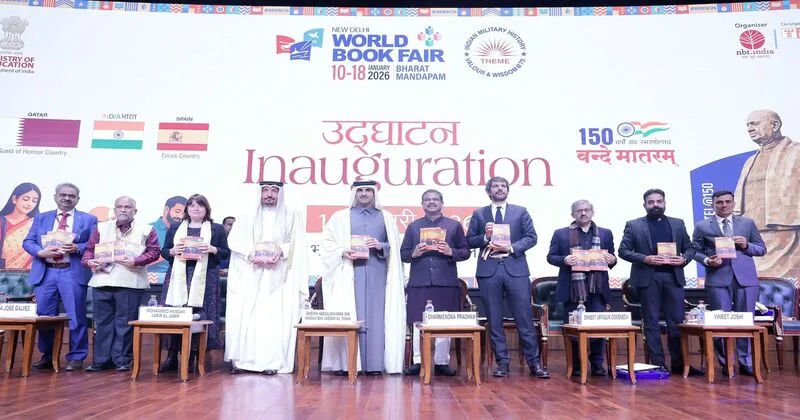
BHUBANESWAR: On the occasion of the inauguration of the New Delhi World Book Fair 2026 at Bharat Mandapam, the book “The Saga of Kudopali: The Unsung Story of 1857” was formally released in ten languages, including Spanish. The book was unveiled by Union Minister for Education Dharmendra Pradhan, along with several other distinguished dignitaries.
The latest editions of the book were launched in Spanish, Bengali, Punjabi, Assamese, Malayalam, Urdu, Marathi, Tamil, Kannada, and Telugu, taking the total number of languages in which the book is now available to thirteen. Earlier, the book had already been published in Odia, English, and Hindi. The release in Spanish—one of the world’s major languages—is being seen as a significant milestone in presenting Odisha’s history of the freedom struggle to European and global readers.
A special video presentation based on the historic struggle of Kudopali was also screened during the book launch ceremony, drawing considerable attention from visitors and dignitaries alike.
Addressing the gathering, Union Minister Dharmendra Pradhan said that December 30, 1857, marked one of the most significant yet lesser-known chapters of India’s freedom movement. On that day, 53 freedom fighters laid down their lives on the battlefield of Kudopali, while four others were later executed by the British, bringing the total number of martyrs to 57.
He stated that the current initiative is a powerful step toward restoring due recognition to the long-neglected sacrifices and heroism of the freedom fighters of Kudopali, both nationally and internationally. “The publication of this book will give a new global identity to an important but overlooked chapter of India’s freedom struggle,” Pradhan said. He added that the effort would also inspire the younger generation to learn about the courage, sacrifice, and resistance shown by the heroes of their own land.
Describing Kudopali as more than just a geographical location, the Union Minister said it stands as a luminous symbol of India’s independence movement. During the Revolt of 1857, this region of Odisha emerged as a major centre of resistance against British colonial rule.
Pradhan recalled that after being released from Hazaribagh Jail on July 30, 1857, Veer Surendra Sai returned to Sambalpur and, with widespread public support, devised a strong anti-British “Ulgulan” (guerrilla warfare) strategy. Kudopali, located just four miles from Sambalpur, became the primary base for freedom fighters because its hilly terrain allowed them to closely monitor enemy movements.
He noted that on December 17, 1857, the first British assault on Kudopali was decisively repelled when freedom fighters rolled massive boulders down the hills, forcing the colonial forces to retreat. This unexpected defeat stunned the British administration. However, the British later resorted to deception by feigning retreat and launching a sudden counterattack when the freedom fighters descended from the hills.
In this fierce confrontation, Chhabil Sai, the fourth brother of Veer Surendra Sai, fought valiantly and attained martyrdom. In total, 57 brave sons of the soil sacrificed their lives at Kudopali—53 in battle and four by execution. Far from weakening the freedom movement, this tragedy intensified resistance against British rule, culminating in subsequent battles, including the historic Pahadsrigida confrontation.
Pradhan emphasised that the historic struggle of Sambalpur was led by Veer Surendra Sai, under whose leadership a mass uprising against British authority spread across the region. Alongside Chhabil Sai, Surendra Sai’s brother Udant Sai and his uncle Balram Singh played crucial roles in strengthening the movement.
Among the 57 martyrs who sanctified the soil of Kudopali with their blood were prominent figures such as Krushna Chandra Singh Nayak, son of the Kulabira zamindar; revolutionary commander Shrikrishna Behera; and Balabhadra Das Birtia, the Gauntia of Patrapali. Their collective sacrifice earned Kudopali recognition as a sacred site of martyrdom in the annals of India’s freedom struggle.
The Union Minister further noted that for decades, this heroic history had largely remained confined to local folk songs and oral traditions. Now, through the concerted efforts of the Indian Council of Historical Research (ICHR) and the National Book Trust (NBT), this forgotten saga has been documented and disseminated worldwide in thirteen languages through the book “The Saga of Kudopali.”
He also announced that plans are underway to construct a grand martyrs’ memorial at Kudopali, which will serve as a lasting tribute from the nation to its freedom fighters.
The book launch ceremony at the World Book Fair was graced by several international dignitaries, including His Excellency A.R. bin Hamad bin Jassim bin Hamad Al Thani, Minister of Culture of Qatar; H.E. H.J. Al Jaber, Ambassador of Qatar to India; and Ms Maria José Gálvez, Director General of Books at Spain’s Ministry of Culture. Their presence underscored the growing global recognition of India’s freedom struggle narratives and the universal respect for the sacrifices made by its unsung heroes.