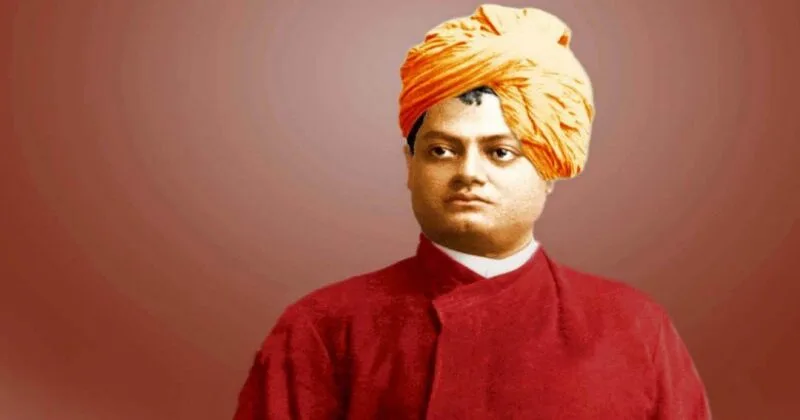
He was in this world in a human body for only thirty-nine years. He did not introduce any new doctrine or initiate any so-called reform movement. What he did was to make the principles of the eternal Sanatana Hindu Dharma relevant in the context of changing times. Just as Sri Chaitanya Mahaprabhu protected Hindu society from the Islamic aggression, Swami Vivekananda, in a similar manner, countered European aggression under British rule and restored the faith of the so-called educated, modern Hindus in Hindu religion and culture.
One of Swami Vivekananda’s major contributions to Hinduism was presenting a true and complete identity of the religion to the world duringchallenging circumstances – he gave a sense of completeness to the identity of Hindu culture. Before Swami Vivekananda came into the limelight, Hindu society seemed to consist of isolated communities, each more or less independent and each claiming superiority over the others. These communities had no clear understanding of the common foundation of Hinduism. Sister Nivedita wrote: “Regarding Swami Vivekananda’s speech at the Parliament of Religions, it can be said that when he began his speech, his subject was ‘the religious sentiments of the Hindus’, but when he finished, Hinduism had acquired a new form”. Swami Vivekananda was the first to show that Hinduism as a whole has certain fundamental concepts that are acceptable to all communities as a common foundation. Swami Vivekananda not only gave Hinduism its complete identity but also unified it.
As the first Hindu to be represented in the West, Swami Vivekananda represented Hinduism at the Parliament of Religions in America in 1893 and by propagating Hinduism there for the next few years, he himself became a symbol of Hindu unity—not as the head of a particular or new sect. Through his speeches and letters, he awakened the consciousness of Hindus, reminded them of their common heritage and strengthened the bonds of unity among them.
Hinduism is a vast collection of institutions, customs, practices, belief systems, philosophies, religions, deities, scriptures and more, which together constitute its remarkable diversity. Sri Ramakrishna and Swami Vivekananda embraced the entirety of Hinduism with all its diversity. They accepted the complete Vedas, both the knowledge formats (Jnana Kanda) and the ritualistic portion (Karma Kanda). They accepted all the Hindu scriptures ; all sects such as Shaivism, Shaktism and Vaishnavism; all schools of philosophy such as Advaita Vedanta, Dvaita Vedanta, etc.; all sages and seers; from idol worship to the worship of God in human form – they accepted everything, rejecting nothing. By embracing and revitalizing all the diverse aspects of Hinduism, Sri Ramakrishna and Swami Vivekananda helped to preserve them. Swamiji wanted to make Hinduism once again a universal religion, open to all people and all castes.
Swami Vivekananda not only made Hinduism universal but also dynamic. He instilled a zeal among the Hindus. He wanted the ancient message of India’s spirituality to spread to all corners of the world and for Indian spirituality to be revealed to all people. In the 19th century, people in the West had a negative opinion of Bharat and Hindus. Hinduism was considered a religion of superstition. One of Swami Vivekananda’s greatest achievements was changing this misconception. According to Swamiji, religion has an essential inner core and a less essential outer shell. The outer shell consists of mythology, rituals, customs, festivals, etc. The essential core comprises spirituality. Swamiji demonstrated that in terms of spirituality, Hinduism is superior to all other religions. Another contribution of Swami Vivekananda was spreading awareness about the importance of the Upanishads as the essence of the thoughts of the ancient Indian sages.
Due to the influence of Swami Vivekananda, the importance of yoga in Hinduism has gained universal recognition today. Swamiji presented yoga as the practical aspect of Vedanta. He guided the revival, reorganization and setting of specific goals for the Hindu monastic order. Swami Vivekananda showed the way to revive monastic life by giving it a new direction and adapting the eternal principles of spiritual life to suit the larger modern society. In the history of Hindu monasticism, Sri Shankaracharya was the first to provide a specific framework for the formation of Hindu monastic life. He established the ten orders or Dashanami, defining the duties of the monks and organizing them. From the time of Sri Shankara, monks went out across India as teachers and propagators of Advaita Vedanta.
Swamiji planned to utilize the power of the monastic order for social welfare. The Ramakrishna Mission is a result of this. Not only the Ramakrishna Mission, but most of the spiritual and nationalist organizations currently working in the country draw their inspiration from Swami Vivekananda. Even in this extremely materialistic modern age, those who are sacrificing their personal interests and disregarding worldly pleasures to work for the preservation of religion and culture see Swamiji as their guiding light. Swamiji’s teachings are also our most potent weapon in countering the theoretical attacks against Hinduism and Bharatiya culture, both from within and outside the country. Swamiji said, “For the next fifty years, let our glorious Mother India be our only deity”. Similarly, we can say that for the next hundred years, Swami Vivekananda should be our source of inspiration.