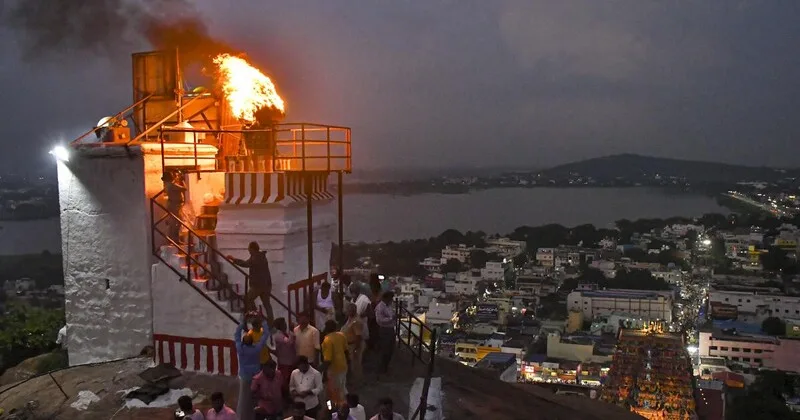
The Karthigai Deepam at Thiruparankundram has long stood as a symbol of religious continuity rooted in Tamil Hindu tradition. Associated with one of the six sacred abodes of Lord Murugan, the ritual of lighting the Deepam on this hill has been part of the region’s spiritual and cultural life for centuries. This lighting ceremony at the hill should have been a quiet moment of continuity– a ritual reconnecting present-day devotees with an ancient tradition rooted in Tamil Hindu memory. However, in the recent weeks this longstanding practice has become the subject of administrative hesitation and legal contestation, bringing the ritual into the public and judicial spotlight.
What followed in Tamil Nadu was not simply a disagreement over ceremonial arrangements, but a broader debate on how ancient religious traditions are addressed within contemporary governance frameworks. The developments at Thiruparankundram invite reflection on the manner in which lawful religious practices, judicial authority and executive decision-making intersect in a diverse and democratic society.
The immediate trigger and the executive defiance
The immediate controversy surrounding Thiruparankundram Hill began when a devotee, Rama Ravi Kumar approached the Madurai Bench of the Madras High Court, seeking restoration of the traditional practice of lighting the Karthigai Deepam at Deepathoon.
On December 1, 2025 Justice G. R. Swaminathan delivered a detailed judgment allowing the lighting of the Karthigai Deepam at the Deepathoon. The Court restored the right to light the Karthigai Deepam at Deepathoon, describing it as a well-established, customary tradition supported by overwhelming literary and historical evidence. It substantially relied on those historical evidences and prior judicial rulings, including a 1923 civil decree affirming the temple’s title over the hill, which was upheld by the Privy Council at that time.
What followed next exposed a troubling sequence of events. Despite clear directions, temple authorities confined the ritual to the lower-hill mandapam. This prompted a contempt petition by the Hindu devotees. In response, Justice Swaminathan passed an order, allowed the petitioner and ten other persons to proceed to the Deepathoon for Deepam (lighting the lamp) under CISF protection, remarking pointedly on the importance of symbolism in matters of faith.
Yet even this was not implemented. Local police invoked prohibitory orders, blocked access and prevented the ritual. Protests followed, detentions were made and several persons injured, with one devotee namely, Thiru Poorna Chandran self-immolated himself. A court order, operative in real time, was effectively neutralized by executive defiance. Meanwhile, the state approached the Supreme Court. At every stage, what should have been a straightforward implementation of judicial protection of Article 25 rights of devotees was transformed into a confrontation between the executive and the judiciary. The issue thus ceased to be merely religious. It became constitutional.
Political escalation and targeting of the judge
As the issue gained national attention, political rhetoric escalated. Allegations were levelled against Justice Swaminathan, culminating in a letter by over a hundred opposition Members of Parliament seeking his removal. The allegations – accusing him of bias and deciding cases contrary to secular principles – were broad and vague without providing specific evidence or data.
This provoked a rare but powerful response – fifty-six former judges of the Supreme Court and various High Courts issued a strong statement condemning the impeachment attempt as “a brazen effort to browbeat judges who do not fall in line with the ideological and political expectations of a particular section of society”. They warned that permitting such actions would strike at the roots of democracy and judicial independence.
HR&CE and the crisis of representation
Perhaps the most unsettling aspect of the controversy is the role of the Hindu Religious and Charitable Endowments Department. Instead of defending Hindu devotees, the department opposed them and even filed an appeal against the judgment of Justice Swaminathan.
This inversion—where a state-controlled body meant to safeguard Hindu institutions acts against Hindu ritual rights—exposes the structural flaw of government control over temples. A genuinely autonomous religious institution would have defended its traditions, mobilized its resources for protection and stood with its devotees. Instead of acting as a guardian or representative body of Hindu religious practices, it positioned itself against the very devotees it meant to serve. Autonomy is replaced by bureaucratic caution and faith becomes subordinate to administrative convenience.
This episode strengthens a long-standing critique of state control over Hindu temples. When religious institutions are administered by the government, they are prone to become tools to serve their political ideologies instead of becoming autonomous and defending their own rituals and traditions. The call to free temples from government control thus emerges not as ideology, but as institutional necessity.
Broader implications
The implications of the Thiruparankundram episode extend far beyond a single ritual or location. At its core, the controversy raises a deeper institutional concern: whether lawful religious practices can be stalled or nullified on the basis of anticipated resistance rather than actual illegality. While Article 25 is subject to public order, the threshold should not be reduced to speculative or pre-emptive fears. If the mere possibility of unrest—real or presumed—becomes sufficient to interrupt constitutionally recognized practices, it effectively grants an informal veto to those most willing to threaten disorder. Such an approach risks rewarding intolerance rather than upholding the rule of law. It may risks encouraging pressure politics and gradually hollowing out the assurance that constitutional guarantees are meant to provide.
Equally troubling is the incident of targeting a judge for upholding such rights The impeachment motion against Justice G.R. Swaminathan, despite lacking any realistic chance of success, has been rightly criticized by former judges and public at large. When a government defies a court order and simultaneously vilifies the judge as biased, it sends a chilling message. Personal attacks on the Judge, who recognized legitimate rights of petitioner devotees, while discharging his duty, are not welcomed in a constitutional democracy.
It is also significant to note that Hindu devotees in this matter consistently pursued peaceful and institutional routes—through historical decrees, administrative representations, peace committee resolutions and finally the courts. Their conduct underscores restraint and faith in constitutional processes. To characterise such lawful assertion as ‘provocative’ invites an unsettling question: if the lighting of a single lamp, once a year, at its traditional site is deemed disruptive, what does that suggest about the space available for Hindu religious continuity in public life? The whole episode also raises concern as to whether public tolerance has been reduced to such an extent that even the lighting of one traditional lamp, at its historic site, is perceived as capable of disturbing communal peace and harmony. A society that cannot bear a lawful, peaceful religious ritual reveals a deeper discomfort with Hindu religious expression itself. The Thiruparankundram episode thus serves as a reminder that public order cannot be sustained by curtailing or ignoring lawful practices, but only by upholding legality with consistency and fairness.
The Karthigai Deepam episode ultimately invites reflection on the kind of constitutional culture India seeks to sustain. Respect for judicial authority and ancient, lawful religious practices does not weaken communal harmony or public order; it reinforces both. A mature state fulfils its role not by shrinking religious visibility out of political convenience or discomfort, but by ensuring that constitutionally protected practices are not obstructed unnecessarily under the guise of law-and-order concern or maintaining communal peace and harmony. The country’s plural character has endured not by dimming Hindu lamps, but by allowing Hindu culture—its festivals, temples, sacred hills and ritual practices—to exist confidently and lawfully in the public sphere. Only a civilization secure in its own identity can accommodate diversity without anxiety.
The Karthigai Deepam at Deepathoon is not a demand for privilege. It is a reminder of continuity. When the state honours judicial orders, protects lawful worship and resists the impulse to manage Hindu expression downward, it strengthens constitutional faith itself. A lamp lit at its right place is a quite affirmation of memory and belonging. How such affirmations are treated will shape not only the future of Hindu religious expression, but also the credibility of constitutional governance itself.