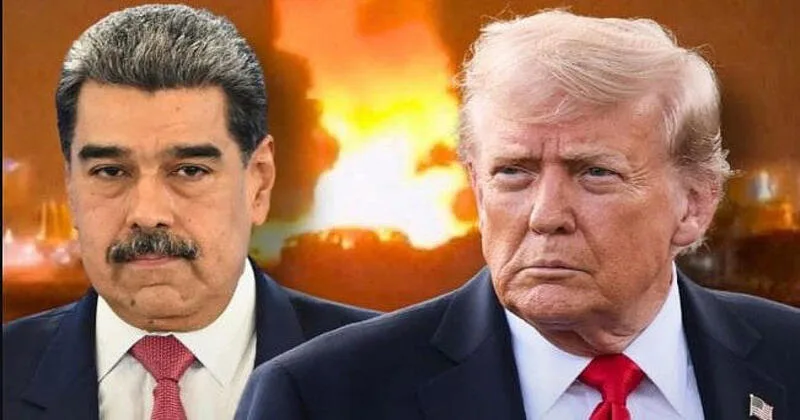
President Donald Trump commenced the second year of his presidency through US military intervention in Venezuela on January 3. His quest to ‘Make America Great Again (MAGA)’ took a bizarre turn when the US forces bombed major cities in Venezuela and the special forces captured President Nicolas Maduro and his wife. The pre-dawn attack forced a regime change in Venezuela and President Trump claimed that the US was now in charge of the South American country and its oil supplies.
Though US has a long history of intervention in other countries for a regime change to suit its geopolitics, the military intervention in Venezuela is unprecedented in scale and scope. The official reason for capturing President Maduro is ostensibly for his involvement in narco-terrorism against the US, calling it a law-enforcement operation. But soon the US claimed for the vast oil reserves in Venezuela, believed to be the largest in the world, at more than 300 billion barrels. President Trump has also threated Latin America countries like Cuba and Columbia of a similar fate.
When President Trump went overboard in his exuberance and staked claim over Greenland, the European counties cited NATO charter which treats attack on any member as an offensive against the entire grouping. Greenland is an autonomous territory of Denmark and the US feels that this territory serves their strategic and economic interests in the Arctic region. But one thing is clear: the bogey of democracy from the US stands exposed. India and the Indians should not hereafter take any comments from them about democracy seriously.
The unlawful intervention of the US in Venezuela has come in for global condemnation. The debate in the UN happened on the expected lines and one knows that any resolution in the UN Security Council will be vetoed by the US. Therefore, the issue will more or less die down after a while. But the change of regime in Venezuela would be keenly watched. President Trump has warned the new interim government in Venezuela that it has to align with the US interests. It is 30 million population of Venezuela that has to decide where they stand.
President Trump has also claimed the military intervention in Venezuela codenamed ‘Absolute Resolve’ a resounding success. Militarily, the operation was well-executed. It is emerging that the US military and CIA were planning this operation for more than last three months. President Maduro was guarded by a security force consisting of about 2000 personnel and it is obvious that his security was compromised. The special forces from Delta Force of the US military did not face much opposition and could easily extract President Maduro and his wife. It is feasible that during the military intervention, the US crippled command and control structure in Venezuela through its highly advanced US Cyber Command.
The larger issue from the so-called success in Venezuela is to watch future global interventions by the US under President Trump. President Trump has indirectly emphasised the Monroe Doctrine through this intervention, which opposes any foreign intervention in the Western hemisphere. Venezuela under President Maduro had tilted towards Russia and China. In fact, the air defence cover over Venezuela was largely of Russian origin military equipment. China also has major economic interest in Venezuela, particularly in the oil sector. Thus, President Trump through this intervention has been able to secure the US strategic interests in Latin America in general and Venezuela in particular.
We Indians are fortunate that we are regarded as a responsible power in the comity of nations. In an uncertain world, India is growing economically at more than 7 per cent of growth annually, notwithstanding the tariffs imposed by President Trump. The latest US Foreign Agents Registration Act (FARA) has revealed that Pakistan reached out to the US authorities no less than 60 times to intervene during Operation Sindoor. India had inflicted such severe damage to Pakistan during Operation Sindoor that it spent Rs. 45 crores for an intense lobbying for the US intervention to end the conflict. This report should now conclusively end the debate on President Trump’s repeated claims on brokering ceasefire between India and Pakistan during Operation Sindoor.
The year 2026 has begun on a violent note, be it Venezuela, Iran, Bangladesh or Yemen and there are signs that this year may witness more friction between the nations and their groupings. India has advocated a multi-polar world but the signs for a peaceful world are not many. India also has a not so friendly neighbourhood. Under these circumstances, India has no choice but to empower itself to deal with external threats and internal security challenges, particularly from the threat of cross-border terrorism. We Indians should evolve a unified stance on the issues of national security. Politically, India also has to present a united front to deal with the current and emerging geopolitical challenges.