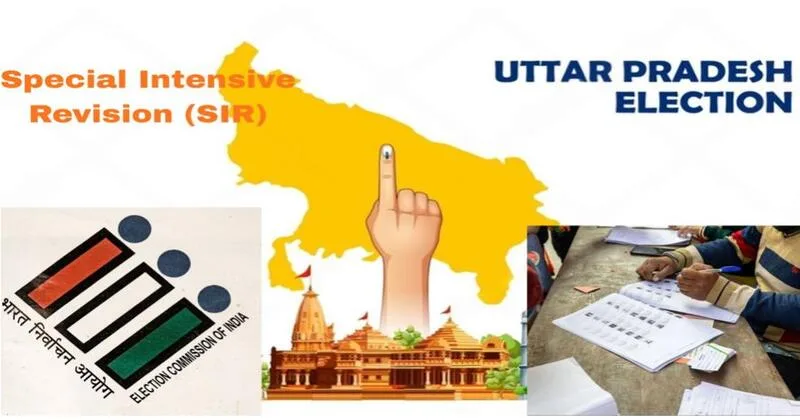
The Special Intensive Revision of the Electoral Rolls being conducted in the state of Uttar Pradesh has turned out to be the most discussed government exercise that has taken place in the last few years. According to sources, the number of people whose names have been deleted from the voters’ list has gone up to 2.89 crores. Although the Election Commission of India has clarified that the exercise is a normal and regular feature that needs to be conducted to ensure the purity of the polls, the Opposition parties feel that the number of people being deleted can have political repercussions.
Scale of Uttar Pradesh’s electoral rolls
Uttar Pradesh has the biggest electoral roll in India, with more than 15.44 crores of its eligible voters enrolled in 403 Assembly seats and 80 Lok Sabha seats. Handling so large a database is no less than an achievement. Election officers admitted that any difference, even of 1-2 per cent, means lakhs of names. There has been so much urbanisation and migration over the last decade that errors or repetitions in voter databases have increased.
According to administrative data cited in newspapers, Uttar Pradesh records millions of inter-district and inter-state migrants annually, particularly from eastern districts such as Purvanchal and Bundelkhand. Many migrants register in new locations without deleting earlier entries, leading to duplication, which is one of the key reasons behind inflated electoral rolls.
What the SIR Involves
The SIR is not a desk exercise. It involves door-to-door verification conducted by Booth Level Officers (BLOs), supported by local officials and supervised by Electoral Registration Officers. Across Uttar Pradesh, over one and a half lakh BLOs are engaged in field verification, checking addresses, confirming voter existence and verifying documentation.
Officials explained that the revision focuses on four broad categories:
* Deceased voters, where death records have not been formally updated
* Duplicate entries, often due to migration
* Permanent migrants, no longer residing in the constituency
* Ineligible entries, including wrong age or incorrect details
Preliminary scrutiny, according to reports, flagged nearly two crore entries for verification. Election authorities emphasise that this does not mean automatic deletion, every flagged name goes through a statutory process of notice, publication of draft rolls and claims with objections are made.
Election Commission’s Position
The Election Commission of India has repeatedly clarified that voter list revision is mandated under the Representation of the People Act, 1950, and similar exercises have been conducted in the past under governments of different political parties. Officials insisted that no qualified voter will ever be removed through the process and every citizen has the right to reinstate his or her eligibility during the period of claims.
The Commission has equally called upon political parties to actively take part in this process via the nomination of Booth Level Agents (BLAs). According to government statistics, constituencies with Booth Level Agents tend to feature a low error rate because parties help to identify true voters.
Support From BJP to SIR
The ruling political party, the Bharatiya Janata Party, has wholeheartedly supported the SIR because the SIR is critical to the sanctity of elections. The BJP leaders believe that free elections are dependent on free electoral rolls, which are presently bloated to the advantage of those who flourish on uncertainties.
The spokesmen for political parties have used instances where fraudulent elections were alleged due to outdated electoral lists. The fact that the country has over 96.88 crore voters makes any inaccuracies affect the legitimacy of elections. The SIR stands to fortify democracy, not undermine it, as seen from the BJP perspective.
On November 21, 2025, Home Minister Shri Amit Shah termed the Election Commission’s ongoing Special Intensive Revision (SIR) as the purification of the voter list. He also cautioned political parties that are opposing the process and fare favouring illegal infiltrators.
How Yogi Adityanath Views the Special Intensive Revision
Uttar Pradesh Chief Minister Shri Yogi Adityanath has supported the Special Intensive Revision of electoral rolls, hailing this as a constitutional requirement for ensuring the purity of elections. According to a Press Trust of India news report, Yogi Adityanath has explained that a cleaner electoral roll is necessary for ensuring free and fair elections, since duplication of names, bogus and dead electoral rolls impact democracy.
He has been repeatedly backing the independence of the Election Commission of India against allegations from the Opposition parties that there is political interference. It is also noted that the Chief Minister made it clear that “the role of our government is limited to only logistics and manpower. The list is entirely with the election officials.”
In response to the fear of being disfranchised, Adityanath has referred to the process of claims and objections and exhorted the public to check if their names are there and make corrections if necessary. He has also appealed to the political parties to use the Booth Level Agents rather than spreading fear.
Opposition’s Stand: Timing or propaganda
The opposition parties have questioned the extent of the exercise as well as its timing. The Samajwadi Party has claimed that massive deletions could adversely affect migrant workers, minorities and slum dwellers who are either irregular on the electoral rolls despite being qualified to vote.
There have been demands for more transparency by the Indian National Congress for district-by-district information regarding the number of excised and restored numbers, explaining that confusion in the verification process might lower the numbers among first-timers and marginal voters.
The Bahujan Samaj Party has taken a more cautious line, urging voters to check their names proactively while reminding the Election Commission of its responsibility to ensure inclusivity.
Administrative Reform: Numbers behind the debate
Past electoral revisions provide useful context. During earlier intensive revisions in large states, 3–5 per cent of names were typically flagged for correction or deletion. In Uttar Pradesh, that percentage translates into 45–75 lakh entries, which is 3-4 times the previous SIRs. The current figure of 2.89 crore flagged names appears large, but officials argue it reflects cumulative inaccuracies over multiple years, not a single-cycle effect.
Election data also shows that urban constituencies record higher duplication rates, while rural areas see more deletions linked to unreported deaths. Officials say such patterns represent the underlying administrative impact, not the political; it’s a nature of the exercise. And so far as there is a highly political atmosphere in a state such as Uttar Pradesh, even simple electoral procedures assume political connotations. In institutional terms, it seems that the objective of SIR is to ensure that ‘one person, one vote.’
With the release of draft lists for objections, the real challenge would be in their transparency, reach and redressing grievances. The success of the exercise would be pegged on how well the actual voters are protected while the discrepancies are corrected.
The SIR in Uttar Pradesh points to a larger democratic dilemma of how to simultaneously ensure electoral integrity as well as maximum inclusion. Whether SIR is seen as a necessity for administration or as a political point of contention, the answer to this issue has crucial implications not only for electoral roles but also for the electoral process as a whole.