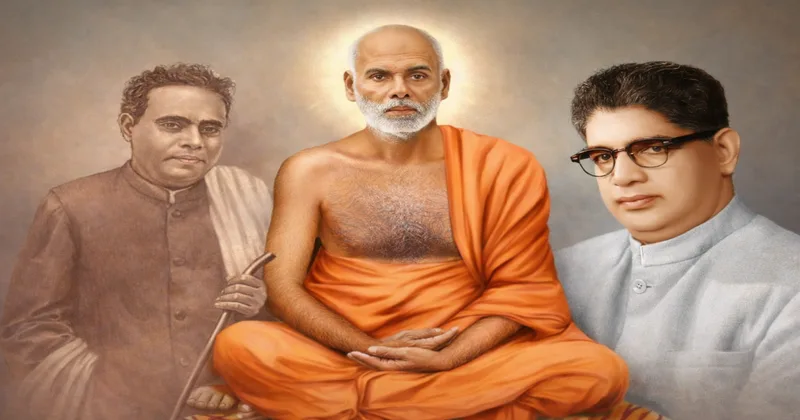
Kerala is often portrayed as a land of progressive thought, social reform, and moral leadership. High literacy and political awareness are worn as badges of honour. Yet, behind this carefully curated image lies a deeper contradiction. Kerala has repeatedly shown an inability to engage honestly with reformers who refused to align with dominant ideological narratives. Those who questioned power structures from within the civilisational framework were not openly attacked; they were slowly sidelined, diluted, and forgotten.
Two figures exemplify this uncomfortable truth more than anyone else. Kumaran Asan and R. Shankar belonged to different generations and spoke through different media, yet they shared a common fate. Both were disciples of Sree Narayana Guru, both upheld moral clarity over political convenience, and both were gradually pushed to the margins of Kerala’s public memory.
The Ethical Foundation of Narayana Guru
Sree Narayana Guru’s philosophy was not merely a call against caste oppression. It was a demand for ethical consistency in public life. His vision of One Caste, One Religion, One God for humankind rejected social hierarchy, religious supremacy, and political opportunism. This made his philosophy deeply transformative and deeply inconvenient.
Kumaran Asan and R. Shankar absorbed this vision in its totality. They did not selectively apply reform to suit the prevailing mood. They believed that truth could not be filtered through ideology and that justice lost its meaning when compromised for power. This uncompromising inheritance would eventually place both men on a collision course with Kerala’s dominant political and intellectual currents.
Kumaran Asan Beyond the Sanitised Icon
Kumaran Asan is widely remembered today as a progressive poet and a social reformer. His verses are quoted in classrooms and public events, but often in a carefully edited form. The more unsettling dimensions of his thought are rarely discussed.
During the Moplah Riots of 1921, Malabar witnessed large-scale violence that left deep scars on society. While later political narratives attempted to portray the episode almost exclusively as an anti-colonial peasant revolt, Asan refused to romanticise bloodshed. He wrote with anguish in his work, Duravsatha, about the suffering of innocent civilians, particularly Hindus who faced killings, forced conversions, destruction of homes, and displacement.
Asan did not deny the presence of anti-British sentiment in the uprising. What he rejected was the moral shortcut that justified religious violence as political resistance. For him, brutality against innocents could never be redeemed by ideology. This position, rooted in Narayana Guru’s ethical vision, placed him at odds with later reinterpretations of history.
How Kerala Chose to Edit Asan
Post-independence Kerala witnessed the rise of a powerful intellectual ecosystem, largely shaped by Left historiography. History began to be interpreted predominantly through class struggle, with religious violence either minimised or reframed. Within this framework, acknowledging Hindu suffering during 1921 became deeply inconvenient.
Kumaran Asan’s writings posed a direct challenge to this sanitisation. Rather than confronting his arguments, Kerala adopted a subtler approach. Asan was not erased. He was edited. His poetry on social reform was celebrated, while his moral condemnation of religious violence was quietly sidelined. Academic focus shifted away from his uncomfortable observations, reducing him to a harmless progressive icon rather than a courageous moral witness. This selective remembrance ensured that Asan’s name survived, but his full truth did not.
R Shankar and an Alternative Political Vision
If Kumaran Asan challenged historical narratives through poetry, R. Shankar challenged contemporary politics through governance. Emerging from the same Guru-inspired reform tradition and closely associated with the SNDP movement, Shankar represented a political alternative that Kerala never fully embraced.
As Chief Minister in the early 1960s, R. Shankar stood for social justice without Marxist rigidity and secularism without religious appeasement. He believed that democracy must be grounded in citizenship rather than communal arithmetic. This belief led him to take a firm stand against religion-based politics, including the Muslim League.
His opposition was not rooted in hostility toward any community. It stemmed from a conviction that politics organised around religious identity would eventually fracture society. In an era when political pragmatism increasingly meant accommodating communal interests, Shankar’s refusal to compromise marked him as an obstacle.
Isolation by the Congress and the Birth of Political Silence
R Shankar’s moral clarity proved costly. The Congress leadership of the time, which later evolved into the UDF, viewed his position as politically inconvenient. When he refused to bend to alliance pressures and vote bank calculations, support was quietly withdrawn. A sitting Chief Minister was isolated, not for administrative failure, but for refusing to trade principles for survival.
This episode sent a clear message across Kerala’s political landscape. Integrity would not be rewarded. Accommodation would. Shankar’s fall was not merely the fall of a government. It was the rejection of an alternative political ethic.
The LDF and Erasure Through Omission
If the Congress let off R. Shankar through political manoeuvring, the Left did something more enduring. They erased him from Kerala’s collective memory. Shankar posed a direct ideological challenge to the Left by demonstrating that social reform did not require Marxist dogma and that spirituality and equality were not mutually exclusive.
Rather than engage with this challenge, the Left chose silence. Shankar’s contributions were rarely discussed in serious political discourse. His tenure was reduced to a brief interlude, his ideas dismissed as irrelevant. Over time, he disappeared from textbooks, debates, and commemorations. This was not accidental. It was ideological self-preservation.
A Pattern of Selective Secularism
The disregard shown to Kumaran Asan and R. Shankar reveals a broader pattern in Kerala’s public life. Secularism has often been applied selectively rather than consistently. Religious violence is condemned only when it fits ideological convenience. Reformers are celebrated only after they have been stripped of their civilisational courage.
Asan spoke of Hindu suffering during 1921 and was branded inconvenient. Shankar opposed communal politics and was politically orphaned. In both cases, the response was the same. Silence. Dilution. Erasure. Kerala did not attack them outright. It neutralised them through neglect.
Honour Without Meaning
Today, both men are remembered in name. Statues exist. Anniversaries are marked. Textbook mentions remain. Yet these gestures lack substance. The moral positions that defined their lives are rarely acknowledged. The courage that made them uncomfortable is absent from public discussion. This is a familiar strategy. By honouring the symbol while discarding the substance, society protects itself from self-examination.
Why Their Legacy Matters Now
Kerala today lives with the consequences of decades of ideological compromise. What was once defended as pragmatism has gradually hardened into habit. Religious vote bank politics has been normalised and even justified in the name of secular balance. Dissenting interpretations of history are viewed with suspicion, not because they lack evidence, but because they disrupt comfortable narratives. Moral clarity, instead of being respected, is routinely dismissed as political naïveté or ideological immaturity.
It is within this atmosphere that the legacy of Kumaran Asan and R. Shankar becomes urgently relevant. Revisiting them is not an exercise in nostalgia or symbolic remembrance. It is a necessity for a society struggling with ethical confusion. Asan reminds us that reform loses its meaning when truth is selectively applied, and that violence cannot be morally sanitised through ideology. Shankar reminds us that secularism collapses the moment governance is reduced to a matter of religious arithmetic.
Both men draw their strength from the teachings of Sree Narayana Guru, who never offered reform as a matter of convenience. His philosophy demanded courage, consistency, and moral discipline. Asan and Shankar embodied that demand in literature and politics.
In an age where silence is rewarded and compromise is celebrated as wisdom, their lives stand as uncomfortable reminders that true reform is never safe. It demands the courage to stand alone, speak clearly, and accept the cost of integrity.
Restoring the Edited Truth
Reclaiming Kumaran Asan and R. Shankar in their entirety is not about rewriting history to suit a new ideology. It is about ending the far more dangerous practice of historical editing. When a society chooses what to remember and what to forget conveniently, it does not merely distort the past; it sabotages its own moral future. Reformers are not meant to be comfortable. When they are made so, something vital has been stripped away.
Kerala’s tragedy is not that it lacked great minds or courageous voices. Its tragedy is that it domesticated them. Kumaran Asan was reduced to a harmless progressive poet, his moral outrage selectively quoted while his courage to speak about Hindu suffering during the 1921 violence was quietly pushed aside. R. Shankar was reduced to a footnote in political history, his refusal to surrender governance to religious arithmetic treated as political naivety rather than ethical strength. In both cases, the message was unmistakable: truth is welcome only when it does not disturb ideological comfort.
This is how societies decay intellectually. Not through open censorship, but through polite silence. Not by burning books, but by editing syllabi. Not by attacking reformers, but by praising them selectively until their sharpest edges disappear. Over time, conscience is replaced by convenience, and moral courage is dismissed as impractical idealism.
Kerala still stands at such a crossroads. It can continue to celebrate carefully curated half truths, where reform is applauded only when it aligns with dominant narratives. Or it can confront the uncomfortable reality that its greatest disciples of social reform were sidelined precisely because they refused to lie. Asan did not dilute violence to preserve ideological purity. Shankar did not barter principle for political survival. They paid for this honesty with isolation and erasure.
History did not fail Kumaran Asan. History did not fail R. Shankar. They did what reformers are meant to do: speak when silence was safer, stand when compromise was easier, and remain faithful to conscience when betrayal promised rewards. It is Kerala that failed to listen.
Restoring the edited truth is not an academic exercise. It is a civilisational necessity. A society that cannot honour its reformers fully will eventually lose the capacity to produce new ones. And a society that fears moral clarity will forever remain trapped in ideological darkness, mistaking selective memory for progress.