Pokhran-II: How India shocked the CIA and changed history
September 14, 2026
  • Read Ecopy
  • Circulation
  • Advertise
  • Careers
  • About Us
  • Contact Us
Android AppiPhone AppArattai
Organiser
  • ‌
  • Bharat
    • Assam
    • Bihar
    • Chhattisgarh
    • Jharkhand
    • Maharashtra
    • View All States
  • World
    • Asia
    • Europe
    • North America
    • South America
    • Africa
    • Australia
  • Editorial
  • International
  • Opinion
  • RSS @ 100
  • More
    • World Hindu Congress 2026
    • Op Sindoor
    • Analysis
    • Sports
    • Defence
    • Politics
    • Business
    • Economy
    • Culture
    • Special Report
    • Sci & Tech
    • Entertainment
    • G20
    • Azadi Ka Amrit Mahotsav
    • Vocal4Local
    • Web Stories
    • Education
    • Employment
    • Books
    • Interviews
    • Travel
    • Law
    • Health
    • Obituary
  • Subscribe
    • Subscribe Print Edition
    • Subscribe Ecopy
    • Read Ecopy
  • ‌
  • Bharat
    • Assam
    • Bihar
    • Chhattisgarh
    • Jharkhand
    • Maharashtra
    • View All States
  • World
    • Asia
    • Europe
    • North America
    • South America
    • Africa
    • Australia
  • Editorial
  • International
  • Opinion
  • RSS @ 100
  • More
    • World Hindu Congress 2026
    • Op Sindoor
    • Analysis
    • Sports
    • Defence
    • Politics
    • Business
    • Economy
    • Culture
    • Special Report
    • Sci & Tech
    • Entertainment
    • G20
    • Azadi Ka Amrit Mahotsav
    • Vocal4Local
    • Web Stories
    • Education
    • Employment
    • Books
    • Interviews
    • Travel
    • Law
    • Health
    • Obituary
  • Subscribe
    • Subscribe Print Edition
    • Subscribe Ecopy
    • Read Ecopy
Organiser
  • Home
  • Bharat
  • World
  • Operation Sindoor
  • Editorial
  • Analysis
  • Opinion
  • Culture
  • Defence
  • International Edition
  • RSS @ 100
  • Magazine
  • Read Ecopy
Home Bharat

Pokhran-II: How India secretly conducted nuclear tests, outsmarted the CIA, and redefined global power in 1998

In 1998, India stunned the world by conducting secret nuclear tests at Pokhran, exposing a rare intelligence failure by the CIA. Pokhran-II was not just a scientific triumph, but a bold assertion of India’s strategic sovereignty

WEBDESKWEBDESK
Jan 10, 2026, 03:00 pm IST
inBharat, World, Defence, Sci & Tech, International Edition
Follow on Google News
Representative image

Representative image

Facebook
Twitter
WhatsAppTelegramEmail

In May 1998, India quietly altered the global balance of power. Without prior warning, without satellite alerts, and without intelligence leaks, India conducted a series of underground nuclear tests at Pokhran in Rajasthan. Known as Pokhran-II, these tests stunned the world, and exposed one of the most significant intelligence failures in modern history. Even the CIA, widely regarded as the world’s most sophisticated intelligence agency, failed to detect them.

How India Outsmarted the CIA… And Made History in 1998 🇮🇳🔥

> In his book, former CIA Director George Tenet admitted a rare failure.
> The US intelligence completely missed India’s nuclear tests… a mistake he says still haunts him.

📌 How Pokhran-II fooled the world’s best… pic.twitter.com/5aWm8G5mrd

— The Tathya (@_TheTathya) January 6, 2026

Years later, former CIA Director George Tenet admitted this lapse in his memoir, describing it as a mistake that continued to haunt him. For India, however, Pokhran-II was far more than a scientific breakthrough. It was a triumph of planning, secrecy, and national resolve.

A masterclass in strategic deception

The success of Pokhran-II lay not only in nuclear physics but also in operational discipline. Indian scientists and military planners understood that satellite surveillance posed the greatest risk. Every step was therefore designed to appear ordinary, routine, and unremarkable from space.

Work at the test site was carried out exclusively at night or in the early hours before dawn, when spy satellites were least effective. Heavy equipment was moved carefully and then returned to its original position before sunrise. Disturbed sand was reshaped to match natural wind patterns, erasing signs of human activity. Even sand heaps were aligned with prevailing wind directions to avoid drawing attention.

Also Read: Bangladesh: Hindu man Rana Pratap shot multiple times and throat slit in Jashore amid growing attacks on minorities

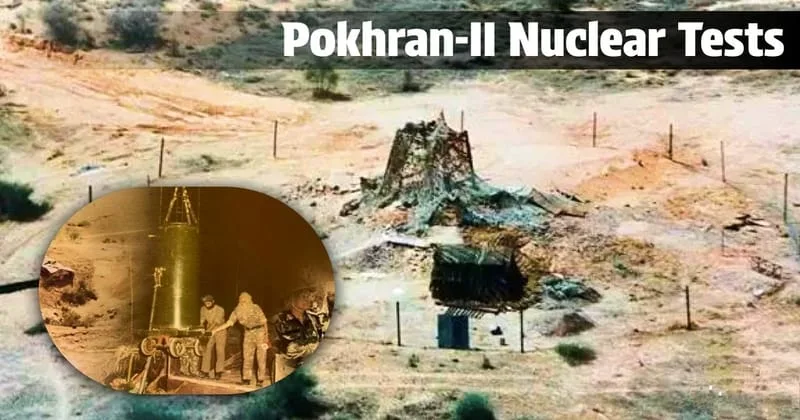
Advanced camouflaging techniques blended the site seamlessly into the desert landscape. From above, Pokhran looked unchanged, deceptively calm. The hydrogen bomb test shaft itself was code-named “White House” (Whisky), a quiet irony that underscored India’s confidence and discretion.

Five tests, zero warnings

On May 11 and 13, 1998, India conducted five underground nuclear tests, including a thermonuclear device. The world only learned of them after Prime Minister Atal Bihari Vajpayee announced the achievement. There had been:
No satellite warnings
No intelligence alerts
No diplomatic leaks

For global intelligence agencies, especially the CIA, it was a complete surprise. Pokhran-II was possible because of political courage at the highest level. Atal Bihari Vajpayee ji demonstrated rare resolve, fully aware that sanctions, pressure, and international criticism would follow. Yet he chose long-term national security over short-term approval. That decision fundamentally transformed India’s strategic position. India declared itself a nuclear weapons state, not through rhetoric, but through capability. The tests established credible deterrence and ensured that India could never again be coerced or threatened with impunity.

A silent victory beyond science

While Pokhran-II is often remembered as a nuclear milestone, it was equally an intelligence victory, a moment when meticulous planning and national unity outwitted the world’s most powerful surveillance systems. It demonstrated that discipline, secrecy, and determination can rival even the most advanced technology. Above all, it reaffirmed India’s sovereignty and strategic independence.

More than two decades later, the legacy of Pokhran-II endures. India stands stronger, more confident, and secure in the knowledge that its leadership once made a choice that forever safeguarded the nation.
Topics: India Nuclear TestsNuclear HistoryCIA FailureAtal Bihari VajpayeeNational SecurityIndian IntelligenceIndia RisingPokhran-II
Share
Tweet
SendShareSend
✮ Subscribe Organiser YouTube Channel. ✮
✮ Join Organiser's WhatsApp channel for Nationalist views beyond the news. ✮
Previous News

Delhi: State police arrest 3 more accused in Turkman Gate stone-pelting case, total arrests rise to 16

Next News

Karnataka: Public funds or party patronage? Congress under fire over National Herald advertisement windfall

Related News

Representative Image

National Security Strategies Conference 2026: How India has sealed a paradigm shift in consolidating security!

Jharkhand's former Chief Minister Babulal Marandi (Left) and Union Home Minister Amit Shah (Right)

Bangladeshi infiltration in Jharkhand’s Santhal Pargana a national security threat: Babulal Marandi writes to Amit Shah

Uttarakhand STF arrested Mohammad Salahuddin for spreading extremist propaganda through Telegram

Unchecked Encryption, Compromised Sovereignty: How Telegram became the digital haven for transnational terror

The new FCRA rules seek to curb unchecked foreign funding, strengthen financial accountability, and protect Bharat’s national security

Stopping Unchecked Foreign Money: How new FCRA rules protect Bharat’s security and financial sovereignty

Home Minister Amit Shah holds a review meeting on the security situatinon in Siliguri Corridor

Home Minister Amit Shah outlines Siliguri strategy; Calls for inter-departmental synergy to foster national security

EAM Jaishankar(File Photo)

EAM Jaishankar decodes geopolitical reality with 3Cs; Outlines 4Ds as strategic solutions to fortify national security

Load More

Latest News

A representative image

How PM SHRI schools are changing the way Bharat thinks about education

Cocroach Abhijit Dipke plays as MP CM, but is it an act? Who gave him this authority?

Abhijit Dipke ‘Resigns’ as MP CM, but when did he become Chief Minister & in what capacity did he use state symbols?

Ganesh Chaturthi 2026

Ganesh Chaturthi 2026: From Lalbaugcha Raja to Kolkata’s ‘New Bengal’, faith & festivity centre stage

Rashtriya Hindi Diwas (AI-generated Image)

Rashtriya Hindi Diwas 2026: From Devanagari to AI, Hindi charts a powerful new journey

Fact Check: Viral Video Falsely Claims PM Modi Said He Would End Poverty ‘In One Go’

FACT CHECK: Did PM Modi say he would end poverty in Bharat in one go? Viral video is clipped

At just 19, Mohammad Nabeel built an online Al-Qaeda network in UP

Al-Qaeda plot in UP: 19-year-old Mohammad Nabeel arrested over plan to recruit youths for Jihad

A representative image

Bankers Books Evidence Act 2026 to replace 1891 law from October 1: Here’s what will change?

SSC CGL exam Schedule (This is an AI generated image)

SSC CGL Tier 1 exams from September 30 to October 30; Check schedule and admit card details, vacancies

New Delhi, Sep 12 (ANI): Prime Minister Narendra Modi holds a bilateral meeting with Chinese President Xi Jinping on the sidelines of the BRICS Summit 2026, in New Delhi on Saturday. External Affairs Minister S. Jaishankar, NSA Ajit Doval and Principal Secretaries to the PM, Pramod Kumar Mishra and Shaktikanta Das also present. (@MEAIndia X/ANI Photo)

BRICS 2026: Why Putin, Xi and Pezeshkian meetings stand out in PM Modi’s diplomacy

Odisha Chief Minister Mohan Charan Majhi addresses the media at Bhubaneswar airport after returning from his UAE visit on September 13, 2026.

Odisha secures Rs 2.43 lakh crore investment proposals during CM Majhi’s five-day UAE outreach programme

Load More
  • Privacy
  • Terms
  • Cookie Policy
  • Refund and Cancellation
  • Delivery and Shipping

© Bharat Prakashan (Delhi) Limited.
Tech-enabled by Ananthapuri Technologies

  • Home
  • Search Organiser
  • Bharat
    • Assam
    • Bihar
    • Chhattisgarh
    • Jharkhand
    • Maharashtra
    • View All States
  • World
    • Asia
    • Africa
    • North America
    • South America
    • Europe
    • Australia
  • Editorial
  • Operation Sindoor
  • Opinion
  • Analysis
  • Defence
  • Culture
  • Sports
  • Business
  • RSS @ 100
  • Entertainment
  • More ..
    • Sci & Tech
    • Vocal4Local
    • Special Report
    • Education
    • Employment
    • Books
    • Interviews
    • Travel
    • Health
    • Politics
    • Law
    • Economy
    • Obituary
  • Subscribe Magazine
  • Read Ecopy
  • Advertise
  • Circulation
  • Careers
  • About Us
  • Contact Us
  • Policies & Terms
    • Privacy Policy
    • Cookie Policy
    • Refund and Cancellation
    • Terms of Use

© Bharat Prakashan (Delhi) Limited.
Tech-enabled by Ananthapuri Technologies