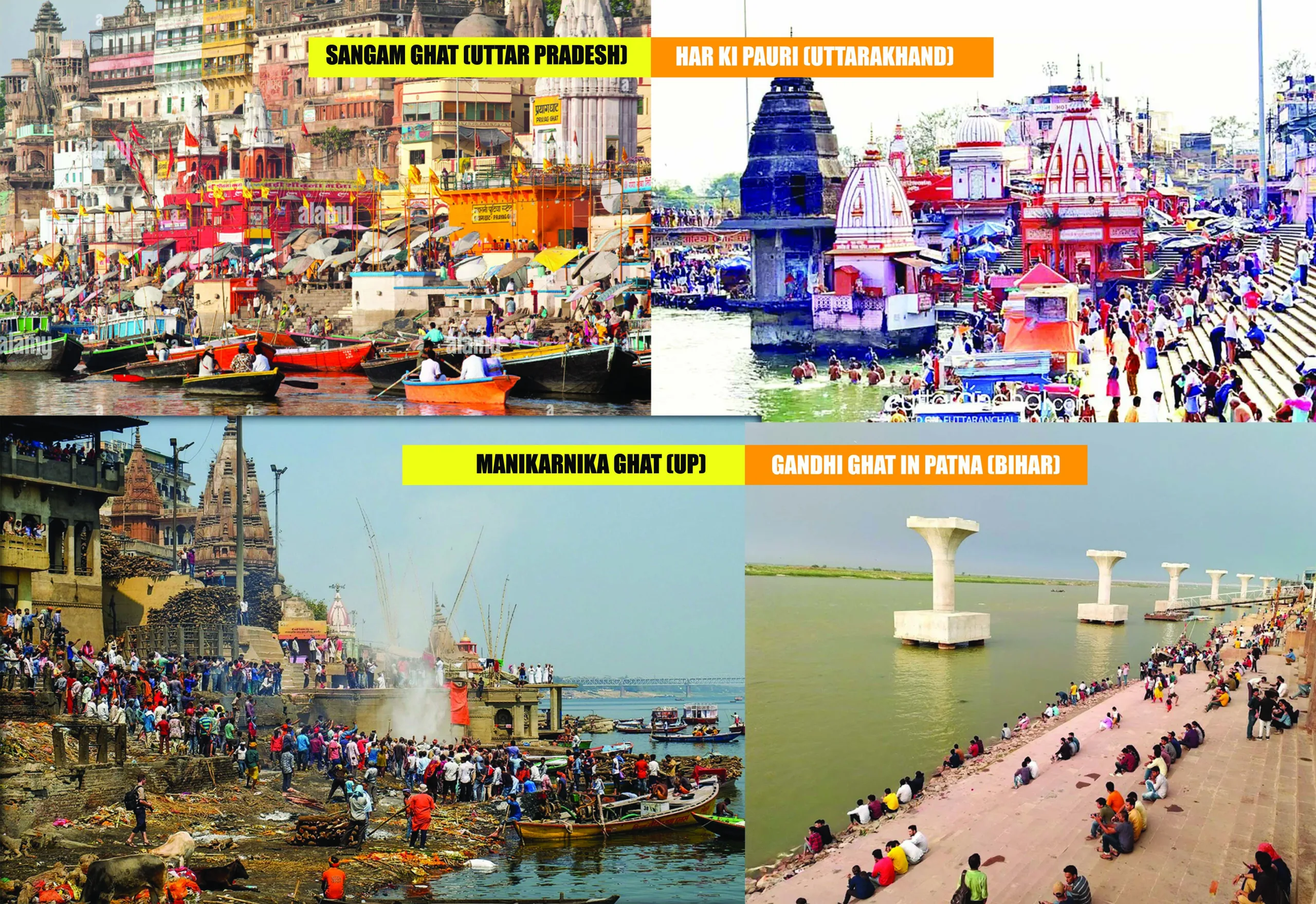
A ghat, is not merely a physical structure; it is a sacred interface designed to connect human life with the eternal, purifying flow of Maa Ganga. Across centuries, ghats have evolved as ritual landscapes where daily life, devotion, and have acted as an extension of the temples around. In Haridwar (Uttarakhand), the revered Har Ki Pauri stands as one of the holiest ghats along the Ganga. Believed to bear the footprint of Lord Vishnu, it is the focal point of the grand Ganga Aarti and the sacred Kumbh Mela, drawing millions of pilgrims from across the world.
Further upstream, Rishikesh (Uttarakhand) represents the yogic and ascetic tradition of the Ganga. Triveni Ghat, where pilgrims perform ritual ablutions and attend the evening Aarti, is a place of deep spiritual resonance. Nearby, Parmarth Niketan Ghat is renowned for spiritual discourses, yoga practices, and international gatherings cantered on inner awakening. At Prayagraj (Uttar Pradesh) lies the immensely sacred Sangam Ghat, marking the confluence of the Ganga, Yamuna, and the invisible Saraswati. This site holds unparalleled importance in Hindu cosmology and is central to the Maha Kumbh Mela as well as ancestral rites such as pind daan.
The city of Varanasi (Kashi), regarded as the eternal city, is adorned with over eighty ghats, each possessing distinct spiritual and historical significance. Dashashwamedh Ghat is famous for its grand daily Ganga Aarti, while Manikarnika Ghat serves as the principal cremation ghat, symbolising the cycle of life and liberation. Assi Ghat reflects the city’s scholarly and ascetic traditions, and Panchganga Ghat marks the sacred confluence of five holy streams.
In Patna (Bihar), ghats such as Gandhi Ghat combine modern riverfront development with historical memory, while Kali Ghat remains an important site for religious ceremonies and local devotion.
Downstream in Kolkata (West Bengal), the Ganga is known here as the Hooghly. Dakshineshwar Ghat, adjacent to the Dakshineshwar Kali Temple, is deeply associated with the spiritual legacy of Sri Ramakrishna. Bagbazar Ghat plays a vital role during Durga Puja immersions, and Prinsep Ghat reflects colonial-era riverfront architecture, blending history with contemporary urban life.
Together, these ghats form a continuous sacred geography along the Ganga, spaces where ritual, memory, architecture, and faith merge, affirming the river’s role as both a life-giver and a path to spiritual emancipation.