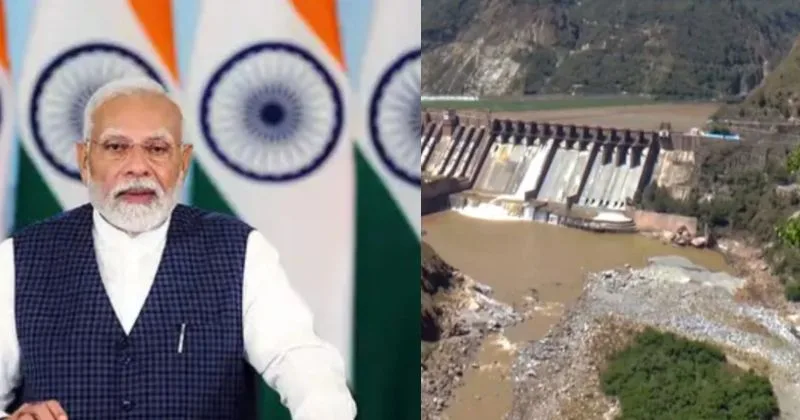
The Indus Waters Treaty, long projected as a symbol of cooperation between India and Pakistan, has in reality functioned as one of the most lopsided international water-sharing agreements of the 20th century. Signed in 1960 under World Bank mediation, the treaty effectively handed Pakistan control over nearly 80 per cent of the Indus river system’s waters, while India, despite being the upper riparian state, was left with a constrained and highly regulated share.
For decades, successive Indian governments adhered to the treaty even as Pakistan repeatedly violated the spirit of peace through wars, proxy conflicts, and state-sponsored terrorism. That restraint has now ended. Following sustained provocations, culminating in the April 2025 Pahalgam terror attack, the Modi government placed the Indus Waters Treaty in abeyance and began executing a long-pending strategic recalibration of India’s water and energy policy.
The inspection of multiple hydropower projects along the Chenab by Union Power Minister Manohar Lal Khattar on 5 January 2026 was not a routine administrative exercise. It marked a clear political and strategic signal: India is no longer willing to allow Pakistan an unfair, uninterrupted flow of Indian waters while its own developmental and energy needs remain constrained.
A Treaty Born of Idealism
The Indus Waters Treaty was signed on 19 September 1960 in Karachi by Prime Minister Jawaharlal Nehru and Pakistan’s military ruler Ayub Khan. Under its provisions, the six rivers of the Indus system were divided into eastern and western groups.
India was granted exclusive rights over the eastern rivers, Ravi, Beas, and Sutlej, while Pakistan was allocated the western rivers, Indus, Jhelum, and Chenab. In volumetric terms, this meant India received access to roughly 33 million acre-feet (around 41 billion cubic metres) of water annually, while Pakistan received nearly 135 million acre-feet (approximately 99 billion cubic metres).
Even on rivers allocated to Pakistan, India was permitted only limited, non-consumptive uses such as run-of-the-river hydropower projects, with strict restrictions on storage, design, and operational flexibility. Any attempt by India to optimise infrastructure on the western rivers was routinely challenged by Pakistan through dispute-resolution mechanisms embedded within the treaty.
Despite this imbalance, India continued to honour the IWT through wars in 1965, 1971, the Kargil conflict of 1999, and decades of cross-border terrorism. Pakistan, meanwhile, repeatedly weaponised the treaty diplomatically while benefitting from uninterrupted water flows that sustained its agriculture, power generation, and economy.
Why the Modi Government hit pause on the Indus Waters Treaty
India’s patience finally wore thin after repeated terror attacks traced back to Pakistan-based jihadist networks. While earlier attacks such as Uri (2016) and Pulwama (2019) triggered strategic responses, the April 2025 Pahalgam attack marked a turning point.
The Modi government concluded that continuing to uphold a treaty that underpinned Pakistan’s economic and agricultural stability, while Pakistan actively destabilised India, was strategically untenable. Operation Sindoor and the suspension of the Indus Waters Treaty followed, fundamentally altering the hydrological balance of South Asia.
Pakistan responded with predictable outrage, issuing threats, invoking international forums, and even approaching the Court of Arbitration. However, New Delhi remained firm, signalling that national security, resource sovereignty, and developmental imperatives would no longer be subordinated to diplomatic symbolism.
The Chenab River, one of the three western rivers previously constrained under the IWT, has now emerged as the focal point of India’s hydropower acceleration.
On January 5, 2026, Union Power Minister Manohar Lal Khattar inspected multiple projects along the Chenab basin in Jammu and Kashmir. His visit underscored a new urgency in project execution that was absent for decades.
At the Salal Power Station in Reasi district, Khattar directed NHPC officials to expedite long-pending desilting operations. Built in 1987, the Salal project had never undergone major reservoir capacity enhancement due to IWT restrictions. Desilting will now allow greater storage, improved water regulation, and enhanced power generation.
In Kishtwar district, the minister laid the foundation stone for dam concreting works at the 850 MW Ratle Hydropower Project, one of the most contested projects under the IWT framework.
Ratle Hydropower Project
The Ratle Hydropower Project, executed through a joint venture between NHPC (51 per cent) and the Jammu and Kashmir State Power Development Corporation (49 per cent), is a run-of-the-river scheme on the Chenab.
Designed with a 133-metre-high gravity dam and an underground powerhouse housing four Francis turbines, the project is expected to generate over 3,100 million units of electricity annually.
Pakistan had repeatedly objected to Ratle’s pondage capacity and spillway design, alleging violations of the IWT. India consistently maintained that the project complied with treaty norms. Nevertheless, dispute proceedings delayed construction for years, keeping the project stuck at around 25 per cent completion.
After the IWT was placed in abeyance in 2025, those constraints were lifted. Construction has since been fast-tracked, transforming Ratle from a diplomatic liability into a strategic energy asset.
On the second day of his visit, Minister Khattar reviewed progress on three major projects under the Chenab Valley Power Projects (CVPP):
Kiru (624 MW)
Kwar (540 MW)
Pakal Dul (1,000 MW)
He directed officials to ensure the commissioning of Pakal Dul by December 2026 and Kiru by March 2028, emphasising quality, safety, and timelines.
In a post on X, Khattar noted that these projects would establish new benchmarks in green energy production while strengthening regional infrastructure and creating employment opportunities for local communities.
Collectively, these projects signal a decisive shift from symbolic compliance to assertive utilisation of water resources.
India’s assertive posture on Indus waters did not begin overnight. In May 2018, Prime Minister Narendra Modi inaugurated the 330 MW Kishanganga Hydropower Project on a tributary of the Jhelum River, despite strong objections from Pakistan.
The project stores approximately 0.65 million acre-feet of water and has the potential to irrigate nearly 30,000 hectares of land. Construction began in 2007, but Pakistan used arbitration mechanisms to delay and dilute its execution.
Kishanganga became the template for India’s post-Uri strategy: operate fully within legal frameworks, but without yielding to intimidation or obstruction.
Eastern Rivers: Closing the Tap on Unused Flows
While Pakistan focused its objections on western rivers, India quietly strengthened control over eastern rivers allotted exclusively to it under the IWT.
The completion of the Shahpurkandi Barrage in 2024 marked a major milestone. For decades, nearly 1,150 cusecs of India’s share of Ravi waters flowed unused into Pakistan due to lack of storage infrastructure. Shahpurkandi halted this wastage, diverting water to Jammu and Kashmir and Punjab for irrigation.
Earlier projects such as Bhakra (Sutlej), Pong and Pandoh (Beas), and Ranjit Sagar (Ravi) had already enabled India to utilise nearly 95 per cent of eastern river waters. Shahpurkandi closed one of the last remaining gaps.
Days after the Pahalgam terror attack, India initiated desilting and reservoir enhancement at the Salal and Baglihar hydel projects, facilities that had remained frozen in time due to IWT prohibitions.
Baglihar, commissioned in 2008-09, had faced intense Pakistani opposition even during its construction. Any expansion or storage optimisation was off-limits under the treaty. With the IWT suspended, India has begun upgrading these reservoirs to improve both power generation and water regulation.
Another significant development is the revival of the long-pending Ujh multipurpose project in Kathua district. A tributary of the Ravi, the Ujh project will serve hydropower, irrigation, and drinking water needs.
A second Ravi-Beas link, earlier shelved due to treaty sensitivities, is now being integrated into a broader canal system involving barrages and tunnels to transfer surplus water into the Beas basin.
Inter-Basin Water Transfer
In June 2025, India initiated a feasibility study for an ambitious 113-km inter-basin canal to divert surplus waters from Jammu and Kashmir to Punjab, Haryana, and Rajasthan. The canal will link the Chenab with the Ravi-Beas-Sutlej system and eventually feed into the Indira Gandhi Canal.
This project aims to ensure full utilisation of India’s water share while addressing regional imbalances exacerbated by climate variability and declining groundwater levels.
As part of this plan, the Centre is set to double the length of the Ranbir Canal from 60 km to 120 km to draw additional water from the Chenab.
The most dramatic shift has come in the form of fast-tracking long-stalled storage-based projects that were previously constrained under the IWT.
The 1,856 MW Sawalkote Hydropower Project on the Chenab, stalled for years, received environmental clearance in October 2025 along with a revised budget of Rs 31,380 crore. Spread across Ramban, Reasi, and Udhampur districts, the project is expected to generate over 7,500 million units of electricity annually.
Similarly, the Dulhasti Stage-II project (260 MW) received clearance in December 2025, reviving expansion plans for a project whose first stage has been operational since 2007.
The Indus river system accounts for nearly 25 per cent of Pakistan’s GDP. About 75 per cent of its renewable water, 80-90 per cent of farmland irrigation, and 20-30 per cent of electricity generation depend on Indus basin flows.
With per capita water availability declining and climate stress intensifying, any significant reduction or regulation of Indus, Jhelum, and Chenab flows could have devastating consequences for Pakistan’s agriculture and food security.
This reality explains Islamabad’s alarmist rhetoric and diplomatic desperation.
For over six decades, India subordinated strategic advantage to diplomatic idealism under the Indus Waters Treaty. That era has ended.
With the treaty in abeyance, the Modi government is unlocking the full hydropower and storage potential of the Indus basin, strengthening energy security, supporting regional development, and asserting India’s rightful claim over its natural resources.
What was once a symbol of one-sided “Aman ki Asha” has now become a lesson in hard realism: water, like security, cannot be ceded indefinitely in the face of sustained hostility.