Thiruvananthapuram: SNDP Yogam General Secretary Vellappally Natesan has said that he is being deliberately targeted and branded a communalist simply for raising his voice in the cause of social justice. Speaking openly, Vellappally alleged that the Indian Union Muslim League, which once maintained cordial relations with him, is now leading a sustained campaign against him. He further claimed that even members of the Christian community in Kerala today view the League with apprehension.
According to Vellappally, leaders of the Muslim League are attempting to isolate him politically and socially, while television channels, with their backing, are relentlessly targeting him. He asserted that he has never spoken against the Muslim community as a whole, but has only exposed what he described as the betrayal and duplicity of the League.
Recalling his past associations, Vellappally said that he had once stood firmly with the League and trusted its assurances. The League, he claimed, had promised that if it helped bring the United Democratic Front (UDF) to power, it would take an appropriate and just decision on the issue of reservation.
However, he alleged that once the League became part of the ruling dispensation, all such assurances were conveniently forgotten. At that time, he said, the League even worked to sabotage efforts aimed at fostering unity between the SNDP and the Nair Service Society (NSS), an initiative intended to strengthen social harmony between the Ezhava and Nair communities.
Vellappally further stated that he had repeatedly applied for permission to establish educational institutions under the SNDP banner, but his requests were consistently ignored. Disillusioned by these developments, he gradually distanced himself from the League.
Vellappally said that after the League lost political power, its leaders attempted to re-establish ties with him, but he chose to ignore their overtures. According to him, the present campaign against him is a form of political vendetta. “Their method,” he alleged, “is to hunt me down.”
Emphasising Kerala’s social fabric, Vellappally observed that unity between Hindus and Christians constitutes a formidable social force in the state. He alleged that the Muslim League, fully aware of this reality, is now attempting to weaken such unity by targeting him. He pointed to remarks made by Muslim League leader K. M. Shaji, particularly his sermon asserting the primacy of religion, as a cause of fear and concern among Christian communities. Vellappally asked whether society could afford to ignore the activities of certain extremist Muslim organisations, which, he said, have contributed to growing insecurity.
Referring to the Marad riots, in which Hindus were killed, Vellappally noted that these incidents occurred at a time when communal tensions were not as pronounced as it is today. He argued that the present situation in Kerala has undergone a drastic transformation. According to him, the Muslim League has gained political strength by exacerbating communal divisions. He warned that if the UDF were to return to power, Kerala could witness not just one, but several riots similar to those that occurred in Marad.
Growing Muslim population and religious discriminations
Vellappally further alleged that extremist and jihadist elements are attempting to portray him as a communalist in order to silence him. Leaders of the SNDP Yogam have pointed out that Vellappally first came into prominence by raising questions about the unequal allocation of educational institutions. They noted that while 4,020 schools were allotted to Muslim managements in Malappuram district, the SNDP was granted only 320 schools. According to SNDP leaders, exposing this disparity upset certain vested interests, who are now retaliating against Vellappally. They maintain that the questions raised by Vellappally are not issues that Kerala can simply brush aside. In their view, he is articulating uncomfortable but undeniable truths. They also referred to his speech at an SNDP meeting, where he expressed concern over the rapid growth of the Muslim population in Kerala. That speech, they said, revealed several hard realities. Vellappally had argued that demographic growth has directly contributed to the Muslim League’s increase in legislative seats, and that population growth is being strategically encouraged to enhance the number of Assembly constituencies in Malappuram.
Supporters of Vellappally contend that a closer examination of the facts lends credence to some of his arguments. At present, Malappuram district has 16 Assembly constituencies: Kondotty, Eranad, Nilambur, Vandoor, Manjeri, Perinthalmanna, Malappuram, Mankada, Vengara, Vallikkunnu, Tirurangadi, Thanur, Tirur, Tavanur, Kottakkal and Ponnani. Earlier, the district had only 12 constituencies. Following the delimitation exercise carried out in 2011, four new constituencies, Eranad, Tavanur, Kottakkal, and Vallikkunnu, were added, increasing the total to 16.
In contrast, during the same delimitation process, the Hindu-Christian-dominated Kottayam district in central Kerala saw its number of Assembly constituencies reduced from 10 to nine. Proponents of Vellappally’s views point out that constituency boundaries are determined primarily on the basis of population. They argue that Malappuram gained four additional constituencies due to a significant rise in population. Vellappally had remarked that Kerala was no longer functioning as a democracy but was sliding towards what he termed a “religious dictatorship,” warning that a time might come when people would have to go to Malappuram for decisions on all major issues in the state.
He also alleged that the political trajectory was moving towards a situation where a Muslim League leader might have to be made the Chief Minister. According to his supporters, these remarks were intended to expose what they describe as the hidden agenda of political Islam. The controversy has triggered strong reactions in Malappuram district, with activists of Muslim organisations and the Muslim Youth League mobilising aggressively. Haris Muthur, president of the Youth Congress in Malappuram, announced a cash reward for anyone who would pour black oil on Vellappally’s face. DYFI leader Shiju Khan also issued sharp criticism against him.
BJP and Hindu Aikyavedi back Vellappalli
These threats were strongly condemned by Sasikala Teacher, leader of the Hindu Aikyavedi. She asserted that India is neither Bangladesh nor Pakistan, but a democratic republic governed by law. Sasikala Teacher warned that if any move was made against Vellappally Natesan, the Hindu Aikyavedi would step in to provide him protection.
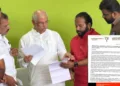
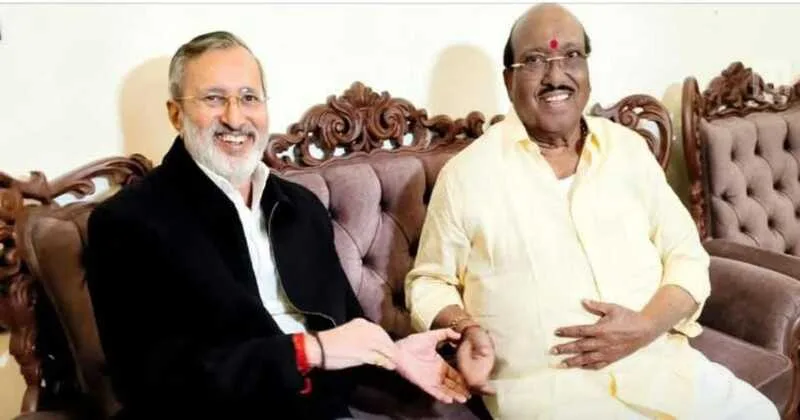
Meanwhile, the Bharatiya Janata Party has openly extended support to Vellappally Natesan’s remarks. After the BJP’s state leadership announced that it would resist attempts to attack Vellappally for articulating what it called the social realities of Malappuram, the party’s Kerala in-charge Prakash Javadekar visited Vellappally at his residence in Kanichukulangara, Alappuzha district, and held detailed discussions with him.
BJP state general secretary S. Suresh told the media that the issues raised by Vellappally Natesan deserve serious public discussion. He said that stating facts should not automatically invite the label of communalism. “It is extremely dangerous to convert facts into communal arguments,” Suresh said, alleging that this was part of a strategy by the Left to shield the growth of political Islam in Kerala. He maintained that there is nothing communal in pointing out the lack of educational institutions for the Ezhava community, and argued that what should instead be questioned is what he described as the government’s own communal approach.
Suresh further emphasised that India is a democratic country where citizens have the right to express their opinions freely. “This is democratic India,” he said, “not the Taliban or Communist China,” underscoring the BJP’s position that Vellappally Natesan’s remarks fall within the bounds of legitimate democratic discourse.