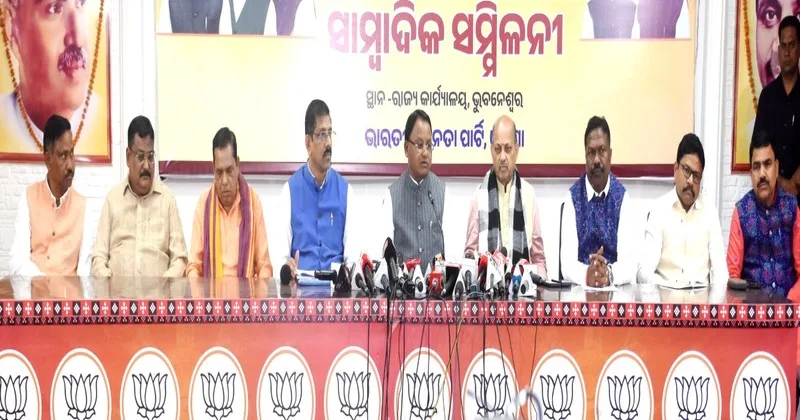
BHUBANESWAR: The Viksit Bharat Guarantee for Employment and Livelihood Mission (Rural), popularly known as the VB G Ram G, has been passed by Parliament and enacted into law under the leadership of Prime Minister Narendra Modi. This landmark legislation aims to transform rural India and contribute decisively to the goal of building a Developed India by the year 2047.
At a press conference held at the BJP state office in Bhubaneswar, Odisha Chief Minister Mohan Charan Majhi stated that the new act is designed to provide meaningful, accountable, and corruption-free employment to rural families while fulfilling Mahatma Gandhi’s vision of Gram Swaraj and sustainable rural self-employment. He noted that deliberate misinformation is being spread about the ‘VBJ Ramji’, despite the legislation’s core objective being to realise the vision of a ‘Developed India’ and strengthen rural India.
Linking Employment Guarantee with ‘Viksit Bharat’
Chief Minister Majhi explained that the law’s name reflects its alignment with the national goal of Viksit Bharat. He emphasised that the objective is not to exploit Mahatma Gandhi’s name for political gain, but to practically realise his ideals of rural empowerment and self-reliance.
In response to opposition allegations that the law is anti-farmer or anti-poor, Majhi asserted that the legislation includes comprehensive provisions for the welfare of farmers, labourers, and rural households. He accused opposition parties of spreading misinformation to mislead the public.
Historical Context of Rural Employment Efforts
The Chief Minister traced India’s long struggle to provide employment for farmers and the rural poor. He recalled the devastating famine from 1876 to 1878, which prompted the British administration to establish a Famine Board in 1880. Although work was made mandatory to receive relief, people had no legal rights.
After Independence, Article 41 of the Constitution recognised the provision of employment as a moral responsibility of the State, subject to its economic capacity. However, the responsibility for implementation was left to state governments. Several schemes introduced in 1960 and 1971 promised employment contingent on work availability, but ultimately failed to create sustainable jobs or ensure regular income for workers.
Majhi stated that poor planning, administrative failures, a lack of decentralisation, and corruption led to the collapse of these schemes, leaving farmers and labourers vulnerable to exploitation.
Shortcomings of MGNREGS Under UPA Rule
Referring to the Mahatma Gandhi National Rural Employment Guarantee Scheme (MGNREGS), introduced in 2005 and renamed in 2009, the Chief Minister alleged that the UPA government failed to reform its basic structure.
While the scheme promised 100 days of guaranteed employment, beneficiaries received barely 50 days of work in reality, he claimed. Wages were minimal, unemployment allowances were ineffective, and corruption became widespread.
Majhi cited large-scale scams, including alleged misappropriation of ₹6,000 crore in Bihar and Rs 10,000 crore in Uttar Pradesh. Odisha also witnessed irregularities, with cases reported in 2012 from Sambalpur, where wages were drawn in the names of deceased persons, the sick, and pension beneficiaries. He noted that fake muster rolls, incomplete road works, and fund siphoning were common.
Technology-Driven Reform Through the VB G Ram G
The Chief Minister stated that the VB G Ram G is designed to address structural weaknesses by leveraging modern technology and mission-mode governance. The use of artificial intelligence, GPS tracking, and mobile-based monitoring will promote transparency, accountability, and real-time verification of work.
This new framework addresses seasonal agricultural needs that were overlooked under MGNREGS. To safeguard farmers’ interests, all employment work will be suspended during sowing and harvesting periods for up to 60 days annually. This measure aims to prevent labour shortages and curb artificial wage inflation in agriculture.
Expanded Employment and Stronger Centre–State Coordination
Under the new law, guaranteed employment has increased from 100 to 125 days per rural household, establishing employment as a legal entitlement. This change is expected to enhance rural productivity and increase household income.
The funding structure has also been streamlined. For northeastern states, the Centre–State funding ratio will be 90:10; for Union Territories, the Centre will cover 100 per cent of the costs; and for other states, the expenses will be shared at 60:40 between the Centre and the states. According to Majhi, these adjustments will improve coordination and accountability at all levels of governance.
Focus on Four Priority Sectors
The VB G Ram G Mission prioritises four key areas: water security and related works, strengthening basic rural infrastructure, creating and expanding livelihood assets, and enhancing climate resilience and preparedness for extreme weather events. The mission mandates the payment of an unemployment allowance if employment is not provided within 15 days of demand.
The press conference was attended by notable figures, including BJP state president Manmohan Samal, Panchayati Raj Minister Rabi Narayan Nayak, Parliamentary Affairs Minister Dr. Mukesh Mahaling, Nityanand Gond, Deputy Chief Whip Govind Das, MLAs Babu Singh and Ashrit Patnaik, and BJP state general secretary Sharda Prasad Satpathy, among other senior leaders.