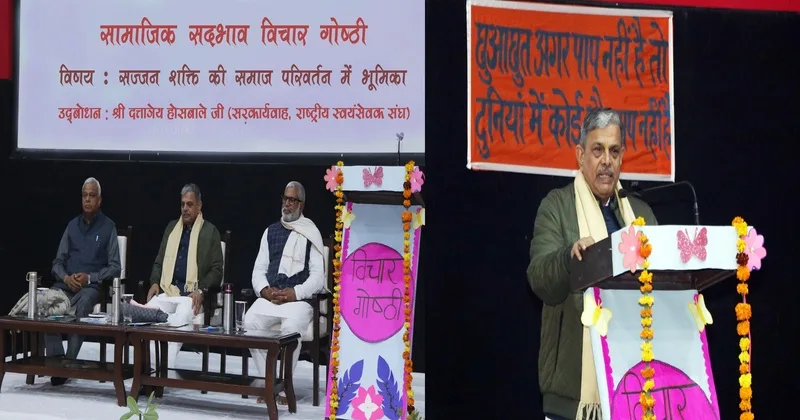
ROHTAK: For Bharat to guide the world, the nation must become internally strong. Internal strength must be built, and the Sangh has been working continuously for this purpose for the past 100 years. To strengthen the nation from within, the sajjan shakti of society must unite and come forward. All birth anniversaries of great personalities should be celebrated together in a spirit of harmony; only then will the nation become strong and the divide of caste be bridged, said Dattatreya Hosabale, Sarkaryavah, Rashtriya Swayamsevak Sangh (RSS), during a Samajik Sadbhav Vichar Goshti on the topic “The Role of Sajjan Shakti in Social Transformation” held at Shiksha Bharti Senior Secondary School on Gohana Road, Rohtak, Haryana.
Dattatreya Hosabale stated that in ancient times, Bharat was known as the ‘Sone ki Chidiya’ and therefore endured repeated invasions by foreign aggressors. In 1600 AD, when the East India Company was established in England, Bharat’s share of international trade stood at 23 per cent. This reflects the economic prosperity of Bharat in ancient times. He said that our knowledge, tradition, and culture were superior to those of all other countries. We consider the entire world as one family and regard all religions, traditions, and customs of Bharat as our own. We see a divine presence even in an ant. However, we became divided based on caste and sects, and foreign invaders took advantage of this, resulting in prolonged slavery. As a consequence, even years after independence, we have not fully emerged from a colonial mindset and have lost self-confidence. To regain this confidence, the sajjan shakti of society must come forward and make efforts.
Dattatreya Hosabale said that plundering a country as invaders, destroying its culture, or oppressing others for cruel pleasure is not our nature, because we consider the entire world as one family. Our culture stands on its own, helps others progress, and teaches humanity.
The Sangh has been engaged in character-building for the past 100 years to benefit society. He stated that it is the government’s responsibility to protect the nation from external threats, maintain balance, and establish law and order. However, guiding youth, inculcating values, promoting culture, eradicating social evils, and preparing good citizens are the responsibilities of society. For this, the sajjan shakti of society must take initiative. Alongside development, we must advance “Rashtra Dharma and Rashtra Hit” in mind.
Citing Japan as an example, he said that after World War II, in 1946, Japan was completely devastated, but within 15 years, it stood firmly before the world again. The main reasons behind this were patriotism, the education system, and the strength of Japanese society.
He said that despite numerous invasions on our country and repeated attempts by aggressors to destroy our education system and culture, we did not perish. The strength behind this resilience is our family system. Even foreign travellers have prominently described our family system in their travel accounts, as it has traditionally imparted both skills and values to children simultaneously. Our youth possess immense talent, but today, many are being led astray by drug addiction and moving away from their culture under the influence of Western civilisation. To instil and preserve values among youth, social and religious organisations, along with society’s sajjan shakti, must work together in unity.
He said that for the nation to once again lead the world, the sajjan shakti must strengthen the country from within. Rising above personal interests and divisions along lines of caste, language, and sect, society must work toward nation-building and social transformation. The Sangh is continuously striving for this and has taken Panch Parivartan: social harmony, environmental protection, Swa, Parivar Prabodhan, and civic duties. To make the nation self-respecting and strong, a firm resolve must be taken to fulfil these five resolutions.
Question–Answer Session
Responding to questions during the discussion, Dattatreya Hosabale stated that continuous reflection and societal churn are essential for progress, and the Sangh works precisely for this purpose. Apart from this, the Sangh has no special agenda. He recalled that at the time of the Sangh’s founding, Dr Hedgewar had said that once the work of society is complete, the Sangh should merge into society. If society were fully awakened, there would be no need for the Sangh to operate independently.
Answering questions on moral education and the Bhagavad Gita, he stated that efforts have been made under the New Education Policy to impart moral education and to explain spirituality alongside academics. However, it will take time to move away from the curriculum that has been followed for decades. Until then, intellectuals and heads of educational institutions must ensure that students acquire knowledge of patriotism and culture. To protect youth from drug addiction, collective efforts are required, as it is a form of international conspiracy. He said that wherever a Bharatiya citizen faces injustice anywhere in the world, the Sangh raises its voice in support of the victim.
On the issue of untouchability, Sarkaryavah ji stated that in 1969, the then Sarsanghchalak, Shri Guruji, passed a resolution opposing untouchability, with saints in attendance. To eliminate untouchability from society, the Sangh has been running campaigns such as one well, one cremation ground, and temple entry for all.
He further stated that the Sangh has never claimed credit for positive changes in society. The Sangh functions like a thread in a garland: a single thread binds flowers together to form a garland, yet remains unseen; similarly, the Sangh does not seek praise or recognition from society.