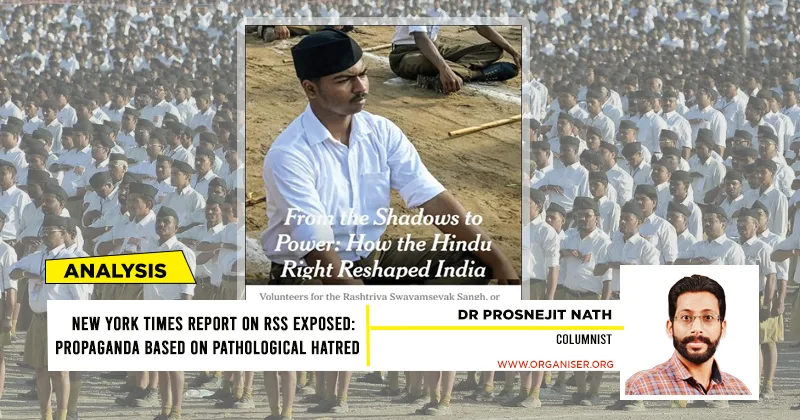
On December 26, 2025, The New York Times published an article titled “From the Shadows to Power: How the Hindu Right Reshaped India”, authored by Mujib Mashal and Hari Kumar. Presented as a long-form investigation, the piece claims to map the rise of the Rashtriya Swayamsevak Sangh (RSS) from obscurity to influence. What the article offers is not journalism grounded in Indian social reality, but an ideological narrative shaped by Western liberal discomfort with Hindu civilisational resurgence.
The objective is transparent. This is not merely a critical examination of the RSS. It is an attempt to delegitimise Hindu self-organisation itself by casting it as inherently authoritarian, conspiratorial, and dangerous. The RSS is not engaged with as a social phenomenon rooted in Indian history, but caricatured as a near-omnipotent “far-right” force, India’s supposed equivalent of a shadowy European extremist network.
The problem is not criticism. In a democracy, all organisations are open to scrutiny. The issue is the method. Evidence is replaced with insinuation. Context is sacrificed for analogy. Indian political realities are filtered through Western moral frameworks that are neither neutral nor universal. The result is a familiar Left-liberal narrative where Hindu assertion is treated as pathology.
Western labels as Intellectual Evasion
At the heart of the NYT article lies its obsessive use of the term “far-right Hindu nationalist group”. This label is not explained, interrogated, or contextualised. It is asserted, as though its meaning were self-evident.
In Western discourse, “far-right” typically refers to fringe movements rooted in racial supremacy, exclusionary nationalism, and often explicit violence against minorities. These movements usually operate at the margins of society and in opposition to the constitutional order. To transplant this label onto the RSS, an organisation that has existed openly since 1925, operating daily in public parks across India, is intellectually lazy at best and ideologically dishonest at worst.
The RSS is not a political party. It does not contest elections. It does not maintain an armed wing or clandestine cells. It is a volunteer-driven cultural organisation focused on social work, discipline, and national cohesion. Yet once the “far-right” label is attached, the authors absolve themselves of the responsibility to engage with India’s social complexity. The label functions not as an analytical category but as a moral verdict. It forecloses debate rather than encouraging understanding.
Fascism by Association
The most telling feature of the NYT article is its careful deployment of fascist imagery without ever making a direct accusation. The word “Nazi” is never used, but its shadow looms over the text. References to early RSS thinkers allegedly drawing inspiration from European fascist movements are presented selectively, stripped of historical context and intellectual debate. MS Golwalkar’s writings are cited in connection with Hitler’s policies, not to explore ideological evolution or critique in good faith, but to morally contaminate the present-day RSS through historical association.
This technique is deliberate. By invoking fascist Europe, the article anchors the RSS to the moral trauma of the Holocaust without having to substantiate a direct comparison. Terms like “paramilitary discipline”, “supremacy”, “shadowy cabal”, and “institutional capture” are carefully chosen to mirror Western descriptions of authoritarian movements. This is narrative engineering. The reader is guided toward a conclusion without the burden of evidence. Plausible deniability is maintained, while the intended moral judgement is unmistakable: Hindu organisation equals fascism.
Inventing a Conspiracy Where None Exists
Despite overwhelming evidence to the contrary, the NYT repeatedly describes the RSS as secretive and shadowy. This claim collapses the moment it encounters reality.
RSS shakhas are held openly in neighbourhood parks. Anyone can attend them. There are no secret oaths, no hidden hierarchies, no underground meetings. RSS leaders routinely address public gatherings, issue statements, and engage openly with the media.
Prime Minister Narendra Modi has never concealed his association with the RSS. On the contrary, he proudly identifies as a swayamsevak. Ministers, MPs, judges, civil servants, and professionals have openly acknowledged their background in the Sangh. This is not how secret societies operate. The truth is simpler and more unsettling for Western liberal commentators: the RSS is massive. It is decentralised, disciplined, and culturally embedded. It does not rely on elite validation or foreign funding. For a worldview accustomed to NGO-driven activism and donor-approved legitimacy, such an indigenous model appears threatening. What cannot be controlled is
recast as conspiratorial.
The Myth of Institutional ‘Infiltration’
One of the most serious allegations in the NYT article is that the RSS has “infiltrated” institutions such as the judiciary, police, media, and academia. This is a grave charge. It is also entirely unsupported. No documents are produced. No command structures are identified. No financial trails are traced. No directives are cited. Instead, ideological proximity and personal background are presented as evidence of subversion.
Citing The Caravan 11th December, the NYT portrays RSS-linked schools, hostels, orphanages, medical missions, yoga centres, and disaster relief initiatives as instruments of ideological control. This reveals the core anxiety of Left-liberal discourse. The issue is not the work, it is who is doing it. If the same services were delivered by NGOs funded by Western foundations or foreign governments, they would be celebrated as grassroots empowerment. When Hindus organise their own civil society, it becomes a fascist infrastructure. At this point, criticism stops being political and becomes civilisational.
What Truly Disturbs the Left-Liberal Imagination
The RSS has achieved something few organisations anywhere in the world have managed: institutional continuity across generations without dependence on foreign funding, elite endorsement, or ideological conformity to Western liberalism.
It produces cadres, not conferences. Volunteers, not donors. Decentralisation, not bureaucratic grants. This model challenges the assumptions of Left-liberal power structures, which are built on gatekeeping and approval. What cannot be assimilated must be demonised.
Throughout the article, there is a persistent suggestion that while Indians vote, the RSS “really” rules. Electoral mandates are explained away as organisational manipulation. Institutions function, but are allegedly co-opted. This framing allows Western commentators to question Indian democracy without openly admitting it. Since 2014, whenever Indian voters have delivered outcomes that defy Western preferences, democracy itself has been subtly delegitimised.