Modern Hindu existentialism is the synthesis of the spiritual question ‘Who am I?’ and the urgent political question ‘How do I survive? The concept of “Hindu” has long been defined by its inclusivity—a term encompassing those who view this Rashtra (nation) as their motherland and cultural origin. However, in the 21st century, this identity faces a dual-track challenge: a philosophical quest for meaning and a political crisis of survival. As Bharat transitions from a regional power to a civilisational state, its foreign policy is increasingly defined by a “Hindu Existentialism” that seeks to protect both the essence of its ancient wisdom and the physical safety of its people.
Western existentialism (Sartre, Camus) often begins with the “void” or the idea that life has no inherent meaning except what we create. Hindu philosophy approaches the “existence” of the individual very differently. While Sartre said “existence precedes essence,” Hindu philosophy (specifically Advaita Vedanta) suggests that our true essence (Atman) is eternal and precedes our physical existence. In Hinduism, authenticity is found through Atma-Jnana (self-knowledge)—peeling away the layers of ego and social identity to realise oneness with the universe. A civilisation and culture can only thrive if its members are safe and coexist. Modern Hindu existentialism is a blend of the ancient spiritual quest for “who am I?” and a contemporary political struggle for “where do I belong and how do I survive? Proponents argue that since Hindus have no other “homeland” (unlike fifty plus Islamic nations or multiple Christian-majority nations), the survival of Hinduism is tied to the survival of a strong, sovereign Bharatiya state. To move from a “defensive” posture to a “proactive” one, ensuring that the civilisation does not fade like the Greeks or Romans. This sense of crisis has fuelled the movement to redefine Bharat not just as a secular republic, but as a Hindu Rashtra (Hindu Nation).
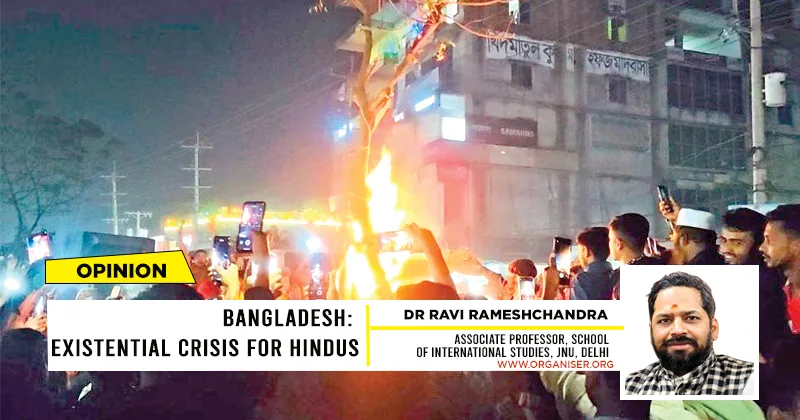
Recent targeted mob lynchings and killings of Hindus in Bangladesh have fanned the rise of “Hinduphobia” as the new global narrative against the increasing sense of self–realisation amongst Hindus. There is a growing sentiment among the diaspora (USA, UK, Canada) that Hindu practices are being unfairly targeted or “demonised” in academic and media circles. Vandalism of temples in Australia and Canada is viewed not just as a crime, but as an attack on the very existence of Hindu culture in the West. However, the Caribbean and African countries have compassionately associated themselves with the Hindu civilisation of Bharat. In recent years, the discourse around “Hindu Existentialism” has shifted towards the survival of the community. Many Hindus feel an existential threat from various global and domestic factors. It also presents a demographic and regional threat. The rapid decline of the Hindu population in Afghanistan, Pakistan, and Bangladesh (due to persecution, conversion, or migration) is often cited as a warning of what happens when Hindus lose political or territorial protection. Domestically, the Hindu-targeted killings and subsequent exodus of Kashmiri Pandits in the 1990s remain a central symbol of “existential displacement” within Bharat’s own borders. West Bengal and Kerala are in the pipeline of demographic jihad. Thus, domestic elements need to be carefully monitored and taken into consideration when shaping foreign policy.
Philosophical and Political Tribulations
The challenges of “Existentialism of Hindus” can be viewed through two lenses: Philosophical (the quest for meaning and the nature of the self) and Political (the survival of Hindu identity in the modern world). The philosophical challenge lies in reconstructing and reviving its ancient philosophy and knowledge. On one hand, the Gyan Bharatham Mission (National Manuscript Mission) and the efforts made by sants, sages, and kathavachaks as ambassadors of Hindu philosophy are significant in preserving global Hindu values. On the other hand, the crisis of political existentialism should be addressed through a well-crafted foreign policy measure, which includes flexing some muscles when required. It is conversed in the form of ‘smart power,’ a pragmatic blend of ‘hard power’ and ‘soft power’ diplomacy.
The most direct “protectionist” policy Bharat has adopted is its Citizenship Amendment Act (2019). This is often compared to Israel’s Law of Return, although it is more limited in scope. The main objective of CAA is to provide a fast-track to citizenship for persecuted religious minorities—specifically Hindus, Sikhs, Buddhists, Jains, Parsis, and Christians—from Pakistan, Afghanistan, and Bangladesh. It is known as the ‘Natural Home Doctrine’. Under the Modi administration, the government has articulated that Bharat is the ‘natural home’ for Hindus facing religious persecution. This mirrors the Zionist idea of Israel as a haven for the global Jewish diaspora.
The Diplomacy in Action
It provides a Diplomatic Advocacy keeping the ‘Neighbourhood First’ approach. Bharat uses diplomatic pressure to address the safety of Hindus, primarily in South Asia (Bangladesh, Pakistan, and Sri Lanka). The Government accords the highest priority to the safety, security, and well-being of Bharatiya nationals abroad. The Government closely monitors developing hostile situations in war zones. In a reply to a question in the Lok Sabha, the MEA provided information about such operations, including the number of people evacuated. Operation Ganga was announced on February 26, 2022 to evacuate Bharatiya nationals, mainly students, at the Government of India’s cost from Ukraine through the neighbouring countries of Romania, Poland, Hungary, and Slovakia. A total of 18,282 Bharatiya nationals were repatriated to Bharat by 90 flights, comprising 76 commercial flights and 14 IAF flights, in February and March 2022. Besides Operation Kaveri 4097, including 136 foreign nationals (Sudan 2023), Operation Ajay 1343, including 14 OCI card holders and 20 foreign nationals (Israel 2024), Operation Indravati 17 (Haiti 2024), 77 people (Syria 2025), Operation Sindhu 3597, plus 14 OCI Card holders and 14 foreign nationals (Iran 2025), Operation Sindhu 818 and (Israel 2025). Besides, its successful intervention has stopped the prosecution and punishment of Bharatiyas, such as 15 people in Kuwait. A confident Bharat is one where every Hindu, regardless of their location, feels secure and proud of their heritage. By embracing a foreign policy of Hindu existentialism, Bharat is not just surviving in the modern world—it is ensuring that its ancient light continues to illuminate the future.