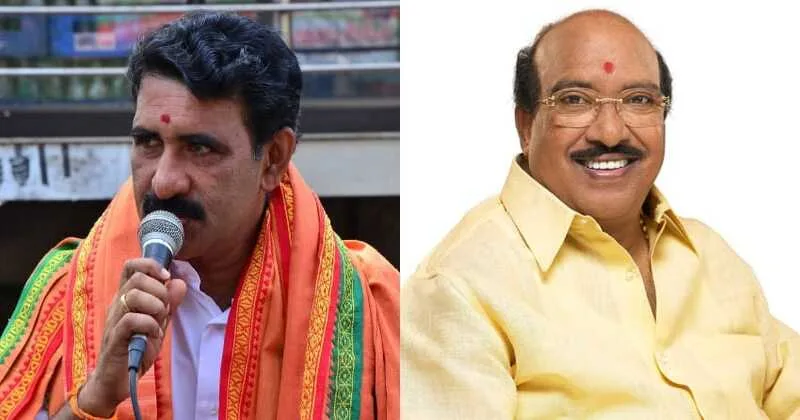
Bharatiya Janata Party leader B. Gopalakrishnan has come out strongly in support of SNDP Yogam General Secretary Vellappally Natesan, following a controversial statement by a Youth Congress leader from Malappuram district. Gopalakrishnan’s response came after Youth Congress Malappuram District President Harris Muthur stated that money and awards would be given to those who attack Vellappally Natesan by pouring black oil on him. The remark triggered sharp reactions across political circles in Kerala, with the BJP leader describing the statement as dangerous, communal, and reflective of what he called the “jihadi mindset” within the Congress.
In a Facebook post, B. Gopalakrishnan alleged that the Youth Congress leader’s statement revealed the reality behind what he described as the Congress party’s “mask of secularism.” According to him, such remarks show that despite outward claims of secular values, extremist tendencies surface at critical moments. He further stated that the United Democratic Front (UDF), which he referred to as a “communal front,” was attempting to gain power in Kerala with the backing of political Islam. Gopalakrishnan went on to claim that this communal front was “a poison a hundred times more dangerous than the temple-robbing communists,” accusing it of undermining Kerala’s social harmony and Hindu interests. He asserted that such statements were part of a broader political strategy aimed at intimidating Hindu leaders and organisations that oppose radical narratives.
Highlighting the social significance of the Ezhava/Thiya community in Kerala, the BJP leader pointed out that the sect constitutes approximately 23 percent of the state’s Hindu population. He described Vellappally Natesan as the undisputed leader of the SNDP Yogam, which represents the interests of the Ezhava and Thiya communities. Given this context, Gopalakrishnan argued that no individual or political group should dare to issue threats or attempt public humiliation against such a leader. He further claimed that attempts to target Vellappally Natesan were directly linked to the BJP’s growing political influence in Kerala. According to him, such reactions stem from fear of the BJP’s rise and its potential to challenge entrenched political alliances in the state.
The controversy erupted after Vellappally Natesan referred to Rahees Rasheed, a former leader of the Muslim Students Federation (MSF), the student wing of the Indian Union Muslim League, and a current journalist, as a “terrorist” during a public interaction. This remark provoked criticism from the Youth Congress leadership in Malappuram. Responding to Vellappally’s comment, Harris Muthur called for black oil to be poured on Vellappally Natesan’s face as a form of protest. He also announced via Facebook that financial rewards and prizes would be given to those who carried out the act. The post included a photograph of Vellappally Natesan, further escalating the controversy.
In his detailed Facebook statement, Gopalakrishnan addressed Harris Muthur and the wider Kerala society, stating that calls for public attacks reflected a dangerous political culture. He remarked that this was not “Varyamkunnan’s (leader of 1921 Hindu massacre) 1921,” but a modern India progressing toward 2026 under the leadership of Prime Minister Narendra Modi. He warned that Kerala would not tolerate threats or violence disguised as political activism. Gopalakrishnan also reminded that the Hindu population in Kerala still constitutes around 54 percent and cautioned against the assumption that Malappuram or Malabar belonged to any one political or ideological group. He linked the controversy to recent demands raised in Malappuram regarding district bifurcation based on population, suggesting a pattern of divisive politics.
Criticising the Congress further, he alleged that while the party projects itself as secular, it has allied with organisations like SDPI in Maharashtra municipal elections and maintains alliances with the Muslim League, Welfare Party, and, according to him, indirectly with SDPI in Kerala. This, he claimed, exposed the real nature of the Congress-led UDF. Gopalakrishnan said his message was directed at Hindus, Christians, and what he described as “nationalist Muslims” who question the relevance of the Bharatiya Janata Party while identifying themselves as secular. According to him, the BJP’s role in Kerala and the country at large was essential to ensure peace and security for future generations. Gopalakrishnan argued that recent demands to divide Malappuram district into three units on the basis of population were a warning sign. He claimed that if such demands were entertained, similar arguments could eventually be used to push for the fragmentation of Kerala into numerous divisions in the future. He further stated that, in the coming decade, communism would cease to have any meaningful presence in the country, while the Congress would, in his view, be politically overtaken by organised forces including the League, the Welfare Party, and the Social Democratic Party of India.
Referring again to the controversy surrounding Vellappally Natesan, the BJP leader said that the public call by a Youth Congress functionary to attack Natesan could have serious long-term consequences. He warned that such statements, if normalised, could push the state towards a dangerous and unstable situation. Gopalakrishnan also made broader allegations about Kerala’s security environment. He claimed that despite its small size, Kerala had seen a disproportionately high number of individuals being drawn towards extremist organisations. He referred to cases of Kerala natives joining the Islamic State and to individuals who were later killed in encounters with Indian security forces in Kashmir. He further alleged that the state had been the birthplace of several banned organisations, including SIMI, NDF, the Popular Front, and Madani’s PDP, and said this context made recent provocative calls against Vellappally Natesan particularly concerning.
While some may attempt to dismiss such statements as trivial, Gopalakrishnan said certain incidents could not be ignored. He cited the murder of a 21-year-old Akhil Bharatiya Vidyarthi Parishad leader, Vishal, in Chengannur. According to him, the killing took place in broad daylight on a public road, with no one claiming responsibility and no eyewitnesses coming forward, raising serious questions about the prevailing law-and-order situation. He said these developments underscored why the BJP’s presence in Kerala was necessary, not for immediate political gains, but to ensure long-term safety and stability for the next generation. Gopalakrishnan also referred to the terrorists led killing of civilians in Kashmir in recent years, stating that such incidents should not be forgotten in the name of political convenience or forced harmony. Concluding his remarks, the BJP leader said that preventing Kerala from being divided along religious or population lines required decisive political intervention. He maintained that bringing the BJP to power in the state was essential to safeguard social unity and ensure that future generations could live without fear. He described his statement as a warning and a reminder to those who, he claimed, were unwilling to acknowledge the seriousness of the situation.