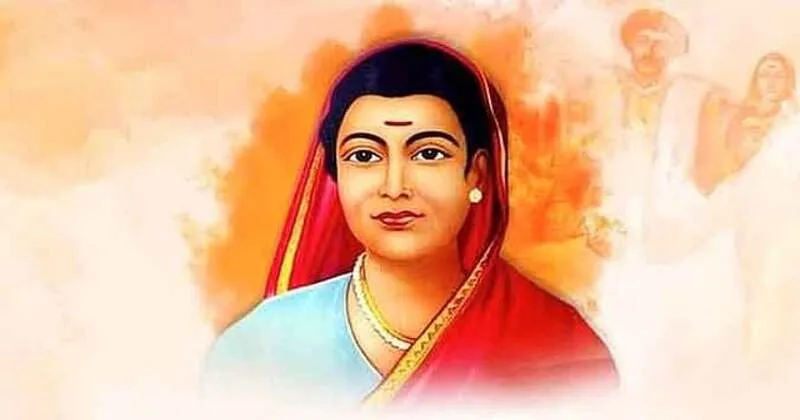
Savitribai Phule will always be remembered for her extraordinary zeal in the field of women’s education. She fought for the cause against heavy odds and had to suffer hardships. However, nothing could stop her.
Savitribai Phule is considered the pioneer of women’s education in modern India. She opened the first school exclusively for women in Pune in 1848. She was the wife of Mahatma Jyotiba Phule, who is also known as one of the greatest social reformers of the 19th century and continues to inspire today. Savitribai’s entire life was devoted to the cause of her husband’s mission, which was mainly concerned with the eradication of caste discrimination and establishing equality. She carried out her mission despite heavy resistance from orthodox people and even physical attacks.
Childhood – Savitribai was born in Naigaon village of Satara district in Maharashtra on January 3, 1831. Her father was Khandoji Newse-Patil, while her mother’s name was Laxmibai. Savitribai was born and brought up in a village, where education for women was beyond imagination. Naygaon was a very small village, and her father was the head of the village.
Marriage – Savitribai’s life was drastically changed when she got married to Jyotiba in 1840. She was hardly nine years old, while Jytotiba was 13 years old at the time of marriage. Jyotiba had undergone severe hardships because of caste discrimination, outdated traditions, rituals, and social exploitation since childhood. Jyotiba decided to fight against social ills, and Savitribai was determined to walk with him despite heavy odds. Her role in Mahatma Jyotiba Phule’s life is immensely important, for which she is known as ‘krantijyoti’ (torchbearer of revolution).
Education for women – While Mahatma Jyotiba Phule was fighting for his mission, Savitribai realised the importance of women’s role in bringing about social change. A majority of the women were double victims at that time. Firstly, gender discrimination and secondly, caste discrimination. She was of the firm opinion that society cannot be changed unless women’s lives are changed. She believed that modern education was the only tool to change the lives of women.
Savitribai opened the first school for girls in Pune in January 1848. Significantly, the school was opened in an area which was dominated by orthodox people, who were opposed to the idea of women’s education. However, the person who offered his property for the purpose belonged to the orthodox Brahmin community. Savitribai is known as the first woman teacher because of her bold steps.
Savitribai was tortured, threatened and abused when she opened the school. However, her strong determination to the cause did not deviate from her path. In fact, her idea of women education was gradually accepted by the people as she opened a total of 18 schools in a short span of four years. Her first school – Bhide Wada – is declared as a memorial, which will soon undergo renovation.
Other works – While Savitribai’s life was focused on women’s education, she worked in other fields, which were directly or indirectly related to social reformation. She challenged the norms of society by opening a home for the prevention of infanticide, offering shelter to widows and allowing them to leave their children for adoption purposes. She strongly fought against child marriage and the Sati tradition, she advocated for the remarriage of widows and raised awareness on many other critical issues.
Maharashtra experienced a severe drought in 1876-77, and she is credited with starting relief works for the farmers. The most humanitarian part of drought relief work was shelter for commercial sex workers, who were victims of the drought. She also presided over Satyashodhak Parishad, which was held in Saswad near Pune in 1893. In addition to this, she also penned down her first book of poems – ‘Kavyafule’ in 1854. Later, she wrote three more books – Savitribaichi Gani, Subodh Ratnakar and Bawankashi. Her writings had a great social message.
Devoted wife – Savitribai was a traditional devoted wife whose life was merged with her husband. Mahatma Jyotiba Phule suffered from paralysis in July 1887. He was almost bedridden for a period of three years and died on November 28, 1890. Savitribai looked after her husband during this crucial period. This happened when the couple had hardly any well-wishers because of their work.
Mahatma Jyotiba Phule’s death was also a big examination for Savitribai. In Maharashtra, a tradition prevailed at that time that a person who carried out certain rituals was supposed to be the legal heir of the deceased person. Jyotiba and Savitribai had adopted a boy, Yashvantrao. When Yashvantrao came forward to perform those rituals, he was opposed by the family members of the Phule family. Savitribai came forward at that critical moment and carried out all the necessary rituals. In fact, the funeral procession was led by Savitribai, which was very unusual at that time. She also performed the last rites, which was also very unusual at that time. Her sufferings and hardships continued even after Jyotiba’s death. No family in Maharashtra was ready to have any kind of ties with Yashvantrao, as he was the adopted son of a widow. However, Dnyanoba Krishnaji Sasane, who was a close fellow of Mahatma Phule, came forward, and Yashvantrao got married to Dnyanoba’s daughter, Radha.
Death – Pune was gripped by a plague pandemic in 1897. Savitribai began providing relief and medical assistance to plague patients. Plague was considered a fatal disease at that time. Savitribai was caught up with plague while serving plague patients. She breathed her last on March 10, 1897. Her life was full of struggle, but she never deviated from her path. Despite severe resistance, she continued her social mission with great courage to bring about social reforms.