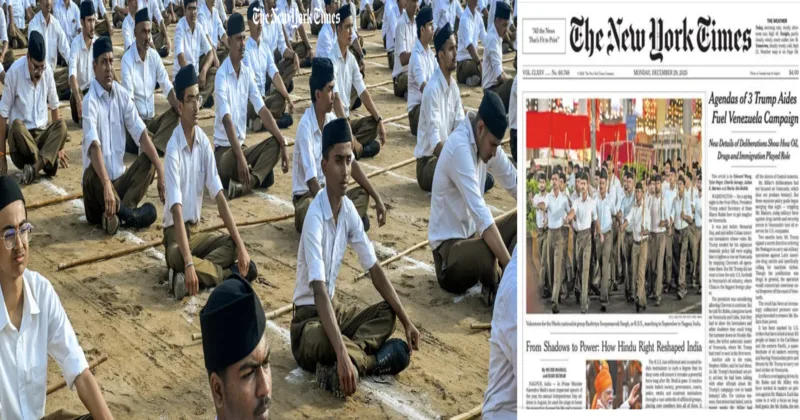
There is a predictable pattern in sections of Western commentary on India: complexity is briefly acknowledged, only to be quickly abandoned. Social movements are reduced to morality tales, history is collapsed into analogy, and political disagreement is elevated into existential alarm. The recent New York Times portrayal of the Rashtriya Swayamsevak Sangh (RSS) as an “ultra-powerful secret society,” casually flirting with Nazi imagery, is not an exception to this pattern—it is its most recent expression.
This is not a defence of the RSS. It is a rejection of intellectual dishonesty.
Criticism of the RSS is not alien to India. It has existed for decades, articulated across the ideological spectrum—by political opponents, academics, civil society actors, and former sympathisers. But criticism that detaches itself from history, replaces evidence with insinuation, and relies on imported ideological frameworks rather than Indian realities does not enlighten—it distorts.
The RSS was founded in 1925 in a colonised civilisation grappling with fragmentation, social inertia, and cultural disorientation. It did not emerge from fantasies of racial conquest or imperial revanchism, but from an attempt—contestable, incomplete, yet historically intelligible—to organise a society weakened by foreign domination. To forcibly squeeze this origin into the mould of European fascism is not comparative analysis; it is a category error.
India’s nationalist impulses did not arise from the trauma of defeated militarism, as they did in interwar Europe. They arose under colonial subjugation. This distinction is foundational, not semantic. Any analysis that ignores it begins with a false premise and inevitably arrives at a false conclusion.
The most frequently repeated allegation—that of secrecy—disintegrates under minimal scrutiny. RSS shakhas meet openly in public spaces. Its literature is freely available. Its leaders speak often, sometimes injudiciously, rarely invisibly. An organisation that has been banned, investigated, debated, criticised, opposed, and politically scrutinised for decades can scarcely be described as clandestine. One may object to its influence, but to describe it as a hidden cabal is to confuse scale with secrecy.
What truly unsettles sections of Western commentary is not opacity, but rootedness. The RSS does not resemble the Western archetype of civil society—professionalised, donor-driven, ideologically homogenised, and globally networked. It is decentralised, volunteer-based, culturally anchored, and unapologetically indigenous. It does not seek moral certification from international liberal ecosystems. That refusal itself appears sufficient to invite suspicion.
More troubling still is the insinuation—sometimes explicit, often implied—that Indian democracy is merely ornamental, animated by unseen hands. This narrative denies agency to Indian voters and trivialises institutional resilience. Governments in India rise and fall through elections that are fiercely contested, frequently unpredictable, and routinely unforgiving. Political parties lose power. Leaders are voted out. Courts intervene. Media scrutiny is relentless. To suggest that one organisation has hollowed out this entire democratic machinery without presenting rigorous, verifiable evidence is not investigative journalism—it is conjecture disguised as concern.
The casual invocation of Nazism merits particular condemnation. In contemporary Western discourse, the term has been reduced to a moral weapon rather than a historically precise descriptor. Its indiscriminate use shuts down debate while trivialising the magnitude of historical atrocity. The RSS does not advocate racial extermination, does not operate a cult of a supreme leader, does not pursue territorial expansion, and does not command a totalitarian state. Disagreement with its ideology does not justify abandoning proportionality.
This is not to suggest that the RSS is immune to criticism. It is not. Scholars and critics have raised substantive questions about its understanding of pluralism, its engagement with minority anxieties, and its uneven record on internal social reform. Cultural nationalism, when insufficiently tempered, can harden into exclusion. These concerns deserve serious debate—and they have been debated within India with far greater nuance than most external portrayals acknowledge.
But when critique slips into demonology, it ceases to persuade. It speaks only to the already convinced while alienating those open to reasoned argument. Worse, it feeds the grievance it claims to diagnose.
There is also an unmistakable asymmetry in global discourse. Foreign-funded advocacy networks operating in India are routinely framed as benign “civil society actors,” while mass indigenous organisations are treated as latent threats. One is granted legitimacy through alignment with Western liberal norms; the other is viewed with suspicion precisely because it is culturally rooted and socially expansive. This is not neutrality—it is ideological bias.
For readers in the Northeast, this pattern should feel uncomfortably familiar. The region has long been narrated from afar—flattened into conflict clichés, security abstractions, or strategic footnotes. To now witness India itself subjected to similar narrative compression should prompt reflection. Democracies are noisy. Social movements are contradictory. Civilisational assertions are rarely tidy. Journalism that refuses to engage with this complexity does not describe reality—it manufactures fiction.
The deeper issue is not hostility toward the RSS alone. It is a deeper discomfort with the possibility that India’s democratic evolution may not mirror Western expectations. The reflex to interpret every assertion of cultural identity as an authoritarian impulse reveals an inability to imagine democratic forms beyond a narrow ideological frame. That is not universalism; it is parochialism with global reach.
Global journalism preserves credibility only when it resists moral theatre. It must privilege analysis over analogy, evidence over insinuation, and humility over ideological reflex. India does not seek endorsement—but it does deserve accuracy.
The RSS can be criticised—sharply, rigorously, unsparingly. But it must be criticised for what it is, not for what foreign anxieties need it to represent. When commentary drifts into fantasy, it forfeits authority.
Democracy survives not by silencing criticism, but by demanding that criticism meet the same standard it demands of power: intellectual honesty.
Anything less is not vigilance.
It is projection.