Across years, India faced terror threats steadily, holding firm despite lacking a single cohesive strategy. Now comes a shift, and a turning point looms ahead. Soon, officials will unveil the country’s inaugural National Counter Terrorism Policy and Strategy, an adjustment deeper than routine bureaucracy. This marks how the biggest democracy rethinks its stance on enduring dangers.
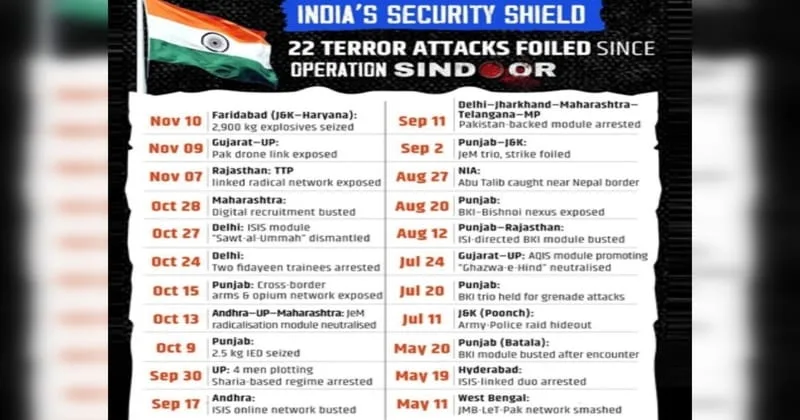
Timing matters here. A widely shared visual summary highlights 22 thwarted terrorist attempts since Operation Sindoor, illustrating gradual gains in India’s ability to counter threats. The seizures of explosive materials in Faridabad were revealed together with the breaking of the extremist recruitment networks in Andhra Pradesh. The measures undertaken against the ISIS-related groups occurred simultaneously with the attempts to break up the arms smuggling through the borders. Successes on the ground reveal skillful implementation by security forces. Still, sharp tactical performance does not replace a clear strategic direction. Crisis handling, inquiry procedures, and sustained risk reduction are still not connected in one flexible system that covers prevention as a whole.
The new approach, developed by Home Minister Amit Shah in consultation with the National Investigation Agency (NIA), seeks to dispel the confusion that has existed in the past. The states that are usually the first to experience attacks will have procedures that are consistent with those of the rest of the country. This, however, will not interfere with their autonomy within the broader governance framework of India. Crucially, the shift reflects a deeper understanding, i.e., threats have transformed over time, therefore strategies cannot remain frozen in the past.
A fresh look at rising dangers shows how today’s extremism differs from past patterns. Through online channels, viz., hidden messages, isolated networks, secretive corners of the internet, radical ideas move faster than before. Recruitment happens less in distant camps, more through glowing devices held close by youth. While officials took time to respond, the shift toward digital engagement was already reshaping risk. Focusing on these virtual pathways marks a necessary step forward.
Looking at how borders stay open too wide, past events show repeated abuse tied to outside money shifting beliefs. Across India’s edges, lines drawn near Pakistan, Bangladesh, Nepal, and Myanmar leak easily, making control tough. Hidden streams of cash flow under the cover of faith-based giving, pushing extreme views without drawing eyes. When funding slips through global gaps like this, danger grows quietly. Dealing only with those who act out won’t fix what feeds them behind the scenes.
What stands out comes from Prime Minister Narendra Modi’s response after the April attack at Pahalgam. When he stated that strikes on Indian territory amount to war, then added India would resist nuclear threats, something shifted. That moment marked a change in how security doctrine might apply today, especially where militants backed by nations operate across borders. Now, responsibility extends beyond attackers themselves to include those offering shelter, funding, or justification from behind the scenes.
Nowhere has India’s shifting defense mindset been clearer than in its recent responses to terrorism. Following major incidents, hesitation once shaped reactions; no longer the case. After 2016, precision actions across borders signaled change; four years later, air raids on Balakot reinforced it. More recently, sustained military pressure after events like Operation Sindoor shows continuity, not exception. Behind these moves lies an evolving doctrine, i.e., one that builds structure around boldness through updated rules, coordination methods, and foreign engagement practices.
Still, crafting a national plan to fight terrorism requires steering clear of specific mistakes. First, no security concern should ever limit the exercise of fundamental rights. The consistent application of constitutional principles, fair legal processes, and lawful rule is what keeps India’s democracy robust and lasting. If at any point the anti-terrorism fight were to undermine these pillars, then the outcome would not be security but rather susceptibility. The policy should be implemented with built-in checks, transparent supervision, and measures for preventing misuse.
The use of only military and spy activities will not lead to the eradication of extremism. To move forward, the most serious problems like unemployment, lack of proper education, corruption in politics, and the feeling of being culturally excluded have to be addressed. Rather than relying purely on crackdowns, the method of securing the area for a long time is when the aid projects, local partnerships, and reintegration paths are included in the plan.
One major challenge stands out, i.e., cooperation across levels of government has never been more necessary. Though the recent NIA meeting in Delhi marked a key moment, progress depends on what follows. When central and state forces align, alongside collaboration between states, the impact grows stronger. What matters now is how local authorities interpret these moves, not as control from above, but as support that sharpens their capabilities. True effectiveness lies not in plans, but in execution across diverse regional landscapes.
To begin with, India needs stronger ties abroad. Since terrorism crosses borders by nature, progress against it relies on shared intelligence, agreements to return suspects, collaboration with allies. Engagement in worldwide anti-terrorism efforts should grow, even as India keeps control over its own strategy. Ending with a note of caution: unity helps, but independence matters too.
What happens at the next anti-terror meeting could shape how well different groups work together. When central agencies meet with state police, intelligence units, and court officials, decisions tend to match real conditions more closely. Without support from people actually doing the work, even strong plans often fail to deliver results.
Change is expected in the national approach to countering terrorism. As tactics shift, response methods need adjustment too. Reviews at fixed intervals could help keep strategies relevant. Updating evaluations of risk will remain necessary. New tools in both attack and defense may shape future decisions. Adaptation might become part of ongoing planning.
From the start, India’s initial National Counter Terrorism Policy and Strategy stands beyond mere paper. This move shows a collective stance, clear thinking paired with steady determination when facing threats. Successes like stopping 22 assaults after Operation Sindoor reveal real capability within the country’s defenses. With a full-scale approach guiding efforts, progress could go further: breaking plots apart, yes, but also tearing down hidden networks behind violence.
The true test of this policy lies less in how many attacks are stopped, important as that is, and more in its ability to build a lasting system where terrorism no longer takes root. Whether it delivers on this goal defines its legacy, shaping how future generations see its impact.