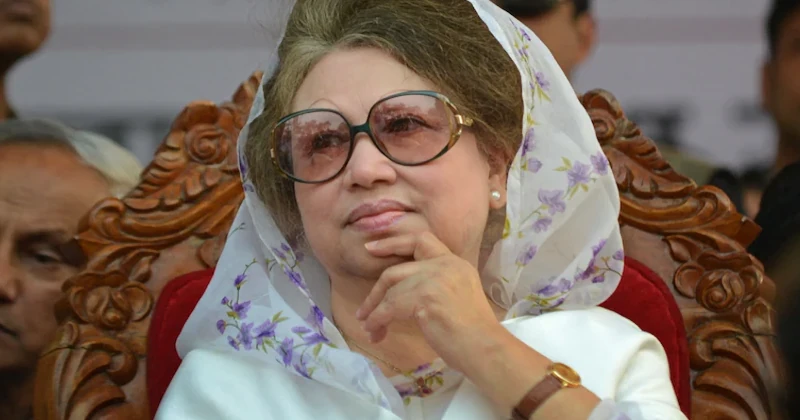
Former Prime Minister and Bangladesh Nationalist Party (BNP) Chairperson Begum Khaleda Zia passed away on December 30.She was 80. Zia died around 6 am local time, shortly after the Fajr prayer, while undergoing treatment at Evercare Hospital in Dhaka, the BNP confirmed in a statement on its verified Facebook page.
Prime Minister Narendra Modi expressed “deep sorrow” over Khaleda Zia’s passing, extending condolences to her family and the people of Bangladesh. In a post on X, PM Modi described her as a historic leader whose contributions would be long remembered.
“Deeply saddened to learn about the passing away of former Prime Minister and BNP Chairperson Begum Khaleda Zia in Dhaka. Our sincerest condolences to her family and all the people of Bangladesh. May the Almighty grant her family the fortitude to bear this tragic loss,” the Prime Minister said.
ঢাকায় সাবেক প্রধানমন্ত্রী ও বিএনপি চেয়ারপার্সন বেগম খালেদা জিয়ার পরলোকগমনের সংবাদে গভীরভাবে শোকাহত।
তাঁর পরিবার এবং বাংলাদেশের সকল মানুষের প্রতি আমাদের আন্তরিক সমবেদনা। সর্বশক্তিমান যেন এই অপূরণীয় ক্ষতি সহ্য করার শক্তি তাঁর পরিবারকে দান করেন।
বাংলাদেশের প্রথম নারী… pic.twitter.com/Aezd2Hl7x6
— Narendra Modi (@narendramodi) December 30, 2025
Recalling her role in regional diplomacy, PM Modi noted that as the first woman Prime Minister of Bangladesh, Khaleda Zia played a significant role in shaping the country’s development and India–Bangladesh relations. He also referred to his meeting with her in Dhaka in 2015, adding that her “vision and legacy will continue to guide” bilateral ties.
Khaleda Zia had been battling multiple serious health conditions for years. According to party sources, she suffered from heart disease, diabetes, arthritis, liver cirrhosis and kidney complications. She was admitted to Evercare Hospital on November 23 after developing a lung infection.
Earlier this month, she was sent to London for advanced medical treatment, reflecting the severity of her condition. Despite intensive care and repeated interventions, her health continued to deteriorate, culminating in her death early December 30 morning.
The BNP, confirming her passing, said: “We pray for the eternal peace of her soul and ask everyone to pray for her departed soul.”
Who was Khaleda Zia?
Begum Khaleda Zia was one of the most influential figures in Bangladesh’s post-independence political history. Widely known as the “Iron Lady” of Bangladeshi politics, she served as the country’s Prime Minister twice first from 1991 to 1996 and again from 2001 to 2006 becoming the first woman to hold the office in Bangladesh.
She rose to prominence as the widow of President Ziaur Rahman, the founder of the Bangladesh Nationalist Party and a former military ruler who was assassinated in 1981. Taking charge of the BNP in the aftermath, Khaleda Zia transformed the party into a major political force and became the principal rival of Sheikh Hasina, leader of the Awami League. Their bitter rivalry dominated Bangladeshi politics for more than three decades, shaping elections, street protests, governance and deep political polarisation.
Under her leadership, Bangladesh returned to parliamentary democracy in the early 1990s after years of military-backed rule. Her supporters credit her with strengthening democratic institutions and steering economic growth during her tenures. Critics, however, often accused her governments of corruption and political intolerance, charges that later led to her conviction and imprisonment during the Awami League era cases in which her family and party alleged political motivation.
Her passing also follows the dramatic return of her son, Tarique Rahman, from years in exile. Rahman had left Bangladesh after being arrested during the 2007–08 political crisis and later settled in London. After the fall of the Awami League government last year, he was acquitted in several cases filed during that period, paving the way for his return. His arrival last week, greeted by massive crowds of party supporters, was seen as a major signal of BNP’s renewed political momentum. He also visited his mother at Evercare Hospital days before her death.