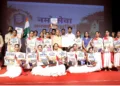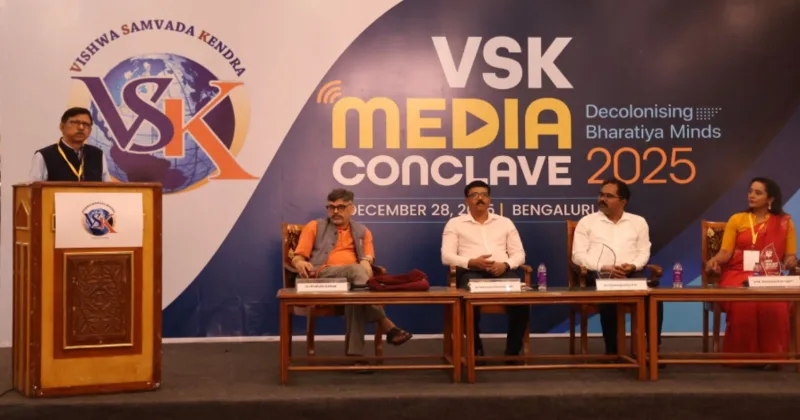
Bengaluru: The Vishwa Samvada Kendra organised the Media Conclave, 2025 and deliberated on “Decolonising Bharatiya Minds”. The soul of the conclave and the core agenda was to dismantle the colonial fort constructed around the Bharatiya minds and their intellectual spirit. The conclave aimed to invalidate the superficial western intellectual paramountcy by hailing the ancient civilisational wisdom of India. Senior journalists and subject experts assembled at the conclave, with solid evidence and sound facts systematically debunked the fantasy weaved for generations that western intellectual thoughts were superior and the Bharatiya ideas were inferior.
Awakening the Bharatiya Chitta as a solution to the present day problems
In the inaugural session of the conclave, senior journalists and media professionals deliberated upon the process of decolonisation of the Bharatiya minds. Prafulla Ketkar, Editor of the Organiser Weekly, asserted that decolonisation involves the action of cultural and spiritual awakening and reinterpretation. He exclaimed that the need of the hour is not mere decolonisation, but the regeneration of the spirit of nationalism has to follow that. The misdeeds of the colonial era have to be uprooted from the Bharatiya minds. Also, the misadventures of the initial decades of the post-independent era has to be eradicated which apparently drifted the Bharatiya minds from their civilisational wisdom, reiterated Prafulla Ketkar. Thus, decolonisation should be coupled with renationalism.
Speaking at the session, Dr. Rakesh Sinha, Former Rajya Sabha MP affirmed that the maiden step to decolonisation of the Bharatiya minds is to espouse “freedom of the ideas”(Vichar ka Swaraj). The ideas that are generated in the Bharatiya minds must be futuristic in approach and solution-oriented, which are inspired from the Bharatiya roots. Instilling such a thought process will yield decolonisation of the Bharatiya minds in the real sense. Intellectual self-rule rooted in Bharatiya perspectives is the need of the hour, said Rakesh Sinha.
The dignitaries also highlighted the role of media in the path of decolonising the Bharatiya minds. It was asserted that the media should act as the reflection of academia, think tanks and other intellectual landscapes of the society by mirroring their drawbacks, thus channelizing them in the path of decolonisation and embracing the spirit of nationalism. The media has the responsibility to strengthen the civilisational discourses of Bharat, the session opined. Rakesh Sinha also expressed that “decentralisation of media” is pivotal to seek the goal of decolonisation of the Bharatiya minds. Centralisation and control of the media by the urban elites drifts it away from its true purpose.
Bharatiya civilisation is hitherto democratic, republic, secular and liberal
Dr. A. Suryaprakash, Former Chairman of Prasar Bharati spoke at the session titled, “Media Bharatiya ethos, constitution and democracy”. He bursted the myth that the concepts of liberty, democracy, republic, integrity, equality, rule of law, participatory governance and secularism were bestowed upon India by the British. He asserted that these concepts were historically present in India and were an integral part of the Indian civilisational ethos. He did a comparative analysis and proved how the modern constitutional concepts were practiced in ancient India and not a gift by the West.
He asserted that when Britain was still primitive and a tribal society, in the kingdoms such as Magadha, Licchavi of Bharat advanced constitutional concepts were practiced. Prior to that, during the era of Indus Valley Civilisation, a well-established urban ecosystem was present, crafted with well-planned streets, sanitation and other elite features. Parallely, Britain or Europe was in deep darkness. Thus, the Europe enlightened Bharat is complete a fake narrative scripted to fulfill western hegemony and consolidate imperial fist in India.
Fighting the fake narratives
In a session titled, “Media and the war of narratives”, Ajit Hanamakkanavar, Editor of the Asianet Suvarna News(Kannada), highlighted how the advent of internet and free access to information has destroyed the castles of fake narratives. He asserted that the independent access to information, has led to the dismantling of the monopoly of the mainstream or few media houses who were constructing fake narratives against the Bharatiya ethos. People in the current era question the fake stories or counter narratives can be easily constructed, thus fake narratives can be bursted.
Ajit Hanamakkanavar also urged the people to research, seek evidence and critically analyse before believing in any piece of information circulated. Such constructive criticism and keen understanding will help to counter or debunk the fake narratives. Fact-checking is vital for both the media houses and the consumers of news, he added.
Media should have the courage to speak the truth
In the final session titled, “Media: Pursuit of truth, Catalysing Social transformation”, senior journalists urged the need for the media houses to stand up to the truth despite any external pressure. They debunked the myth constructed by the western media platforms regarding the “media objectivity”. Journalists exclaimed that no media is objective in its truest sense. Infact, western media began to subjugate the Bharatiya media to fulfill their hegemonic narrative deeds.
Sudarshan Channangihalli, Editor of Vijaya Karnataka(Kannada Daily) asserted that the mainstream media has the responsibility to speak and stand up to truth in the wave of fake information rapidly circulated in the social media. There is a need to pitch research-based, fact oriented information. Mainstream media shouldn’t vanish in the wave of sensational news circulated in the social media and should vouch on facts and credibility, he added. The media houses should also not kneel down to political pressure or any other compulsions in the path of speaking the truth, Sudarshan Channangihalli further reiterated.
Channegowda K.N., Editor of Vijayavani(Kannada Daily) also expressed the need for the media houses to stand above the external pressure in pursuit of truth. He urged the students and young journalists to take up investigative journalism to seek the goal of journalism with truth, thereby working towards reviving the spirit of nationalism.
Prafulla Ketkar, Editor of Organiser Weekly, asserted that, before publishing a news, a journalist has to introspect with the fundamental questions such as what is a news, how to select a news piece, what is the research and evidence behind it, what is the purpose of pitching a particular news in the society and ultimately, what is the intended impact from a news. He said that a journalist with these skills and spirit is essential to catalyse social transformation, decolonise Bharatiya minds and ultimately channelise the revival of nationalism.