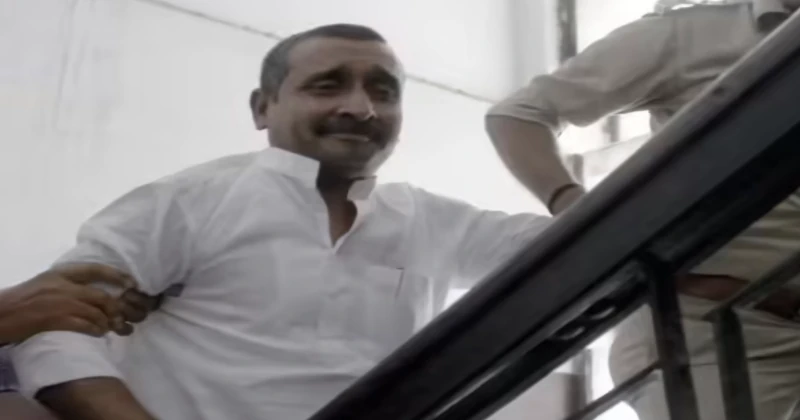
The Supreme Court stayed the Delhi High Court’s order granting bail to former BJP MLA Kuldeep Singh Sengar, making it clear that he will not walk out of prison.
A vacation bench led by Chief Justice of India Surya Kant, along with Justices J.K. Maheshwari and Augustine George Masih, held that the case raises “substantial questions of law” and that the High Court’s reasoning, if accepted, could dangerously distort the interpretation of criminal statutes dealing with sexual offences against children.
Staying the operation of the Delhi High Court’s December 23 verdict, the apex court categorically ruled that Sengar shall continue to remain in custody. It noted that he is already serving a sentence in another criminal case, including a conviction under Section 304 Part II of the Indian Penal Code, and that releasing him pursuant to the impugned order would be wholly impermissible.
Ordinarily, the Supreme Court refrains from staying bail orders passed by trial courts or High Courts without hearing the accused. However, the bench emphasised that the present matter involves “peculiar facts” that warrant immediate interference.
“This is not a routine case of bail,” the court observed, pointing out that Sengar stands convicted in multiple serious offences and is serving sentences that independently justify his continued incarceration.
Acting on a plea filed by the Central Bureau of Investigation (CBI), the apex court issued notice to Sengar, seeking his response, and directed that the High Court’s order suspending his life sentence shall remain in abeyance until further orders.
In a stinging oral observation during the hearing, Chief Justice Surya Kant questioned the implications of the Delhi High Court’s interpretation of the law. “If this interpretation is accepted, even a constable or a patwari would qualify as a public servant, but an MLA or MP could be excluded and claim exemption,” the CJI remarked, flagging the potentially absurd and dangerous consequences of such reasoning.
The Delhi High Court had granted relief to Sengar on the prima facie finding that the offence of aggravated penetrative sexual assault under the Protection of Children from Sexual Offences (POCSO) Act was not made out against him, as he could not be categorised as a “public servant” under Section 5(c) of the Act or under Section 376(2)(b) of the IPC.
The High Court division bench of Justices Subramonium Prasad and Harish Vaidyanathan Shankar had held that Sengar, despite being a sitting MLA at the time of the offence, did not fall within the definition of a public servant under the relevant provisions. It further ruled that he did not come within the ambit of Section 5(p) of the POCSO Act, which deals with offences committed by a person in a “position of trust or authority.”
This interpretation prompted the CBI to approach the Supreme Court, arguing that the High Court committed a serious error in law.
According to the CBI, a sitting MLA occupies a constitutional position of trust and authority and discharges public duties in which the State and the community at large have a direct interest. Excluding legislators from the scope of aggravated offences under POCSO, the agency argued, would defeat the very object of the law and weaken protections for child victims of sexual crimes.
During the hearing, counsel appearing for the rape survivor sought permission to intervene in the proceedings. The Supreme Court clarified that she does not require the court’s permission and has a statutory right to file an independent special leave petition.
The bench further underlined that free legal aid would be provided by the Supreme Court Legal Services Committee if sought, though the survivor is free to pursue the matter through her own counsel.
The Unnao rape case dates back to 2017, when a minor girl accused then BJP MLA Kuldeep Singh Sengar of raping her in Uttar Pradesh’s Unnao district. The case triggered nationwide outrage amid allegations that the police initially refused to register an FIR and that the survivor and her family were subjected to threats and harassment.
In April 2018, the survivor attempted self-immolation outside the residence of Uttar Pradesh Chief Minister Yogi Adityanath, accusing authorities of shielding the powerful legislator. The incident sparked massive protests and intense media scrutiny, following which the investigation was handed over to the CBI.
To ensure a fair trial, the Supreme Court transferred the case from Uttar Pradesh to Delhi.
In December 2019, a Delhi trial court convicted Sengar of rape under the IPC and the POCSO Act and sentenced him to imprisonment for the remainder of his natural life. He was also convicted in separate cases relating to the custodial death of the survivor’s father and for attempting to influence witnesses. Several of his family members and associates were found guilty in connected cases.