The Mahatma Gandhi National Rural Employment Guarantee Scheme (MGNREGS), launched in 2007, marked a historic step toward legally guaranteeing minimum-wage employment to rural households. Over the years, it has served as a crucial instrument of social security, especially during periods of economic stress. However, the sheer scale of expenditure under the scheme has also exposed structural weaknesses that required timely and comprehensive reform.
Between 2007 and 2014, MGNREGS generated 1,660 crore person-days of employment, with an expenditure of Rs 2.13 lakh crore, resulting in the creation of 1.53 crore rural assets. From 2014–15 to 2025–26, the programme expanded significantly, generating 3,029 crore person-days at a cost of Rs 8.54 lakh crore, and facilitating the creation of nearly 9 crore rural assets. In 2020–21 alone, spending reached Rs 1.11 lakh crore, underscoring the scheme’s importance as a safety net during a national crisis.
A comparative assessment highlights the increased fiscal commitment in recent years. While the UPA government spent an average of about Rs 30,500 crore annually during its seven years in office, the NDA government, over 11 years, has spent an average of Rs 77,000 crore per year, significantly scaling up both employment generation and asset creation.
Andhra Pradesh: A Case of Enhanced Support
Under the NDA regime, Andhra Pradesh has received nearly Rs 87,000 crore under MGNREGS up to 2026. These funds have been deployed to create critical rural infrastructure such as cement concrete roads, irrigation canals, drainage systems, farm ponds, Amrit Sarovars, Panchayat buildings, Anganwadi centres, and Gokulam sheds.
Of this total allocation, approximately Rs 52,000 crore has been disbursed as wages for 262 crore person-days of employment, Rs 31,000 crore has been spent on the material component, and Rs 4,000 crore has been spent on staff salaries. In contrast, during the seven years preceding 2014, the state received an average of less than Rs 25,000 crore per year, indicating a relatively limited scale of support.
Systemic Issues Identified through Statewide Review
Despite the increased financial outlay, the scheme’s effectiveness was undermined by persistent irregularities. Under the leadership of Hon’ble Chief Minister Shri Nara Chandrababu Naidu, a comprehensive review of MGNREGS implementation was conducted across all 26 districts of Andhra Pradesh. As Chairman of the Twenty-Point Programme Implementation (Viksit Bharat – Swarna Andhra Pradesh), I conducted this review, which revealed several structural deficiencies.
Key issues included fraudulent payments and defective muster rolls, with wages paid to non-working individuals or to those failing to complete the prescribed working hours. The problem was compounded by the creation of fake job cards, particularly between 2019 and 2024. With the introduction of KYC verification, nearly 11 lakh fake job cards—the highest number identified in any state—were detected in Andhra Pradesh alone, resulting in significant financial leakage.
Furthermore, there were widespread instances of manipulated work measurements, in which work was recorded as completed without execution or in which quantities were artificially inflated. Quality standards were often compromised, resulting in assets that failed to deliver long-term value. Another unintended consequence was a shortage of agricultural labour during peak seasons, which caused hardship for farmers. Most critically, there remained a glaring mismatch between expenditure and asset creation. Over the past two decades, nearly ₹10.67 lakh crore has been spent nationally (over ₹1 lakh crore in Andhra Pradesh), yet the quality and durability of assets have not always been commensurate with the investment.
VB–G RAM G: A Structural Reset
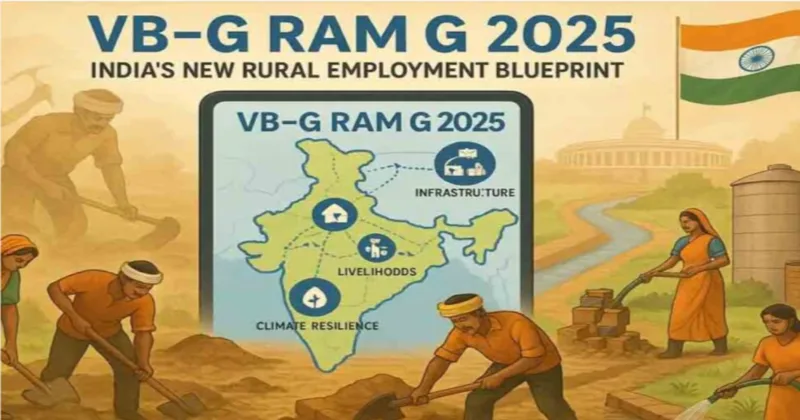
Recognising these challenges, the Government of India has undertaken a comprehensive restructuring of MGNREGS to ensure that public funds translate into durable assets and sustainable livelihoods. The reimagined framework, titled VB–G RAM G – Viksit Bharat: Guarantee for Rozgar and Aajeevika Mission (Rural), aligns the rural employment programme with contemporary economic, technological, and climatic realities.
The central objective of VB–G RAM G is to eliminate leakages, strengthen accountability, and shift the focus from mere expenditure to measurable outcomes. A key reform under the new framework is the increase in the annual employment guarantee from 100 to 125 days per rural household, thereby reinforcing income security. At the same time, the statutory provision mandating payment of an unemployment allowance if employment is not provided within 15 days of demand has been retained, thereby ensuring that workers’ rights remain protected.
To address the long-standing issue of labour shortages in agriculture, the framework introduces flexibility by allowing scheme activities to be paused for up to 60 days during the agricultural season. This enables rural households to participate in agricultural work without losing access to guaranteed employment, thereby balancing the interests of labourers and farmers alike.
Enhanced Funding and Cooperative Federalism
VB–G RAM G is underpinned by a strengthened Centre–State partnership, with a 60:40 cost-sharing ratio that significantly increases the pool of resources available for rural development. This cooperative federal structure ensures that states have both the financial capacity and operational flexibility to implement projects that respond to local needs, while maintaining national standards of transparency and accountability. The enhanced funding framework directly supports the Prime Minister’s vision of Viksit Bharat, rooted in inclusive and sustainable growth.
Technology as the Backbone of Transparency
A defining feature of VB–G RAM G is its emphasis on technology-driven governance. To prevent fraud and misuse, the framework mandates:
● Biometric authentication for wage payments,
● Use of geospatial technologies for planning, measurement, and monitoring of works,
●Mobile app–based, real-time dashboards for supervision, and
● Regular public disclosure mechanisms, including weekly updates accessible to citizens.
These interventions are designed to eliminate payments without work, fake transactions, and non-productive activities, while ensuring that every rupee spent is traceable and accountable. Over time, this technology-backed approach is expected to significantly improve the quality, durability, and utility of rural assets.
The transition from MGNREGS to VB–G RAM G (Viksit Bharat – Guarantee for Rozgar and Aajeevika Mission – Rural) represents a decisive shift towards outcome-oriented, transparent, and accountable governance. It acknowledges the achievements of the past while squarely addressing the deficiencies that undermined public trust and efficiency.
By combining enhanced employment guarantees, agricultural flexibility, increased funding, and advanced technology, VB–G RAM G lays a robust foundation for sustainable rural transformation. Rooted in the ideals of Gram Swaraj, the reformed framework aspires to make India’s villages centres of productivity, dignity, and opportunity—true pillars in the nation’s journey towards a Viksit Bharat.