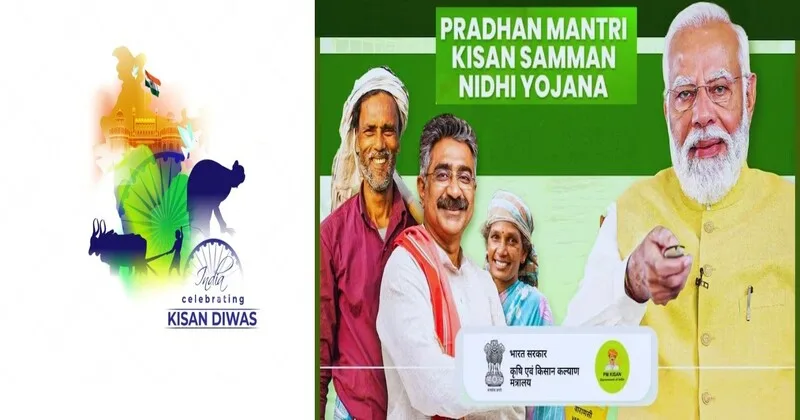
Every year on December 23, India stops for a moment to pay tribute to the spine of Indian civilization farmers. Marked as Kisan Diwas and National Farmers Day, this day was chosen as it is the birth anniversary of Chaudhary Charan Singh, who was one of the strongest voices for farmers rights in India. It is a day for the nation to think about the farmers, the Annadatas, who till the land, shape the future of this land for farming production and how their welfare is shared by the policies of the Indian government.
Pillar of Progress: Modi Government Farming Vision
Since 2014 farmer welfare and development in agriculture have been at the center of the policies of the PM Narendra Modi administration. This has been holistic in nature involving support in terms of finance, risk support, access to credit, development support, technological interventions and future security. These nature makes farming lucrative, secure and sustainable by aligning it with international efficiency. These policies have evolved into tangible outcomes for the lives of millions of farming families in India.
Direct Income Support: PM-Kisan Samman Nidhi (PM-KISAN)
One of the most popular farmer-friendly schemes launched by the government is Pradhan Mantri Kisan Samman Nidhi (PM-KISAN) Scheme. As per this scheme farmers holding eligible agricultural lands get funds of ₹6,000 per annum, which is directly credited into their accounts in three instalments. Through these instalments the farmers can cover few expenses related to agriculture, from seeds to fertilizers and even household items without borrowing money on higher rates.
Till mid-2024, more than 11 crores of farmers have been benefited under this scheme, and an amount of over Rs 3.24 lakh crores has been distributed. The magnitude of this direct benefit highlights how extensively the government assistance has reached in farming communities.
In 2025 November, the 21st instalment of PM-KISAN is credited to the beneficiary farmers accounts and over Rs. 316 crores is given to farmers in the state of Haryana alone. More than 15.8 lakh farmers have been supported through the recent instalment.
Agriculture Protection: Pradhan Mantri Fasal Bima Yojana (PMFBY)
Agriculture is tied to nature and it turn out to be quite unpredictable. To shield the farmers against the loss of crops, due to natural calamities like droughts, floods or cyclones, the government improved the Pradhan Mantri Fasal Bima Yojana (PMFBY). As per this crop insurance scheme, the farmer pays a nominal fee of 2% for Kharif crops and 1.5% for Rabi crops while the rest of the coverage is borne by the government.
Since the launch of this scheme, PMFBY has insured crores of agricultural choices and has also provided appropriate compensation in case of crop failure. In 2025, farmers in various states of the country, like Uttarakhand, have received their compensation for crops insured through PMFBY. An amount of ₹62 crores directly transferred into the accounts of over 28,000 farmers.
Becoming More Self-Reliant and Securing a Bright Future Through Other Initiatives
In 2025 Prime Minister Modi started two new initiatives which focus on encouraging farmers self-reliance and advancing agricultural productivity through the PM Dhan-Dhanya Krishi Yojana and Pulse Self-Relevance Mission. All such programs and projects combined symbolize a focused outlay of Rs 35,440 crores with a focus on 100 districts for holistic agricultural development.
The aim and objectives are quite simple and direct because they focus on improving farmer earnings and advancing agricultural health by reducing the dependency on imports due to increased agricultural productivity and health. These new programs reflect and renew this commitment to not only aid farmers today, to envision and create a future where Indian farming will be strong, innovative and world-class.
Affordable Credit: Kisan Credit Cards and Interest Subsidies
Agriculture requires a capital for seeds, fertilizers, equipment and farm workers. The Kisan Credit Card Scheme provides farmers easy access to credit at low rates and no obstacles. There were more than 7.75 crore functioning Kisan Credit Card accounts by March 2024.
In this case government schemes for the interest subsidy of agricultural loan mean that farmers can easily invest in their land through agricultural loans that are not prohibitively expensive.
Retirement Security: PM Kisan Maan Dhan
Agriculture has been a lifelong occupation for farmers, but social security is equally important. To rectify the issues, the government has come up with the PM-Kisan Maan Dhan Scheme, which is a voluntary pension system. This system ensures that farmers, in collaboration with the government, have social security by receiving a monthly pension after age 60.
Beyond money transfers and insurance schemes, the national government’s other priorities in agricultural development include promoting rural infrastructure, encouraging sustainable practices, and supporting the adoption of technology. Projects such as weather observation systems, crop yield prediction systems such as YES-TECH and weather observation network improvement schemes are intended to help farmers make informed decisions at the correct times. Such projects collectively present an image of an agricultural modernisation-obsessed government.
The Modi government is reshaping New India on this Kisan Diwas. The farmlands in India are silently celebrating the journey of change of digital transactions as a support that finds its way to the farmer’s banking account, insurance payouts that ease the impact of the fluctuating weather conditions and plans thought of in the perspective of long-term prosperity rather than momentary respite. Right from the fertile fields of Haryana and Uttar Pradesh to the beautiful hues of Uttarakhand, there are better prospects and wider opportunities for farming echoes.
Sowing season is no longer a gamble amid uncertainties for farmers; it is now an informed choice with policy, protection, and promise. While paying tribute to Annadata, the nation is actually paying homage to a better future where fields are getting fertilised by a supportive State policy, risks are getting cushioned by economic safeguards and harvests are being converted into a robust, self-dependent and rich India.