Factional fault lines within the Trinamool Congress (TMC) became increasingly visible on Monday (Dec 22) after suspended party MLA Humayun Kabir announced the formation of a new political party, intensifying speculation about internal dissent within the ruling party in West Bengal.
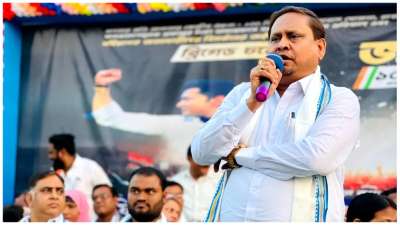
Kabir, the sitting MLA from Bharatpur, formally launched the Janata Unnayan Party (JUP) at a public meeting in Beldanga in Murshidabad district, just days after he was suspended from the TMC over his controversial remarks and actions related to a proposed Babri-style mosque.
Addressing supporters, Kabir declared that his newly formed party would contest the 2026 West Bengal Assembly elections, positioning himself as a serious political challenger in the minority-dominated Murshidabad region.
At the launch event, Kabir announced the names of eight prospective candidates, though he refrained from revealing the total number of seats the JUP would eventually contest. “The final decision on the number of seats will be taken later,” he said, indicating that the party’s electoral strategy was still evolving.
Kabir also announced his intention to contest from the Rejinagar and Beldanga Assembly constituencies, signalling an aggressive push in areas where the TMC has traditionally enjoyed strong minority support.
In a sharp escalation of rhetoric, Kabir launched a direct attack on Chief Minister Mamata Banerjee, accusing her of being disconnected from the people.
“Mamata Banerjee is no longer accessible to ordinary people,” Kabir alleged, claiming that the TMC’s grip on Murshidabad was weakening rapidly. He went on to assert that the ruling party would be “completely wiped out” in the district in the next Assembly elections.
Projecting himself as a pivotal political player, Kabir claimed that no single party would secure a clear majority in the 294-member Assembly in 2026 and portrayed his party as a potential “kingmaker.”
“No government can be formed without my party’s support,” he said, asserting that the JUP would contest a significant number of seats and emerge as a decisive force in government formation.
The launch of Kabir’s party drew an immediate political response from Chief Minister Mamata Banerjee, who, without naming him, accused the Bharatiya Janata Party (BJP) of attempting to divide minority votes in the state.
Addressing a party meeting in Kolkata, Banerjee alleged that deliberate efforts were underway to engineer communal polarisation ahead of the 2026 elections. She described such moves as politically motivated and aimed at weakening the TMC’s traditional support base.
Her remarks were widely interpreted as an indirect reference to Kabir’s rebellion and the growing unease within sections of the party.
The BJP, however, rejected Mamata Banerjee’s allegations and downplayed Kabir’s political significance. State BJP president Samik Bhattacharya said Kabir’s new party would have little to no impact on the electoral outcome and accused him of indirectly benefiting the TMC rather than harming it.
BJP national spokesperson Shahnawaz Hussain went a step further, alleging that Kabir’s political move was part of a calculated strategy by the ruling party.
“His actions appear scripted to prevent disgruntled Muslim voters from shifting to the opposition,” Hussain claimed, accusing the TMC of using splinter politics to manage internal discontent.
Kabir was suspended from the Trinamool Congress on December 4 following his remarks on constructing a Babri-style mosque, which triggered a major political storm in the state.
Despite his suspension, Kabir went ahead with laying the foundation stone for the mosque at Rejinagar on December 6, a date that coincides with the anniversary of the demolition of the Babri Masjid in 1992. The timing of the event further inflamed tensions and sharpened political reactions across party lines.
A veteran of frequent political realignments, Humayun Kabir has had a long and chequered political journey. He was expelled from the TMC in 2015, contested the 2016 Assembly elections as an independent candidate, later joined the Congress, and subsequently switched to the BJP ahead of the 2019 Lok Sabha elections.
After failing to win the Murshidabad parliamentary seat, Kabir returned to the TMC and successfully contested the Bharatpur Assembly seat in 2021, regaining his place in the ruling party.
Kabir’s open rebellion and the formation of a new party highlight visible cracks within the Trinamool Congress at a time when the party is preparing for a high-stakes electoral battle in 2026. With internal dissent surfacing in key districts like Murshidabad, the episode adds another layer of political uncertainty to West Bengal’s already volatile political landscape.
Whether Kabir’s Janata Unnayan Party emerges as a serious electoral force or remains a spoiler will become clearer as the state inches closer to the next Assembly polls.