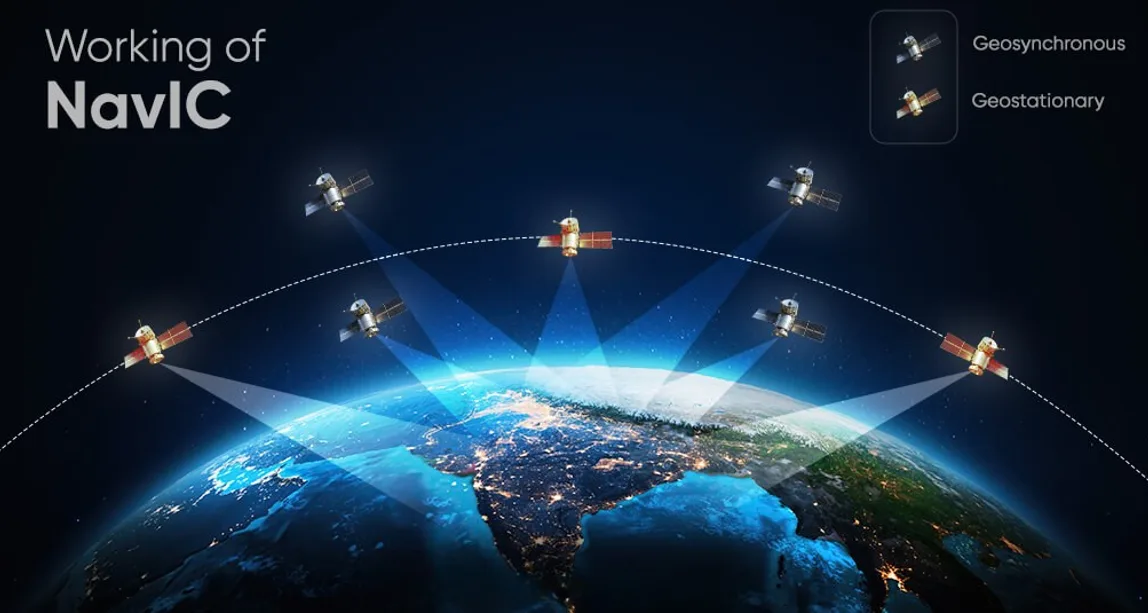
NavIC, the Indian requirement for technology independence has been a pillar for institutions or capacities to make navigation in a subdued manner. The development of NavIC or “Navigation with Indian Constellation”, under the umbrella of Department of Space, is a case which symbolizes the “Make in India and Swadeshi” spirit.
The significance of NavIC lies in the fact that it symbolizes India’s commitment to being in charge of its own Positioning, Navigation and Timing (PNT). It has been the fact for the past several decades that India, had to rely on foreign-based global navigation satellite systems for its needs. Even though the current systems are very efficient and reliable, being dependent on foreign-based systems poses certain limitations and challenges particularly during a crisis or tension.
Developing an indigenous navigation ecosystem
NavIC is more than just a satellite system, it is an ecosystem of satellite navigation. The Department of Space has made concerted efforts to ensure that NavIC is not just a lab-based system or for strategic users anymore. It has integrated NavIC into the fabric of the nation through a series of pilots, tests and technology transfer. NavIC is more than just a demonstration project.
NavIC based real time tracking of trains, already operational on over 10,000 train engines, shows how homegrown navigation systems improve public services. Precision timing and positioning which are imperative in different area for operational efficiency and logistics, are facilitated with accurate and precise location information, which can be achieved only through Indian satellites and approved Indian devices.
The use of NavIC for fishing vessels has become a saving grace for coastal villages. The fact that there are more than 30,000+ fishing vessels with transponders integrated with the NavIC system has increased marine safety, distress relief and enables the fishing fleet to stay within the prescribed areas. This is grassroot technology for the grassroot livelihood which fits the Make in India spirit very closely.
From policy vision to industrial capability
One hallmark quality that defines the development pace of the NavIC system is that it has been promoted with the intention of aligning the system with the Indian environment. Instead of restricting its utilizations solely within governmental applications, the Department of Space also reached out to Indian firms. By technology transfer or certification programs, devices that work with the NavIC system are produced.
This initiative has resulted in some tangible achievements. Over 140 models of devices have been certified for use in vehicle tracking based on NavIC and they are now employed in over 15 lakh public and commercial vehicles in the country. This could not have been possible on such a vast scale, it’s essential because it generates demand certainty for manufacturers, promotes component development in their country and develops industrial capacity in the long run. NavIC basically acts as a demand generator for home-grown electronics, semiconductors and embedded systems.
The incorporation of NavIC in secondary timescale systems that are involved in broadcasting Indian Standard Time in the country again reinforces its applications and implications. Timing is important for various applications, including telecom, power and finance. Employing receivers for time transfer based on NavIC is making this important infrastructure in the field of timing in-house in the country.
Swadeshi technology and strategic autonomy
For any technology to reach the mass market, standardization and innovation are both required. Encouraged by this understanding of the equal role of standardization and innovation for the widespread adaptation of every technology, the Department of Space has made efforts to standardize NavIC. This ensures that NavIC compatibility becomes the basic criteria for products and solutions.
These can be seen in the consumer electronics domain. Today over 60 smartphone models can receive NavIC signals. This has importance not only in terms of its use for consumers, but it also has market signal significance. When international and Indian companies develop products with native support for NavIC, it gives credence to the Indian navigation system being reliable, interoperable and economically feasible. This also has significance in terms of its use by Indian consumers for various navigation-related services on a daily basis.
For Indian regional navigation satellite system, NavIC is open and available. These signals can be used by any individual within the coverage area for any purpose concerning PNT. This practice indicates that the Indian government is taking a strong technology stand by not setting boundaries around the technology and encouraging its use.
The development of NavIC signals a collaboration between India and international GPS solution providers. Instead of positioning NavIC as a competing solution to existing GPS solutions, India takes part in signal coordination and interoperability discussions. India enables seamless coexistence with international GPS solutions while retaining sovereignty over its core solution functions.
This technology, NavIC, shows that swadeshi does not mean being technologically insular. It embodies an indigenous talent confidence merging appropriately with the internationalized architecture. It’s also worth noting that the government has not made the use of NavIC compulsory till now. The discussions for the same are going on, but the growth of NavIC has been smooth because of its utility and support instead of it being made compulsory. This will help increase the authenticity of NavIC because the support for a system coming from the industries and the service providers will solve the problems related to authenticity.
The NavIC lays down a blueprint for the success of the ‘Make in India’ initiative for high tech. This involves public investment for the long term and the creation of mission-oriented institutions. This requires collaboration and focus on the end users. The focus is not only on ‘make in India’, i.e., manufacturing in the country. The whole chain has to be developed. This involves satellites and ground control to the device and the applications.
As India ponders ideas related to digital sovereignty, robust infrastructure and a self-reliant economy, NavIC remains a quiet achiever and a force to reckon with. It proves that swadeshi innovation does not mean a disengagement with the world instead, it signifies that India’s basic architectural structures must remain defined, governed and maintained with Indian capability itself. In a world where data, time and location are determining factors of economic power, NavIC symbolizes a statement of confidence.