India has begun the process of constructing a second, dual-use airfield on Great Nicobar Island near Galathea Bay, close to the Malacca Strait. Complementing INS Baaz at Campbell Bay, it enhances redundancy, surveillance and rapid response across a critical maritime chokepoint. Integrated with port, energy and connectivity projects, it reflects India’s effort to convert geography into sustained strategic capability while balancing ecological and Indigenous concerns.
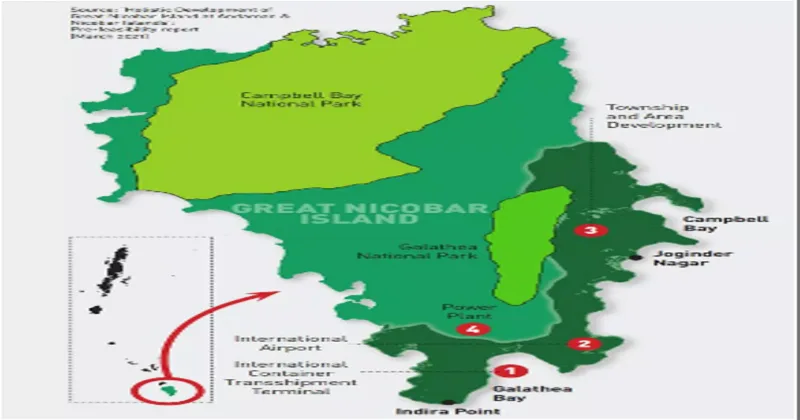
India has formally begun the process of constructing a second airfield on Great Nicobar Island, signalling that New Delhi is moving decisively from intent to execution in strengthening its southernmost island territory as a node of connectivity and security at the edge of the Indo-Pacific’s busiest sea lanes. The proposed greenfield, dual-use airport is planned at Chingen, adjoining Galathea Bay—an exceptional location close to the western approaches of the Malacca Strait and the Six Degree Channel between Great Nicobar and Sumatra. This positioning gives India a forward perch over traffic moving between the Indian Ocean and the western Pacific. It will be the second airfield on Great Nicobar after the Campbell Bay air station and one of four operational airfields spread across the length of Andaman and Nicobar Island chain, extending from near Myanmar in the north to close to Indonesia in the south.
The strategic logic begins with geography, but it does not end there. Great Nicobar already hosts the Campbell Bay air station, a naval facility under the Andaman and Nicobar Command that explicitly overlooks the Malacca Strait and the Six Degree Channel. Its location reflects the enduring logic of island strategy: proximity to chokepoints matters only when it can be operationalised. The proposed airfield at Chingen and Galathea Bay adds depth and redundancy to this posture by placing an additional runway and support ecosystem a few kilometres away, closer to the sea-lanes that funnel toward Malacca.
The intent is not simply to add “another airport”, but to create an operational system. Multiple airheads on the same critical island reduce single-base dependence, expand sortie generation and enable dispersal, surge operations and continuity during crises—considerations that are especially relevant in island environments where weather, distance and natural disasters can abruptly disrupt access. Redundancy, in this context, is not excess; it is resilience.
Galathea Bay’s importance becomes clearer when viewed against the scale of maritime traffic. The approaches to the Malacca Strait are among the most heavily trafficked shipping corridors in the world, with more than 96,000 vessels transiting the strait annually. Such density produces strategic consequences: the ability to observe activity, sustain presence and respond quickly confers a form of maritime leverage rooted in awareness and persistence rather than firepower alone. A dual-use airfield in this location therefore acts as a multiplier for maritime domain awareness, enabling faster turnarounds, wider surveillance arcs and more responsive Humanitarian Assistance And Disaster Relief (HADR) operations toward Southeast Asia when time is critical.
An additional dimension reinforcing Great Nicobar’s strategic value is India’s emerging offshore energy potential in the Andaman Basin. In September 2025, a significant natural gas discovery at the Sri Vijayapuram-2 well offshore in the Andaman Sea was announced, described as opening an “ocean of energy opportunities”. Even at an exploratory stage, the discovery carries immediate strategic implications. Offshore energy assets—whether producing or prospective—inevitably become critical national infrastructure. As India expands deepwater exploration and potentially moves toward production, the security calculus around the Andaman and Nicobar Islands changes qualitatively. Energy platforms, survey vessels, support shipping, subsea infrastructure and associated data flows introduce vulnerabilities that require sustained monitoring and protection, particularly in a region witnessing increased extra-regional naval activity.
This emerging energy dimension strengthens the case for enhanced air and maritime surveillance, quicker response cycles and greater operational depth in the southern Andaman Nicobar sector. A second airfield on Great Nicobar, operating alongside the Campbell Bay facility, directly supports these requirements by enabling persistent aerial monitoring, rapid deployment of maritime patrol aircraft and unmanned systems and faster access to offshore operating areas. Hydrocarbons thus add a resource-security layer to an already compelling chokepoint-security logic.
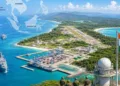
The airport is only one pillar of the wider Great Nicobar Island Development Project, a multi-component initiative intended to transform the island from a sparsely connected outpost into a strategic logistics and economic node. Under policy guidance at the national level, the project brings together four interlinked elements: an international container transshipment terminal at Galathea Bay, a greenfield international airport, power generation infrastructure and a modern township to support the workforce and services required to sustain these assets. The logic is straightforward. Ports and airports become strategically meaningful only when supported by reliable power, communications, maintenance, fuel and urban services. Geography provides position; infrastructure converts that position into persistent capability.
The transshipment port is central to the economic rationale. India’s container traffic has long relied on foreign hubs for transshipment and Galathea Bay is envisioned as a means to retain more of that value chain while creating a credible logistics alternative in the eastern Indian Ocean. While long-term throughput targets are ambitious, the strategic point is clear: a port–airport–power–township cluster on Great Nicobar shortens detours, reduces logistical risk and creates options during geopolitical disruption—functioning as strategic insurance as much as a commercial venture.
Existing infrastructure across the Andaman and Nicobar Islands shows that the Great Nicobar initiative is part of a wider strategic arc, not a standalone move. A small but critical network of civilian and military airfields is already spread along the length of the archipelago. This linear geography makes airfields essential stepping stones, compressing distance, enabling rapid repositioning and sustaining surveillance and response without constant reliance on the mainland. They also serve vital civil and security roles—supporting connectivity, disaster relief, maritime patrol, law enforcement and redundancy against single-base failure.
Yet the island’s promise is inseparable from its fragility. Ecological and social considerations are not peripheral but constitute the project’s legitimacy test. Great Nicobar is a recognised biodiversity hotspot with sensitive coastal and marine ecosystems and it is home to Indigenous communities whose rights, access and cultural continuity must anchor any lawful and durable development pathway. The project therefore carries a dual obligation: strategic and economic assets must be built with enforceable guardrails, including zoning that protects reserves, strict access protocols where required and mitigation measures embedded in contracts and monitored transparently. Sequencing is critical—establishing the minimum strategic spine for access and resilience, while gating subsequent phases on demonstrable ecological and social compliance.
Viewed as a whole, the second airfield at Chingen near Galathea Bay emerges as an enabling node rather than an isolated project. It strengthens India’s ability to sustain presence near the Malacca approaches, supports the logistics logic of a transshipment hub, and improves civilian connectivity and disaster response in a remote island group. If executed with transparent safeguards and genuine community protection, Great Nicobar can evolve into both a frontline maritime security asset and a model of responsible island development—demonstrating that national security and stewardship are not adversaries, but mutually reinforcing imperatives in the Indo-Pacific.