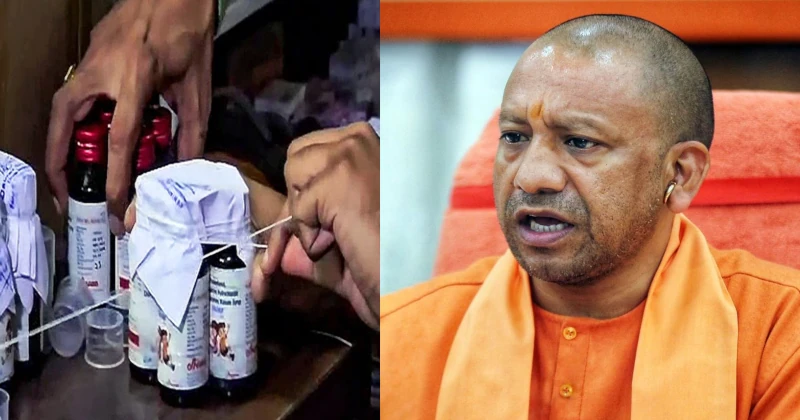
What started as a seemingly routine raid on illegally stocked cough syrup in Lucknow has evolved into one of the most extensive drug crackdowns in India’s recent history, exposing a multi-layered, cross-border codeine syndicate valued at over Rs 425 crore, with tentacles stretching from 28 districts of Uttar Pradesh to Nepal, Bangladesh, Pakistan, and Dubai. The investigation, carried out under the direct supervision of Chief Minister Yogi Adityanath, has not only dismantled a powerful drug mafia but also opened disturbing leads pointing towards money laundering, political patronage, and terror funding.
At the centre of the racket was the systematic misuse of codeine-based cough syrups such as Phensedyl legally manufactured medicines that were deliberately diverted from pharmaceutical supply chains and transformed into cheap narcotics, poisoning thousands of young people across northern and eastern India and neighbouring countries.
Codeine is an opium derivative commonly prescribed to suppress severe cough. In controlled doses, it is medically useful. But when misused, it produces sedative and euphoric effects similar to heroin or opium. Investigators note that just 10 ml of codeine in 100 ml of syrup can trigger addiction, making it a preferred “soft drug” among traffickers due to its low cost and easy concealment.
Over the past decade, codeine syrups have increasingly emerged as a substitute for alcohol and narcotics, especially in border regions and areas with strict alcohol restrictions. The UP investigation has now revealed how this abuse was industrialised into a well-oiled criminal enterprise.
The case dates back to February 2024, when the Uttar Pradesh Special Task Force (STF) raided a premises in Sushant Golf City, Lucknow, acting on intelligence about illegal storage of Phensedyl. The raid uncovered:
- Large quantities of codeine-based syrup
- Forged purchase and transport documents
- Fake billing records
An FIR was registered under the NDPS Act, 1985 and the Indian Penal Code, and Chief Minister Yogi Adityanath issued unequivocal instructions:
“No leniency. Expose every link financial, political, and international.”
The Food Safety and Drug Administration (FSDA) was roped in, and what followed was a year-long forensic investigation that would eventually shake powerful interests.
Investigators discovered that the syndicate was built on the misuse of licensed super-stockist firms, which were legally authorised to procure huge quantities of medicines. These firms:
- Purchased codeine syrups in bulk from manufacturers
- Diverted them to shell companies and fake distributors
- Generated bogus invoices to mask illegal sales
- Sold the syrup as an intoxicant instead of medicine
The drugs moved through an elaborate logistics chain across UP, Bihar, Jharkhand, and West Bengal, before being smuggled into Nepal and Bangladesh, and onward to Pakistan and Gulf countries.
The illegal trade covered 28 districts of Uttar Pradesh, including Lucknow, Varanasi, Saharanpur, Bahraich, Jaunpur, Lakhimpur Kheri, and Ghaziabad, making it one of the largest pharmaceutical diversion rackets ever uncovered in the state.
A decisive breakthrough came on October 18, 2025, when the STF intercepted a truck in Sonbhadra district. The vehicle appeared to be carrying cartons of snack chips. On inspection, officers discovered:
- Thousands of bottles of codeine-based cough syrup
- An estimated value of Rs 3 crore
Three smugglers from Madhya Pradesh Hemant Pal, Brijmohan Shivhare, and Ramgopal Dhakad were arrested. Interrogation revealed that the consignment was headed towards Pakistan via Nepal. Within weeks, similar seizures in Jharkhand and Ranchi confirmed that the Sonbhadra truck was only a small fragment of a massive supply chain.
As agencies screened over 300 firms, one name repeatedly surfaced—Shubham Jaiswal, a native of Varanasi now residing in Dubai. Investigators identified him as the mastermind, operating the syndicate remotely.
Key developments followed:
- Amit Kumar Singh alias Amit Tata was arrested in Lucknow on November 27
- Digital devices recovered from him revealed transaction routes, encrypted communications, and supply maps
- Bhola Prasad Jaiswal, Shubham’s father and owner of Sally Traders, was arrested at Kolkata airport while attempting to flee to Thailand
The probe also revealed that the syndicate exploited legitimate supply chains of major pharmaceutical companies such as Laborate, 3B Healthcare, and Abbott, raising serious questions about regulatory oversight.
The investigation soon entered politically sensitive territory. The name of Alok Kumar Singh, a dismissed UP police constable, surfaced. ED officials were stunned by his 7,000 sq ft mansion, which far exceeded his known sources of income.
Photos of Alok Singh with Samajwadi Party chief Akhilesh Yadav began circulating widely. Social media was flooded with images linking accused individuals to SP leaders, including Rahul Yadav, a close associate of an SP MLA from Jaunpur.
Investigators have confirmed that many drug licences used in the racket were issued during the Samajwadi Party’s tenure, intensifying political controversy. While agencies have not officially named politicians as accused, they have not ruled out further action. At a joint press conference on 8 December, senior officials laid out the scale of the crackdown:
- 128 FIRs registered
- 280 drug licences cancelled
- 3.5 lakh vials seized
- 32 key accused arrested
- Estimated illegal trade value: Rs 425 crore, with the final figure likely to be much higher
The Enforcement Directorate has registered an ECIR against 67 accused, conducted raids at 25 locations across UP, Jharkhand, and Gujarat, and uncovered:
- 700 fake firms
- 220 individuals used as fronts
- Extensive money laundering under the Prevention of Money Laundering Act (PMLA)
Officials say the total laundering amount could run into thousands of crores. Perhaps the most disturbing revelation is the terror funding angle. ED investigations suggest that:
- Drug proceeds were routed through hawala networks
- Funds were moved via Bangladesh to Gulf countries
- Smugglers Asif and Wasim from Meerut played key roles in money movement
Investigators also found that codeine syrups were marketed as “halal intoxicants”, especially in regions where alcohol is prohibited. BSF seizures along the India–Bangladesh border further confirmed the nexus between cough syrup smuggling and anti-national networks.