NEW DELHI: Oman, an economic, energy and maritime bulwark of the gulf region. This gulf nation also acts as a pivotal partner for India across the strategic lexicon of the Indian Ocean to seek solid trade and investment opportunities, to harness energy potential and ultimately to carve a safe, secure and inclusive maritime corridor. India and Oman share historical and civilizational links. This age-old relation was revisited, revamped and upgraded during the recent visit of Prime Minister Narendra Modi to Muscat, in order to suit the demands of the 21st century world-order which is apparently witnessing a once-in-a-century transformation.
During the visit to the West Asian country, PM Modi reiterated that both nations are marking India-Oman Maitri Parv. The occasion is a testament to the cherished civilizational and historical partnership between New Delhi and Muscat. The moment also earmarked the commitment to further fortify the India-Oman strategic partnership for a prosperous future, asserted Prime Minister Modi. The India-Oman relations thus dates back to thousands of years, when there was a critical trade partnership between the Harappan and Sumerian civilization through the ancient maritime routes across the Arabian Sea. Thus, India and Oman cherish a lasting cultural imprint.
An enduring trade and energy partner post independence
The civilizational partnership between India and Oman continued in the post-independent era as well. The diplomatic relations were established in the year 1955 and was elevated into strategic partnership in 2008. For India, relations with Oman are hailed as the most stable and enduring partnership in West Asia amidst all geopolitical volatilities.
Oman is a key pillar for India in ensuring energy security. India is the second-largest market for Oman’s crude oil. India-Oman bilateral trade stands at USD 10.6 billion as of 2024-25. With an intention to further bolster this economic partnership, during the latest visit of PM Modi, New Delhi and Muscat inked the Comprehensive Economic Partnership Agreement(CEPA). This agreement aims to deepen the trade, investment and other commercial engagements between both countries. The agreement also aims to explore new avenues of trade and investment potential beyond traditional energy partnerships.
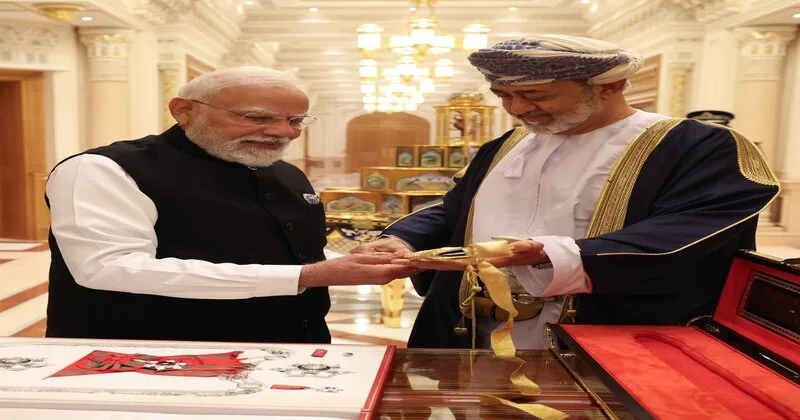
Addressing the Business Summit in Oman, Prime Minister Modi reiterated that New Delhi and Muscat have wide potential to harness opportunities in the domain of Fintech, education, technology, digital public infrastructure, space etc. He invited the youth of Oman to invest in these potential and futuristic sectors rendered by the vast Indian market. During the bilateral discussions between PM Modi and His Majesty Sultan Haitham bin Tarik, both leaders urged to strengthen cooperation in the domain of agriculture, fertilizers, energy critical minerals, healthcare as well.
Had an outstanding discussion with the Sultan of Oman, His Majesty Sultan Haitham bin Tarik. Appreciated his vision, which is powering Oman to new heights. Thanked him for his efforts that have ensured our nations sign the historic CEPA. It is indeed a new and golden chapter of… pic.twitter.com/bSapEwO8tT
— Narendra Modi (@narendramodi) December 18, 2025
As per the analysis by the experts, CEPA will drastically reduce or completely eliminate the tariffs on a wide range of Indian goods in the Oman market. It will ease the market access to the Indian commodities, facilitate ease-of-doing business and will catalyse more investment flows into India from Oman. Thus, the CEPA linked with Oman is a key pawn to India in the path of its economic diversification strategy. The agreement will indeed help to fill the economic gaps and the trade rifts created by the tariff tussle unleashed by the United States under the Trump administration. The agreement gives Indian exporters new and wider market opportunities across West Asia and beyond. The deal is said to be a boon especially for the small and medium traders of India who are struggling to cope up with the US tariffs.
Defence and maritime cooperation
Oman is also a key defence partner for India. The country is considered as one of the closest defence partners of India in the gulf region. As a reflection of the strong defence relations, Oman has offered logistics access to the Indian Navy in the port of Duqm, a critical sea lane in the northwestern Indian Ocean. Both nations also conduct military exercises such as Al Najah(Army Exercise) Eastern Bridge(Airforce Exercise) and Naseem Al Bahr(the Navy Exercise). The joint defence operations seek to gain edge and expertise in counter-terrorism and desert operations.
This deep-rooted defence partnership with Oman gives India a strategic edge and solid footprint in West Asia, specifically in the maritime corridor engulfing the gulf region, which is apparently a gateway for trade with West Asia and Europe at large. For example, Oman sits on the verge of Strait of Hormuz, a key strategic waterway connecting Persian Gulf and the Gulf of Oman. This narrow strip is deemed as the world’s most critical oil chokepoint with nearly 20 to 30 per cent of global oil and LNG supply passing through this. With respect to India’s energy imports, nearly 35-40 per cent of the country’s energy comes from the Strait of Hormuz. Thus, a strong strategic and defence partnership with Oman helps India ensure energy security and larger maritime safety, in an era where energy wars are common and maritime corridors are emerging as zones of geopolitical contestations.
Oman, hence, is a critical partner to orchestrate the strategic footprint of India in West Asia, gulf region and beyond. From investment, trade to energy credentials and to ensure maritime security of the Indian Ocean Region(IOR), Muscat is a valued, trusted and stable partner for New Delhi to manoeuvre the challenges of geopolitical crossroads of the current decade.