India and Oman are set to significantly deepen their economic partnership with the signing of a free trade agreement on December 18 in Muscat, in the presence of Prime Minister Narendra Modi. The agreement will be formalised during Modi’s visit to Oman, which comes after the completion of his tour of Jordan and Ethiopia. The trade pact, officially termed the Comprehensive Economic Partnership Agreement (CEPA), marks a major milestone in India–Oman relations. India’s Commerce and Industry Minister Piyush Goyal is already in Muscat for the signing ceremony, while Commerce Secretary Rajesh Agrawal is also scheduled to reach Oman, according to officials familiar with the development.
Formal negotiations for the CEPA began in November 2023, with both sides holding five rounds of in-person talks. The final round of negotiations took place in New Delhi in January this year, and the negotiations were concluded around August. The agreement is set to become Oman’s first free trade agreement with another country in nearly two decades. The CEPA aims to boost bilateral trade and investment flows, with a particular focus on expanding India’s export footprint in the Gulf nation. Oman is currently India’s third-largest export destination among Gulf Cooperation Council (GCC) countries, which include Bahrain, Kuwait, Saudi Arabia and Qatar. Indian exports to Oman exceed $3 billion and include a wide range of products that are expected to benefit from tariff elimination under the agreement.
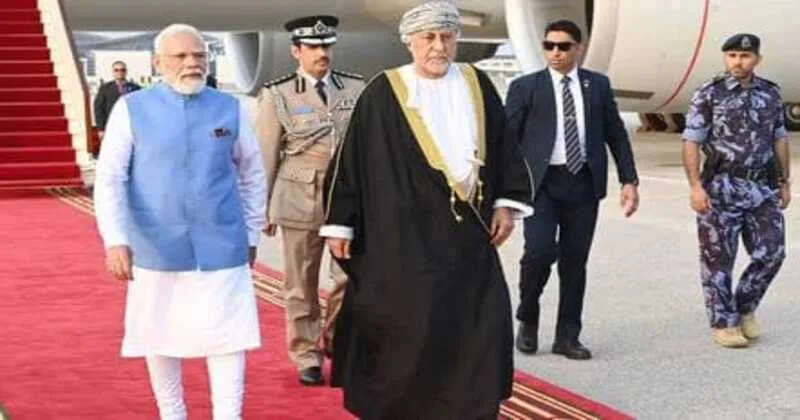
At present, around 83.5 per cent of Indian exports to Oman, valued at approximately $3.42 billion in FY25, face an average tariff of about 5 per cent. Once the CEPA comes into force, a large share of these exports is expected to become tariff-free, providing Indian exporters with improved market access and greater price competitiveness. Prime Minister Modi is scheduled to arrive in Muscat later in the day on the final leg of his three-nation tour. The trade agreement will be signed on the second day of his visit, underscoring the strategic importance both countries attach to economic cooperation.
Bilateral trade between India and Oman crossed the $10-billion mark in FY25, reflecting the steady expansion of commercial ties. However, the trade balance remains in Oman’s favour. India’s exports to Oman stood at $4.1 billion in FY25, while imports from Oman were valued at $6.6 billion. India’s export performance in recent years shows both resilience and untapped potential. Exports dipped slightly from $4.48 billion in FY23 to $4.43 billion in FY24, before easing further in FY25. Imports, on the other hand, jumped by nearly 45 per cent, driven by a sharp contraction in the previous year. Despite these trends, officials see significant headroom for India to expand exports in high-value sectors. Key export sectors poised to gain from the CEPA include engineering goods, automobiles, pharmaceuticals, food products, textiles, electronics and chemicals. While petroleum products remain India’s largest export item to Oman, valued at $1.43 billion and largely duty-free, other major sectors currently face tariffs that could be eliminated under the agreement.
Engineering goods, valued at $812.2 million, and chemicals worth $241.4 million are among the leading beneficiaries. Partially duty-bearing mineral exports such as mica, coal and other ores, which together accounted for $428.6 million, are also expected to gain from reduced tariff barriers. Labour-intensive sectors, particularly textiles, are seen as major winners under the trade pact. With Indian textile exports facing steep tariffs in the United States, the elimination of duties in the Omani market could provide an alternative growth avenue. In FY25, India exported ready-made garments worth $63.8 million to Oman, making it the largest item in the textiles category shipped to the Gulf nation.
Oman’s import duty structure currently ranges from zero to as high as 100 per cent, with especially steep tariffs imposed on certain meat products, wines and tobacco. The CEPA is expected to rationalise tariffs across a broad range of goods, though sensitive items are likely to remain protected. The India–Oman agreement follows India’s earlier CEPA with the United Arab Emirates, which was signed on February 18, 2022, and came into force on May 1, 2022. That agreement significantly boosted bilateral trade with the UAE and is widely viewed as a template for India’s engagement with other Gulf nations. Building on this momentum, India is also expected to soon begin trade negotiations with Qatar, which would make it the third GCC country to enter formal CEPA talks with New Delhi. Together, these agreements reflect India’s broader strategy to strengthen economic ties with the Gulf region and diversify its export markets amid shifting global trade dynamics.