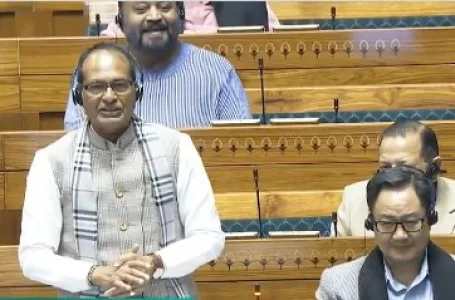
Union Minister for Rural Development and Agriculture & Farmers Welfare Shivraj Singh Chauhan on Tuesday formally introduced the Viksit Bharat-Guarantee for Rozgar and Ajeevika Mission (Gramin), or VB-G RAM G Bill, 2025, in the Lok Sabha. The Bill seeks to provide a legal guarantee of 125 days of wage employment every year to rural families, marking a significant expansion of employment assurance for India’s villages.
While presenting the Bill, Chauhan reiterated the government’s commitment to the welfare of the poor and the comprehensive development of rural India. He said the initiative aligns with the vision of Mahatma Gandhi, who emphasised self-reliant villages as the foundation of a strong nation. According to the minister, the Centre has committed more than Rs 95,000 crore towards implementing the proposed mission.
Beyond Employment: Focus on Holistic Village Development
Chauhan underlined that the proposed law goes beyond merely providing employment and is designed to ensure holistic village development. He said that earlier rural employment initiatives, including schemes such as the Jawahar Rozgar Yojana, had aimed to address joblessness but often suffered from uneven budgetary allocations and inconsistent implementation.
As a result, several gram panchayats remained underdeveloped despite the existence of welfare schemes. To correct this imbalance, the VB-G RAM G Bill proposes a system of grading panchayats based on development indicators. Under this approach, panchayats that are less developed or underperforming would be allocated more work and resources, ensuring targeted intervention where it is needed most.
The minister said this structured approach would help bridge development gaps between villages and ensure that public funds are directed towards regions that require greater support.
Enhancing Employment Guarantee from 100 to 125 Days
Drawing a comparison with the Mahatma Gandhi National Rural Employment Guarantee Act (MGNREGA), Chauhan highlighted that the previous UPA government had spent Rs 2.13 lakh crore on the scheme. In contrast, he said, the current government has spent over Rs 8.53 lakh crore on welfare schemes aimed at the poor, reflecting a stronger focus on social security and livelihood generation.
Under the new Bill, the employment guarantee would be enhanced from the existing 100 days to 125 days per year. Chauhan said this expanded guarantee would be backed by a financial provision exceeding Rs 1.51 lakh crore, underscoring the government’s commitment to making the scheme sustainable and effective.
He added that the increased number of guaranteed workdays would provide greater income stability to rural households, particularly those dependent on daily wages.
Balancing Agricultural and Labour Needs
Addressing concerns that employment guarantee schemes can sometimes affect labour availability for agriculture, Chauhan said the proposed initiative seeks to create a better balance between farm requirements and wage employment opportunities.
The minister noted that rural livelihoods are closely tied to agriculture and that any employment programme must complement, rather than disrupt, agricultural activity. The VB-G RAM G Bill, he said, has been designed keeping this balance in mind, so that farmers and agricultural operations are not adversely impacted while rural workers continue to receive assured employment.
Inspired by Integral Humanism Ideals
Chauhan said the Bill draws inspiration from the ideals of Mahatma Gandhi and Pandit Deendayal Upadhyaya. While Gandhi envisioned villages as self-sufficient units, Deendayal Upadhyaya’s philosophy of Integral Humanism emphasised uplifting the last person in society.
The minister said the proposed law reflects this approach by prioritising the welfare of the most backward and marginalised sections. He stressed that development should be inclusive and reach those who are often left out of economic progress.
According to Chauhan, the Bill includes specific provisions to ensure dignity through employment while offering additional protection to vulnerable sections of society. These include the differently-abled, elderly citizens, women, Scheduled Castes, and Scheduled Tribes.
He said the initiative is aimed at strengthening rural livelihoods by ensuring that employment opportunities are accessible, equitable, and sensitive to the needs of disadvantaged groups. By creating legal safeguards and structured implementation mechanisms, the government hopes to provide not just jobs, but also social security and dignity of labour.
A Step Towards Inclusive Growth
The minister described the VB-G RAM G Bill as a crucial step towards inclusive growth and accelerated rural development. He said that by combining guaranteed employment with village-level planning and targeted resource allocation, the Bill seeks to transform rural economies and improve living standards.
Chauhan added that the proposed legislation reflects the government’s broader vision of a “Viksit Bharat,” where development is not limited to urban centres but reaches the grassroots level. By empowering villages and strengthening local economies, the Bill aims to contribute to sustainable national growth.
With the introduction of the Bill in the Lok Sabha, it will now be taken up for further discussion and scrutiny. If enacted, the VB-G RAM G Bill, 2025, could mark a significant shift in India’s rural employment framework by expanding wage guarantees and linking employment generation with comprehensive village development.
As parliamentary debate unfolds, the proposed law is expected to remain at the centre of discussions on rural welfare, employment security, and the future direction of India’s development agenda.