For decades, Kerala’s political script was a closed loop: the UDF and LDF exchanging power, trading accusations, and rehearsing the same ideological theatre. But while this familiar binary dominated television screens and newspaper columns, something quieter, steadier, and far more consequential was taking shape beneath. For nearly half a century, the political history of Kerala has been written in binary code. The United Democratic Front (UDF) and the Left Democratic Front (LDF) have been the twin Suns of the state’s solar system, their gravitational pull so strong that no third force could sustain an orbit. Elections were predictable oscillations; if one front faltered, the other automatically rose.
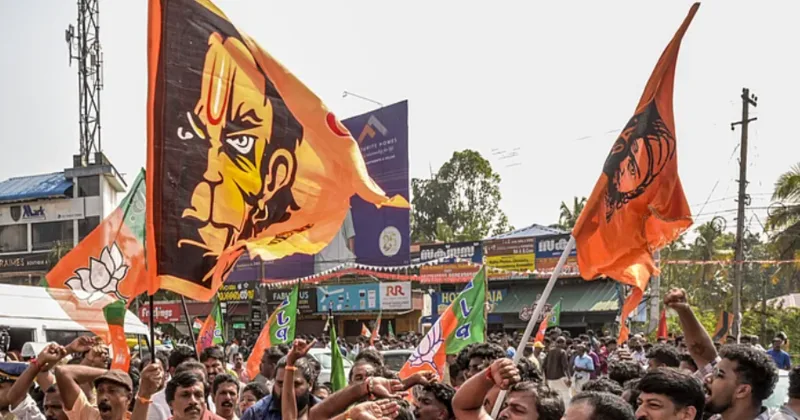
A saffron undercurrent, unknown to many and underestimated by most, had been gathering strength for years rooted in grassroots service, ideological clarity, and a patience that only comes from deep conviction. This was not a sudden wave but a slow, stubborn rise built by thousands of karyakartas who worked relentlessly across Kerala, ward by ward, booth by booth, street by street, often without reward, recognition, or protection. They were the first to arrive when floods struck, the ones who carried food to the elderly during crises, who mediated neighbourhood disputes, who taught children, who organised seva, and who quietly wove the BJP into the daily life of communities. Their work was not glamorous, nor was it safe. For decades, many of them operated in politically hostile terrain where their very presence invited violence. Numerous BJP and RSS workers were brutally attacked, hunted down, and killed by political rivals in a cycle of targeted violence that Kerala has yet to reckon with fully. Their names rarely made headlines, but their martyrdom, sons, fathers, brothers, breadwinners became the emotional backbone of the movement. Their sacrifices lived on in the resolve of their families, in the determination of their comrades, and in the unbroken spirit of an organisation that refused to retreat despite loss, grief, and intimidation.
Yet even as this vast grassroots effort unfolded, mainstream media often chose to look the other way. For years, television studios dominated by ideological bias sidelined the BJP’s growth, dismissing its expanding footprint as irrelevant. Anchors openly mocked representatives, laughed at the party’s prospects, and treated its rise as an unrealistic fantasy. Many times, even when BJP candidates won wards or emerged as the main opposition in panchayats, these victories were nullified in the narrative, reduced to footnotes or ignored altogether. The same media that amplified every misstep of the ruling fronts struggled to acknowledge the daily courage of workers who operated in danger, or the pain of mothers and wives who lost their loved ones to political violence. The trolling, the ridicule, the systematic belittling of the BJP’s presence created the illusion that the saffron movement had no space in Kerala, while on the ground, karyakartas were walking miles each day, deepening their presence through service and sacrifice.
And so, the undercurrent continued, unseen by newsrooms, unfelt by analysts, untouched by prime-time debates. It moved quietly, in the footsteps of the fallen, in the determination of the living, in the belief that conviction outlasts both mockery and violence. When the 2025 Panchayat election results finally arrived, this undercurrent did not simply appear; it surged into view, reshaping Kerala’s political map and overturning long-held assumptions from Thiruvananthapuram to Ernakulam. What emerged was not merely an electoral performance but the recognition of a movement built on blood, belief, and tireless devotion, a force that grew despite ridicule, despite intimidation, despite martyrdom, and despite being rendered invisible by those who claimed to narrate Kerala’s politics.
A central force driving the BJP’s transformation in Kerala was unquestionably the cohesive and forward-looking leadership at the helm of the state unit, spearheaded by Shri Rajeev Chandrasekhar. Taking over as State President of the BJP in Kerala in March 2025, Chandrasekhar brought to the table a combination of technocratic discipline, entrepreneurial insight and a development-first political narrative that was markedly different from the usual ideological rhetoric of Kerala politics.
Drawing on his background as a successful entrepreneur and technologist, Chandrasekhar set out early in the campaign to frame the 2025 local body elections as a referendum on “Vikasita Keralam”—a vision of a modern, economically progressive state characterised by job creation, innovation, transparent governance and sustainable infrastructure. Well ahead of voting, he activated a 100-day election countdown across district party offices, urging workers to turn their energy towards pragmatic local issues like water supply, road connectivity and public services while linking them to a larger narrative of economic opportunity.
Chandrasekhar’s rhetoric in speeches and public appearances consistently echoed a development agenda. He argued that Kerala needed to move away from “nostalgic politics” that focused on controversy and blame, and towards a politics that prioritised investment, employment, education and quality of life for all communities. He explicitly positioned the BJP as a party capable of bridging aspirations with actionable governance, urging voters to consider how local governance can be a catalyst for economic growth rather than mere ideological contestation. In public addresses across the state, including statements urging people to vote in large numbers to fix everyday issues at the grassroots level, Chandrasekhar emphasised that local elections were not just administrative exercises but opportunities to “fix potholes, improve schools and deliver basic services efficiently,” thereby linking microscopic civic concerns to macroeconomic development goals.
Beyond speeches, he also pushed organisational initiatives such as help desks to ensure that central development schemes reached villagers effectively, reinforcing the BJP’s message of service and delivery over rhetoric. The narrative of “Vikasita Keralam” resonated particularly with youth, middle-class families, first-time voters and long-standing non-aligned citizens who had grown weary of perpetual ideological clashes and wanted tangible improvements in infrastructure, jobs and civic life. Importantly, this agenda did not arise from rhetoric alone, candidates and local leaders were trained to speak the same language of development when interacting with voters, ensuring that the party’s grassroots machinery, district teams, booth workers, and volunteers all articulated a unified, future-forward vision: Kerala must move forward.
Nowhere was the force of this narrative more visible than in Thiruvananthapuram, where the BJP executed the most dramatic political breakthrough in Kerala’s modern history. By capturing the Thiruvananthapuram Corporation and ending four decades of unbroken Left control, the party delivered a psychological and structural shock to the state’s political establishment. This urban victory was bolstered by the BJP’s rise across the district’s rural belt, where it emerged as a decisive force in twenty-two Gram Panchayats and three Block Panchayats, consistently acting as either the ruling bloc or the principal opposition.
Many of these panchayat battles were decided by razor-thin margins, some by as little as 20-50 votes, demonstrating how deeply the saffron undercurrent had infiltrated the capital’s political landscape. A similar shift unfolded in Kollam; a district long seen as a Left stronghold. The BJP’s twelve seats in the Kollam Corporation marked a historic milestone, signalling its emergence as a credible urban force.
At the same time, the BJP expanded its influence into rural Kollam, where it became a central player in twenty-two Gram Panchayats and two Block Panchayaths, often finishing as the main opposition or a tie-break power. The pattern across these wards reflected not isolated pockets of support but a district-wide reconfiguration, with saffron votes rising sharply in coastal communities, semi-urban belts, and hinterland panchayats.
In Pathanamthitta, the BJP’s rise continued with ten Gram Panchayats showing significant saffron presence, even as the party narrowly missed retaining power in Pandalam Municipality. The tight margins in multiple wards illustrated a district in transition, one where ideological loyalty was giving way to performance-centric expectations. Many panchayat results here turned on a handful of votes, underscoring how Chandrasekhar’s development narrative resonated with families seeking transparency, investment, and stability.
The most stunning breach, however, came in Alappuzha, where the BJP disrupted decades of Left dominance. By winning five seats in the Alappuzha Municipality and establishing itself as a decisive force in twenty-five Gram Panchayats and two Block Panchayaths, the BJP achieved what was once considered impossible in Kerala’s Marxist heartland.
What made this breakthrough remarkable was its geographic spread; the BJP did not win isolated pockets but gained traction across fishing villages, SC colonies, agricultural interiors, and semi-urban clusters. The party lost dozens of wards by painfully narrow margins, revealing that the district’s political equilibrium is undergoing a historic shift.
In Kottayam, the saffron undercurrent took a quieter but equally significant form. The BJP rose as a major challenger in nine Gram Panchayats, often emerging as the main opposition or finishing within a single seat of victory. For a district shaped by Christian political institutions and long resistant to saffron politics, this evolution marks a meaningful ideological opening, driven in part by steady engagement through development arguments rather than adversarial posturing.
Central Kerala’s commercial hub, Ernakulam, added a strategic triumph to the saffron ledger. The BJP became the single largest party in Thrippunithura Municipality, a symbolic and administrative milestone that reflects the party’s growing appeal among urban professionals, entrepreneurs, and middle-class households. The party also strengthened its foothold in Vadakkekara Panchayat, where its enhanced representation ensured real influence in local governance.
Several other panchayats across the district saw the BJP becoming the main opposition, confirming a broader shift in Central Kerala’s political tide. Even the hill district of Idukki, with its complex geography and dispersed population, was not immune to the saffron undercurrent. In Upputhara Panchayat, the BJP reached parity in a tied council, marking a symbolic breakthrough in territory once considered unreachable. This foothold, though small on paper, reflects an expanding ideological reach into Kerala’s high ranges.
Beneath these electoral results lies the machinery that powered the undercurrent: the RSS, functioning as the organisational bloodstream of the movement. For decades, the Sangh built social capital across Kerala through seva, cultural work, educational outreach, and disaster response. It created relationships that politics alone could not forge, making communities familiar with its ethos long before they cast their votes for the BJP. The RSS served as the fuelling machinery, quiet, consistent, and deeply rooted.
And tying leadership, vision and organisation together were the BJP’s karyakarthas, whose day-to-day dedication made this undercurrent possible. They walked through villages, engaged households, mediated disputes, participated in festivals, helped during crises, and fashioned a neighbourhood-level presence unmatched by any other political party. Their work ensured that Chandrasekhar’s development narrative was not merely spoken, but lived.
Taken together, the rise of the saffron undercurrent across these seven districts represents not an electoral moment but a structural shift. With influence in three Block Panchayaths in Thiruvananthapuram, two in Kollam, two in Alappuzha, decisive presence in more than eighty Gram Panchayats state-wide, and significant victories in Thrippunithura and Alappuzha Municipality, the BJP is no longer a peripheral voice but a principal stakeholder in Kerala’s governance landscape.
The saffron undercurrent did not erupt suddenly; it rose like a shift in tectonic plates, silent, steady, and powerful enough to alter the landscape long before the old establishment realised the ground had already moved. It grew in the same manner India’s own political transformation unfolded under the BJP at the Centre: through consistency, governance, accountability, and a relentless commitment to development over drama. Just as the national narrative under Prime Minister Narendra Modi emphasised “sabka saath, sabka vikas, sabka vishwas”, the undercurrent in Kerala drew strength from the belief that politics must deliver results, not rhetoric. It was the trust the people placed in a party that promised not only economic upliftment but also a sense of security, stability and direction values that had defined the BJP at the national level.
For many Keralites, especially the youth and first-time voters, this undercurrent became a reflection of the larger BJP governance model they watched unfold across India: an insistence on infrastructure-led growth, a focus on jobs and innovation, digital empowerment that touched every home, and a foreign policy that elevated India’s stature globally. This created a psychological shift in Kerala’s electorate, a sense that if these changes were possible for the country, they were possible for the state too. That belief, that trust, became the invisible force powering the saffron rise. The BJP in Kerala did not ask voters to abandon their past; it asked them to imagine their future. It offered the promise of development with accountability, of governance with transparency, of society with security, and of politics with purpose, echoing the central government’s narrative of transforming India into a confident, modern nation.
Thus, when the saffron undercurrent surfaced in the 2025 Panchayat elections, it was not merely an electoral shift; it was the expression of a deeper faith that Kerala, too, could move forward, break free from outdated binaries, and embrace a political culture defined by progress rather than stagnation. It was the people’s trust that the BJP would bring development to their streets, safety to their communities, dignity to their aspirations, and a sense of belonging in a national journey of growth. And that quiet, accumulating trust, layered year after year, was what ultimately reshaped Kerala’s political map long before many realised a new era had already begun.