Govt steps up drive for edible oil Atmanirbharta; Oil palm acreage hits 6.20 lakh hectares under NMEO
September 1, 2026
  • Read Ecopy
  • Circulation
  • Advertise
  • Careers
  • About Us
  • Contact Us
Android AppiPhone AppArattai
Organiser
  • ‌
  • Bharat
    • Assam
    • Bihar
    • Chhattisgarh
    • Jharkhand
    • Maharashtra
    • View All States
  • World
    • Asia
    • Europe
    • North America
    • South America
    • Africa
    • Australia
  • Editorial
  • International
  • Opinion
  • RSS @ 100
  • More
    • Op Sindoor
    • Analysis
    • Sports
    • Defence
    • Politics
    • Business
    • Economy
    • Culture
    • Special Report
    • Sci & Tech
    • Entertainment
    • G20
    • Azadi Ka Amrit Mahotsav
    • Vocal4Local
    • Web Stories
    • Education
    • Employment
    • Books
    • Interviews
    • Travel
    • Law
    • Health
    • Obituary
  • Subscribe
    • Subscribe Print Edition
    • Subscribe Ecopy
    • Read Ecopy
  • ‌
  • Bharat
    • Assam
    • Bihar
    • Chhattisgarh
    • Jharkhand
    • Maharashtra
    • View All States
  • World
    • Asia
    • Europe
    • North America
    • South America
    • Africa
    • Australia
  • Editorial
  • International
  • Opinion
  • RSS @ 100
  • More
    • Op Sindoor
    • Analysis
    • Sports
    • Defence
    • Politics
    • Business
    • Economy
    • Culture
    • Special Report
    • Sci & Tech
    • Entertainment
    • G20
    • Azadi Ka Amrit Mahotsav
    • Vocal4Local
    • Web Stories
    • Education
    • Employment
    • Books
    • Interviews
    • Travel
    • Law
    • Health
    • Obituary
  • Subscribe
    • Subscribe Print Edition
    • Subscribe Ecopy
    • Read Ecopy
Organiser
  • Home
  • Bharat
  • World
  • Operation Sindoor
  • Editorial
  • Analysis
  • Opinion
  • Culture
  • Defence
  • International Edition
  • RSS @ 100
  • Magazine
  • Read Ecopy
Home Bharat

Govt steps up drive for edible oil Atmanirbharta; Oil palm acreage hits 6.20 lakh hectares under NMEO

India’s campaign to cut dependence on edible oil imports has gathered significant pace under the National Mission on Edible Oils (NMEO), with substantial gains in both oil palm expansion and oilseed productivity. Government data shows steady progress toward boosting domestic output and strengthening farmers’ resilience

Shashank Kumar DwivediShashank Kumar Dwivedi
Dec 9, 2025, 01:00 pm IST
inBharat
Follow on Google News
A representative image

A representative image

Facebook
Twitter
WhatsAppTelegramEmail

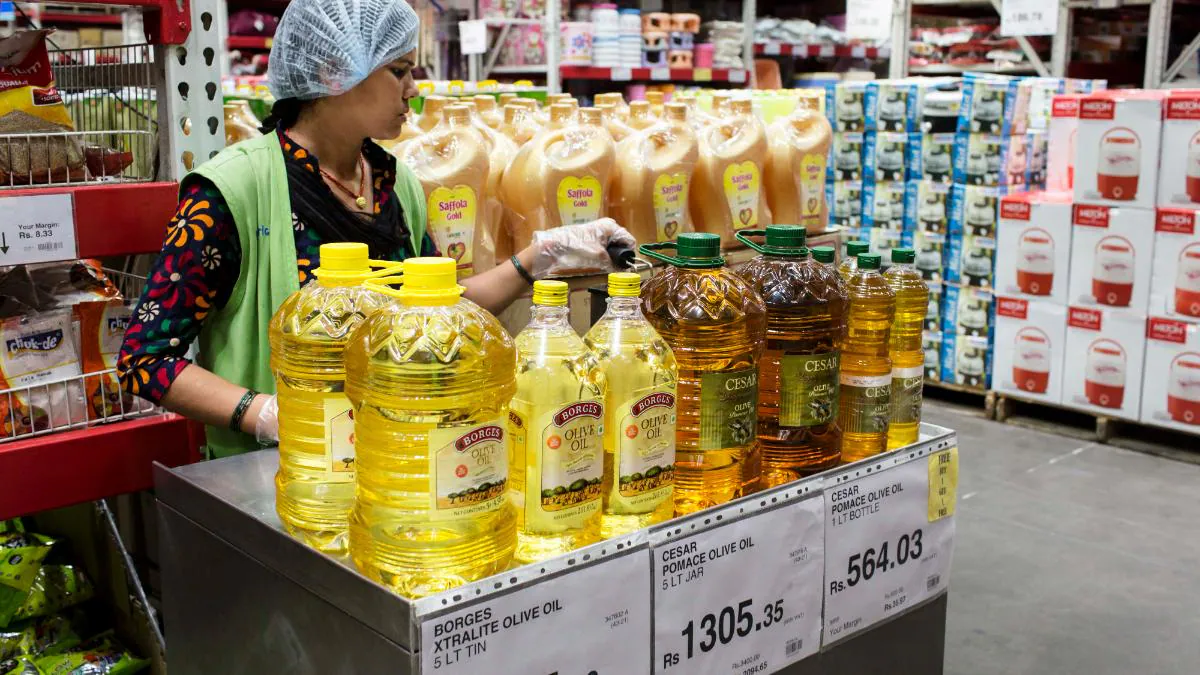
The central government has intensified efforts to achieve long-term edible oil self-reliance with notable progress reported under the National Mission on Edible Oils (NMEO). The mission, which spans oil palm and oilseed development, is emerging as a critical pillar in India’s strategy to reduce its heavy reliance on imports and boost domestic production through scientific interventions, policy support, and expanded cultivation.

An August 2024 report by NITI Aayog highlighted that India ranks first globally in the production of rice bran oil, castor seed, safflower, sesame and niger. Yet, despite these achievements, the country still produces only 44 percent of the edible oil it consumes, underscoring the urgency of the NMEO’s interventions.

Oil Palm Mission Achieves Major Breakthroughs

The NMEO-Oil Palm (OP), launched in 2021, has emerged as a flagship initiative to expand oil palm cultivation in suitable agro-climatic regions. The mission aims to bring 6.5 lakh hectares under oil palm by 2025-26.

As of November 2025, it has added 2.50 lakh hectares, taking the total coverage to 6.20 lakh hectares nationwide. This marks one of the fastest expansions in oil palm acreage in India’s agricultural history.

The impact is visible in production trends:

Crude Palm Oil (CPO) output has nearly doubled in a decade, rising from 1.91 lakh tonnes in 2014-15 to 3.80 lakh tonnes in 2024-25.
Farmers are being shielded from international market fluctuations through a Viability Price (VP) mechanism for Fresh Fruit Bunches (FFBs), ensuring stable income despite volatile CPO prices.
A financial outlay of Rs 11,040 crore has been reserved for the mission, focusing on:

Developing seed gardens and certified nurseries
Promoting high-yield planting material
Expanding drip irrigation systems
Supporting intercropping during the long gestation period of oil palm
Officials say these interventions are aimed at ensuring both sustainability and profitability for farmers venturing into oil palm cultivation.

Oilseeds Mission Targets 69.7 Million Tonnes by 2030-31

The second component of the mission, NMEO-Oilseeds (OS), was approved in 2024 for a seven-year duration. It aims to dramatically scale up the production of primary oilseeds, from 39 million tonnes in 2022-23 to 69.7 million tonnes by 2030-31.

Key interventions under NMEO-OS include:

Expanding oilseed acreage to 33 million hectares
Strengthening seed systems through cluster-based models
Establishing 600+ value-chain clusters covering over 10 lakh hectares annually
Providing farmers free high-quality seeds
Offering training on good agricultural practices
Supporting post-harvest and primary processing infrastructure
The government also plans to bring an additional 40 lakh hectares under oilseed cultivation, primarily through fallow land utilisation and intercropping systems. Combined with NMEO-OP, these measures are expected to raise India’s domestic edible oil production to 25.45 million tonnes by 2030-31, meeting 72 percent of the projected demand.

Addressing Import Dependence Through Policy

India’s edible oil consumption has grown sharply over the years. Between 2004-05 and 2022-23:

  • Per capita intake rose 83.68 percent in rural areas
  • And 48.74 percent in urban areas
  • Despite increased domestic output, India produced 12.18 million tonnes of edible oils in 2023-24
  • but imported 15.66 million tonnes to meet the remaining demand.

However, import dependence has shown a clear downward trend, from 63.2 percent in 2015-16 to 56.25 percent in 2023-24. This improvement is attributed to:

  • Higher Minimum Support Prices (MSPs) for major oilseeds
  • Increased domestic cultivation
  • Strategic policy interventions
  • Higher effective customs duties imposed on crude and refined edible oil to protect Indian farmers
  • Officials say the NMEO is central to India’s goal of insulating the domestic market from global price instability and strengthening farmer incomes.

Research, Innovation and Seed Development

Scientific innovation remains at the heart of the edible oil self-reliance push. The Indian Council of Agricultural Research (ICAR) is leading the development of high-yielding, climate-resilient oilseed varieties through coordinated breeding programmes.

Between 2014 and 2025, ICAR has released 432 improved varieties and hybrids, significantly boosting productivity across oilseed crops.

Two digital platforms are playing a transformative role:

SATHI seed traceability portal, ensuring transparency and quality assurance in seed distribution
Krishi Mapper platform, enabling real-time monitoring of mission progress, crop patterns and seed planning
These tools are helping streamline mission implementation and ensure that farmers have access to verified, high-performing seed varieties.

With the NMEO’s twin focus on oil palm expansion and oilseed productivity, the government is pushing toward a future where India can significantly reduce its edible oil import burden. The mission’s progress, reflected in expanding acreage, rising output and improved farmer safeguards, signals a decisive shift toward agricultural self-reliance and long-term food security.


Topics: Edible Oil ImportsCPO ProductionViability PriceNITI AayogSelf RelianceICAROilseedsNMEO
Share
Tweet
SendShareSend
✮ Subscribe Organiser YouTube Channel. ✮
✮ Join Organiser's WhatsApp channel for Nationalist views beyond the news. ✮
Previous News

‘Rs 500 crore suitcase for CM post’: Navjot Kaur Sidhu tears open the deep-rooted rot of Congress

Next News

Sanskrit teachings on Doordarshan’s Suprabhatam inspire modern India: PM Narendra Modi

Related News

SMILE Scheme: Centre’s big push for ‘BhikshaVrittiMukt Bharat’ as 12,710 persons rehabilitated

Ayurveda is rapidly emerging as one of India's strongest tools of global health diplomacy and soft power

From Jamnagar to the World: How Ayurveda is transforming India’s global health diplomacy and soft power

Odisha CM Mohan Charan Majhi

NITI Aayog’s IFI 2026: Odisha emerges as a leading investment destination, ranks among India’s top five states

India's BioE3 Policy aims to build a $2.6 trillion bioeconomy by 2047 through biotechnology-driven innovation, jobs and growth

India’s Bioeconomy Revolution: How NITI Aayog’s roadmap seeks to make the country a global biotechnology leader by 2047

How E20 vision is powering India’s journey towards energy independence

India's Ayush exports doubled to USD 2.16 billion in a decade, with NITI Aayog charting Ayurveda's global expansion

Ayurveda Export Decade: How India doubled Ayush exports to USD 2.16 billion and reached 150 countries

Load More

Latest News

Pakistan Human Rights Commission questions credibility of PoJK elections

Pakistan Human Rights Commission questions credibility of PoJK elections; Exposes lethal force used against protestors

Bengaluru police send Bangladeshi nationals to Malda for deportation

Karnataka | Operation Muktha: 31 Bangladesh nationals sent to Malda from Bengaluru for deportation

Chandrababu dressed as Mahabali (Image Courtesy- Manoramanews

Keralam: Chandrababu, dressed as “Mahabali”, attacked by Ashraf with boiling oil after wishing ‘Happy Onam’

Prime Minister Narendra Modi addressing public in Jalandhar, Punjab in July 2026

Punjab Assembly Polls: Gearing up for the bordering state

“India’s spiritual values and unity in diversity show the way to the world”: Jason Kenney at Hindu Vishwa Bandhu Event

PM Modi held bilateral discussions with Iran President Masoud Pezeshkian on the sidelines of the SCO Summit

SCO Summit: PM Modi meets Iran President; Reaffirms regional stability & freedom of navigation for global security

PM addressing the gathering at the Economic Times World Leaders Forum – 2026 held, in New Delhi on August 21, 2026.

PLP to PLI: From restrictive quota to proactive incentives

Drug supply chain must be dismantled; AAP has failed in delivering the promise in Punjab: Dr Vikramjit Singh Sahney

Vande Mataram: Pandit Paluskar ji, still alive

Rahul Gandhi’s ‘Patriarchy’ Politics Faces a Test in Kerala Over Muslim Women’s Public Participation

Rahul Gandhi sees patriarchy in Hindutva, but remains silent on Islam: What does the Keralam directive on women reveal?

Load More
  • Privacy
  • Terms
  • Cookie Policy
  • Refund and Cancellation
  • Delivery and Shipping

© Bharat Prakashan (Delhi) Limited.
Tech-enabled by Ananthapuri Technologies

  • Home
  • Search Organiser
  • Bharat
    • Assam
    • Bihar
    • Chhattisgarh
    • Jharkhand
    • Maharashtra
    • View All States
  • World
    • Asia
    • Africa
    • North America
    • South America
    • Europe
    • Australia
  • Editorial
  • Operation Sindoor
  • Opinion
  • Analysis
  • Defence
  • Culture
  • Sports
  • Business
  • RSS @ 100
  • Entertainment
  • More ..
    • Sci & Tech
    • Vocal4Local
    • Special Report
    • Education
    • Employment
    • Books
    • Interviews
    • Travel
    • Health
    • Politics
    • Law
    • Economy
    • Obituary
  • Subscribe Magazine
  • Read Ecopy
  • Advertise
  • Circulation
  • Careers
  • About Us
  • Contact Us
  • Policies & Terms
    • Privacy Policy
    • Cookie Policy
    • Refund and Cancellation
    • Terms of Use

© Bharat Prakashan (Delhi) Limited.
Tech-enabled by Ananthapuri Technologies