Trump administration names India key US security partner
September 13, 2026
  • Read Ecopy
  • Circulation
  • Advertise
  • Careers
  • About Us
  • Contact Us
Android AppiPhone AppArattai
Organiser
  • ‌
  • Bharat
    • Assam
    • Bihar
    • Chhattisgarh
    • Jharkhand
    • Maharashtra
    • View All States
  • World
    • Asia
    • Europe
    • North America
    • South America
    • Africa
    • Australia
  • Editorial
  • International
  • Opinion
  • RSS @ 100
  • More
    • World Hindu Congress 2026
    • Op Sindoor
    • Analysis
    • Sports
    • Defence
    • Politics
    • Business
    • Economy
    • Culture
    • Special Report
    • Sci & Tech
    • Entertainment
    • G20
    • Azadi Ka Amrit Mahotsav
    • Vocal4Local
    • Web Stories
    • Education
    • Employment
    • Books
    • Interviews
    • Travel
    • Law
    • Health
    • Obituary
  • Subscribe
    • Subscribe Print Edition
    • Subscribe Ecopy
    • Read Ecopy
  • ‌
  • Bharat
    • Assam
    • Bihar
    • Chhattisgarh
    • Jharkhand
    • Maharashtra
    • View All States
  • World
    • Asia
    • Europe
    • North America
    • South America
    • Africa
    • Australia
  • Editorial
  • International
  • Opinion
  • RSS @ 100
  • More
    • World Hindu Congress 2026
    • Op Sindoor
    • Analysis
    • Sports
    • Defence
    • Politics
    • Business
    • Economy
    • Culture
    • Special Report
    • Sci & Tech
    • Entertainment
    • G20
    • Azadi Ka Amrit Mahotsav
    • Vocal4Local
    • Web Stories
    • Education
    • Employment
    • Books
    • Interviews
    • Travel
    • Law
    • Health
    • Obituary
  • Subscribe
    • Subscribe Print Edition
    • Subscribe Ecopy
    • Read Ecopy
Organiser
  • Home
  • Bharat
  • World
  • Operation Sindoor
  • Editorial
  • Analysis
  • Opinion
  • Culture
  • Defence
  • International Edition
  • RSS @ 100
  • Magazine
  • Read Ecopy
Home Bharat

Trump administration elevates India as key partner in new US National Security Strategy

The Trump administration has elevated India’s role in its new National Security Strategy, signalling a sharper push to deepen economic, technological and defence ties with New Delhi. The document places India at the heart of Washington’s Indo-Pacific ambitions amid intensifying global competition

Dr Vishnu AravindDr Vishnu Aravind
Dec 6, 2025, 01:30 pm IST
inBharat, USA, World, International Edition
Follow on Google News
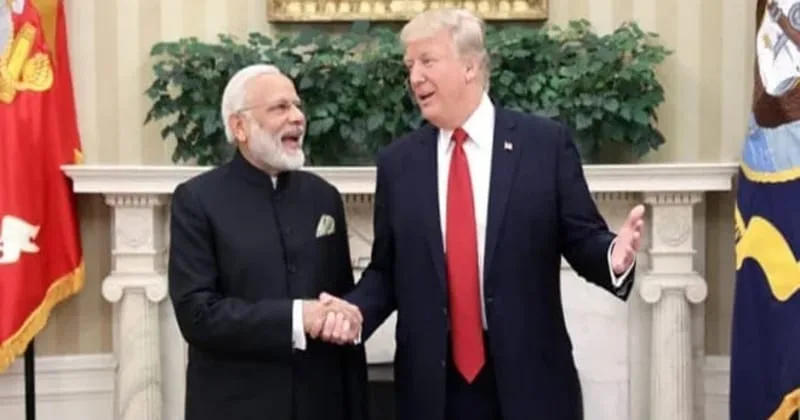
Prime Minister Narendra Modi and the US President Donald Trump

Prime Minister Narendra Modi and the US President Donald Trump

Facebook
Twitter
WhatsAppTelegramEmail

The Trump administration has cast India as a central pillar of its newly released National Security Strategy, underlining Washington’s intent to expand cooperation with New Delhi in economic, technological and defence domains.

The strategy document, issued by the White House, highlights India’s growing importance in US foreign policy and signals a stronger diplomatic focus on advancing bilateral commercial ties. It urges closer economic engagement and encourages India to play a more active role in maintaining stability in the Indo-Pacific through continued participation in the Quadrilateral Security Dialogue alongside Australia, Japan and the United States. The document underscores the view in Washington that strengthening relations with India is essential to advancing US interests in the region.

The Indo-Pacific is described as a region of exceptional global significance, already accounting for nearly half of worldwide economic output and expected to be a major centre of geopolitical and economic competition in the century ahead. Against this backdrop, the strategy outlines a plan for the United States to work closely with treaty allies and strategic partners whose combined economic weight is estimated at around $65 trillion. This coalition is seen as a counterweight to what the administration characterises as unfair and coercive economic behaviour in the region.

India figures prominently in this broader strategy due to its expanding economy, strategic geography and growing global profile. The administration places particular emphasis on deepening cooperation in advanced and emerging technologies, identifying areas such as artificial intelligence, quantum computing and defence-related innovation as key pillars of future engagement. These sectors are viewed as critical not only for economic competitiveness but also for long-term security. The document reiterates strong US support for quadrilateral cooperation under the Quad framework, portraying it as a vital diplomatic and security mechanism in the Indo-Pacific. Washington sees the grouping as central to maintaining stability in the region, safeguarding open sea lanes and ensuring freedom of navigation in strategically important waters.

Also Read: Gujarat ATS dismantles spy network involving Ex-Army personnel and woman for sharing information with Pakistan

On the military front, the strategy sets out plans to develop forces capable of deterring or blocking hostile actions across the First Island Chain. It simultaneously calls on allies and partners to take on greater responsibility for collective defence, both in terms of financial contributions and operational commitments. Regional flashpoints such as Taiwan and the South China Sea are highlighted as issues of major concern, particularly given the volume of global trade that transits these waters each year. Branded under the title “America First,” the new National Security Strategy reflects a shift from approaches adopted by previous administrations. It stresses a more interest-driven and transactional form of engagement, prioritising practical outcomes over ideological alignment. In this context, India is portrayed as well placed, as the strategy downplays efforts to push political or social reform in partner countries and instead focuses on cooperation based on shared objectives and reciprocal gains.

Economically, the strategy presents rivalry with China as a contest over supply chains, critical minerals and leading-edge technologies, including artificial intelligence, biotechnology and quantum systems. Allies and partners are encouraged to align with US-led standards and regulatory controls. At the same time, the emphasis on balanced trade and domestic reindustrialisation sits uneasily alongside recent tariff hikes and trade pressures directed at Indian exports and energy relations with Russia.



Topics: US-China rivalryUS National Security StrategyTrump Administration Foreign Policydefence cooperationindia us relationsIndo-Pacific strategy
Dr Vishnu Aravind
Dr Vishnu Aravind
Dr Vishnu Aravind is a researcher, political commentator and writer based in New Delhi, with a PhD from Jawaharlal Nehru University (JNU). His areas of interest include international politics, Indian foreign policy, electoral politics, election analysis, political developments, and cultural affairs. [Read more]
Share
Tweet
SendShareSend
✮ Subscribe Organiser YouTube Channel. ✮
✮ Join Organiser's WhatsApp channel for Nationalist views beyond the news. ✮
Previous News

“We can increase trade volume to $100 billion by 2030”: President Putin at India-Russia business forum

Next News

Supreme Court upholds Kerala High Court order directing Cooperative Banks to return Thirunelly Mandir deposits

Related News

US Ambassador to India Sergio Gor speaks to the media as he arrives at the residence of J&K CM Omar Abdullah, in Srinagar on August 19, 2026

US Envoy Sergio Gor calls J&K an “Important Part of India”; Islamabad protests as Pakistan suffers diplomatic setback

Indian Billionaire Gautam Adani

US Court dismisses criminal case against Gautam Adani, Judge questions Justice Department’s decision to drop charges

Despite so many efforts, the US-Iran war does not seem to end

The retreat of the global guarantor

The Indian Ocean remains the enduring foundation of the India-US strategic partnership, according to Italy's ISPI

China Isn’t the Real Driver: Indian Ocean keeps India-US strategic partnership strong, says report

Prime Minister Narendra Modi

Indonesia, Australia and New Zealand: What PM Modi’s Indo-Pacific tour means for India’s strategic future

PM Modi attended the National Day celebrations marking the 50th anniversary of Seychelles’ Independence as the Guest of Honour

PM Modi in Seychelles 50th National Day as Guest of Honour; Indian Army marches, reflecting stronger security ties

Load More

Latest News

Exterior of the Lokayukta Building

Karnataka Lokayukta records 1,248 cases in four years, 887 linked to bribery

RSS Akhil Bharatiya Karyakarini Sadasya Dr Manmohan Vaidya at a Pramukh Jan Samvad Sangosthi organised by Kashi Mahanagar on the occasion of the RSS Centenary Year,

Entire society must unite with a sense of oneness; This Is the spirit of Sangh Work: Dr Manmohan Vaidya

‘Samuel Could Never Do This’: Mother Rejects Blasphemy Allegations Against Son in Lahore

Pakistan Blasphemy Case: Mother of Christian man Samuel Arif claims false implication, seeks justice

Prime Minister Narendra Modi, along with Chinese President Xi Jinping, Russian President Vladimir Putin and other world leaders, poses for a picture at a joint tree plantation initiative during the BRICS Summit

BRICS Summit 2026: India as the voice of Global South, shared responsibilities & scripting inclusive world order

Chinese President Xi Jinping and Prime Minister Narendra Modi

BRICS Summit 2026: PM Modi hold talks with President Xi; Stresses border peace & tranquility as key to India-China ties

Tamil Nadu: Hindu Munnani flags TVK govt’s restrictions on Vinayaka pandals, barring women, children from processions

Lashkar-e-Toiba founder Hafiz Saeed. (File image)

J&K Terror Case: Hafiz Saeed gets second NBW; NIA says he operates from Pakistan

Pakistan’s push for a place in the expanding BRICS bloc faces a difficult diplomatic road ahead, despite backing from key partners.

Pakistan knocking BRICS Door: Why Islamabad’s 2023 membership bid remains elusive despite Chinese and Russian support

BRICS Bazaar

BRICS Bazaar: Global traditions and cultural diplomacy take center stage at New Delhi’s National Crafts Museum

(From Left to Right): Russian President Vladimir Putin, PM Modi & Chinese President Xi Jinping

BRICS New Delhi Declaration | Key Takeaways: Cross-border payment, counter-terrorism to tech ties & supply resilience

Load More
  • Privacy
  • Terms
  • Cookie Policy
  • Refund and Cancellation
  • Delivery and Shipping

© Bharat Prakashan (Delhi) Limited.
Tech-enabled by Ananthapuri Technologies

  • Home
  • Search Organiser
  • Bharat
    • Assam
    • Bihar
    • Chhattisgarh
    • Jharkhand
    • Maharashtra
    • View All States
  • World
    • Asia
    • Africa
    • North America
    • South America
    • Europe
    • Australia
  • Editorial
  • Operation Sindoor
  • Opinion
  • Analysis
  • Defence
  • Culture
  • Sports
  • Business
  • RSS @ 100
  • Entertainment
  • More ..
    • Sci & Tech
    • Vocal4Local
    • Special Report
    • Education
    • Employment
    • Books
    • Interviews
    • Travel
    • Health
    • Politics
    • Law
    • Economy
    • Obituary
  • Subscribe Magazine
  • Read Ecopy
  • Advertise
  • Circulation
  • Careers
  • About Us
  • Contact Us
  • Policies & Terms
    • Privacy Policy
    • Cookie Policy
    • Refund and Cancellation
    • Terms of Use

© Bharat Prakashan (Delhi) Limited.
Tech-enabled by Ananthapuri Technologies