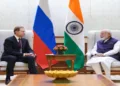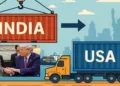
With US President Donald Trump’s contentious “peace plan” for ending the Ukraine war hanging in the balance, Russian President Vladimir Putin arrives in India tomorrow for a two-day visit. During the trip, he will attend the 23rd India–Russia Annual Summit and hold key meetings with Prime Minister Narendra Modi and President Droupadi Murmu. The visit comes at a crucial moment for both countries, as they seek to reinforce their strategic partnership while navigating geopolitical turbulence. A major priority of Putin’s visit is to strengthen bilateral trade ties. India–Russia trade currently stands at $70 billion, but the imbalance is stark: India imports $65 billion worth of goods from Russia while exporting only $5 billion in return. New Delhi has repeatedly expressed concern over the trade deficit, urging Moscow to open its markets wider to Indian agricultural and marine products. The issue is expected to feature prominently in Putin’s discussions with Modi during the summit.
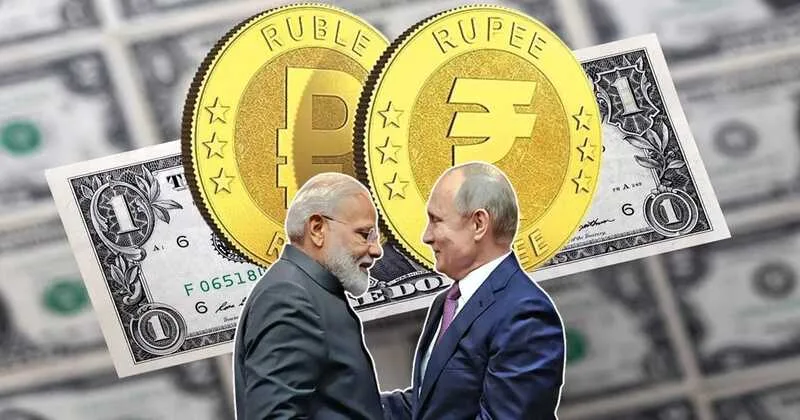
In an effort to address structural imbalances, both sides are also exploring alternatives to dollar-dominated trade. The two nations are expected to push discussions on expanding the rupee–ruble settlement mechanism, a long-discussed proposal aimed at reducing reliance on third-country currencies and insulating trade from Western sanctions and financial shocks.
Ukraine conflict and defence deals on the table; Russian oil flows surge despite US sanctions
Beyond trade, the Ukraine conflict will inevitably form a significant part of Modi and Putin’s dialogue, especially as Trump attempts to push forward his stalled peace formula. India has maintained a calibrated neutrality on the war while deepening its energy and defence engagement with Russia. The S-400 missile defence system, a key pillar of India’s long-term defence procurement from Russia, is also likely to be reviewed. The system remains central to India’s air-defence architecture, even as the country diversifies its military suppliers.
India relies heavily on Russian fertilisers to support its agricultural sector, and securing a stable supply remains a strategic imperative. Alongside fertiliser, energy trade, particularly crude oil, has grown sharply since the Ukraine war began. The two nations are also set to explore cooperation in healthcare, education, culture and media, signalling their intention to broaden engagement beyond the traditional defence-energy axis.
Fresh reports suggest that Russian oil shipments to India have rebounded despite Trump’s new sanctions targeting energy giants Rosneft and Lukoil. According to energy analytics firm Kpler, Indian refiners imported an average of 1.27 million barrels per day of Russian crude in November. Much of this arrived through intermediaries not directly covered by US sanctions, enabling India to maintain a stable supply line. During the first 17 days of November, India imported an average of 672,000 barrels per day, indicating a significant rise towards the end of the month.
Indian markets attempt recovery amid global shockwaves
Indian stock markets, which suffered sharp losses yesterday due to global headwinds, are struggling to stabilise. The GIFT Nifty opened 20 points lower, pointing to a subdued start for both the Sensex and Nifty. On Monday, the Sensex plunged 503 points, closing at 85,138, while the Nifty ended 143 points down at 20,632. Global jitters stemmed largely from the Japanese bond market crisis and renewed weakness in major cryptocurrencies, including Bitcoin. Although Bitcoin briefly recovered to $90,000, it slipped again later in the session. Hopes of a potential US Federal Reserve interest-rate cut provided some relief to global investors.
US markets posted modest gains, with the S&P 500 up 0.25 per cent, the Nasdaq rising 0.59 per cent, and the Dow Jones climbing 0.39 per cent. Stock futures also traded higher. Asian markets mirrored the cautious optimism: Japan’s Nikkei rose 0.76 per cent, and South Korea’s KOSPI gained 1.06 per cent, buoyed by an uptick in South Korea’s GDP growth from 1.7 per cent to 1.8 per cent. In contrast, China’s Shanghai Composite remained marginally lower, reflecting industrial sector strains, while Hong Kong’s Hang Seng slipped 0.63 per cent.
Indian markets are now closely watching the Reserve Bank of India, which will announce its monetary policy decision on December 5. While some analysts predict a 0.25 per cent cut in the repo rate, others argue that strong GDP performance leaves little need for an urgent rate reduction. Maruti Suzuki has launched its new electric SUV, the e-Vitara, marking a significant push into India’s fast-growing EV market. Sales are set to begin early next year, and the vehicle has already secured a 5-star Bharat NCAP safety rating. Meanwhile, airline IndiGo has been hit with a Rs 117.52-crore penalty by the Joint Commissioner of Central Tax and Excise, CGST Kochi Commissionerate, over alleged irregularities related to input tax credit. The airline has stated that it will contest the order legally. International gold prices declined due to profit booking, falling $14.36 to $4,227.09 per ounce. This is expected to push domestic gold prices downward. Crude oil prices remain volatile. Brent slipped 0.30% to $62.26 per barrel, while WTI dropped 0.29 per cent to $58.47.