Communists and Marxists are well-known for producing bogus history to disparage Bharatiya ancestry, culture, the greatness of Bharat, and Sanatan. One of their bogus narratives is “How Macaulay’s education system” established Bharat. The letters and sources of Macaulay and other British commanders clearly show their malicious purpose to destroy Bharat and exploit this great nation, yet communist historians praise them. Let’s face reality.
How can a nation become weakened?
A nation is damaged when individuals are ignorant of their own roots or feel ashamed of themselves or their forefathers. In fact, here is where a country’s true decline begins. A nation that wishes to forget about itself and emulate other nations cannot redeem itself; rather, it is on the way to self-destruction. Our country is experiencing regressive trends since British rule. And if we truly do not want to weaken ourselves as a nation.
Macaulayism is a deliberate program of eradicating indigenous culture through the planned substitution of a foreign culture of a conquering power via the educational system. In order to guarantee that future generations of Bharatiyas would always be Macaulay’s children, Macaulay’s policy explored the attitudes of both common people and aristocrats. Knowing that it would be foolish to replicate other colonial methods in this mind-bogglingly vast and complex nation, Macaulay and his kin were businessmen with good business acumen. Instead, they trained Bharatiyas to be clerks, pencil pushers, and other lower-rung human resources and to handle the lower administrative aspects of governing this vast and humongous country. They caused the most damage to our rich cultural heritage. Unfortunately, we have lost interest in Bharatiya music, history, classics, Science, architecture and society in general. According to Macaulay, the goal of education was to create “a class of persons Indian in blood and color, but English in taste, in opinions, in morals.” This statement not only reeks of racial superiority, but also reveals a sinister intent to mold Bharatiya society in the image of the colonizers, undermining the rich indigenous intellectual tradition. As a result, local identities and languages were undervalued, causing cultural discord.
Macaulay’s dismantling of the Bharatiya education system has adversely affected us socially, economically, and culturally.
When invited to report to the East India Company on the development of Bharatiya education, William Adam, a Scottish missionary who visited Bharat in the 1830s, had a significantly more positive opinion. Although he admitted that Pathashalas had few resources, he also observed that they appeared to fulfill the demands of the day, with Gurus choosing what to teach based on the needs of the pupils. Maybe a lot of us are unaware that, prior to the arrival of the British, Bharat was the richest nation. In contrast to Bharat’s 19 per cent share and GDP was almost 32 percent, Britain’s share of global exports was formerly only 9 per cent. Today, our contribution is merely 2.7 per cent. The majority of international visitors to Bharat were drawn by her enormous wealth. According to Ernest Wood’s book “A Foreigner defends Mother India,” It said that “the droppings of her soil fed distant regions” in the middle of the eighteenth century. Until the eighteenth century, no traveler discovered Bharat to be impoverished, yet Western traders and explorers flocked to her borders in search of the nearly incredible wealth they could find there. The phrase “to shake the pagoda tree” evolved into something akin to the English phrase “to strike oil.” In Bharat, between 35 and 50 percent of village properties were revenue-free. This money was used for things like school operations, temple celebrations, medicine production, pilgrim feeding, and better irrigation. T
he revenue-free lands were reduced to 5 per cent by the British due to their greed. The people’s initiative was destroyed. To their dismay, however, the rulers discovered that despite their conquest, this country remained deeply ingrained in its own culture. They discovered that their “white man’s burden” remained “heavy and cumbersome as ever” as long as the country was conscious of and even proud of its traditions! Bharat had a fairly well-established educational system at the time. Nowadays, the majority of us are trained to think that the lower castes lacked education and that Brahmins were the ones who provided instruction in Sanskrit.
Here are the details of how the British wrecked Bharat’s educational system, rendering one of the country’s most literate people illiterate. In one of his comments at the Roundtable meeting in 1931, Mahatma Gandhi declared, “You British cut down the beautiful tree of education.” Bharat is therefore significantly less literate now than it was a century ago. Parliamentarian Philip Hartog immediately rose to his feet and declared, “Mr. Gandhi, it is we who have educated the masses of India.” You must consequently retract your comment, provide an apology, or provide evidence. Gandhiji promised to demonstrate it. However, time constraints prevented the discussion from continuing.
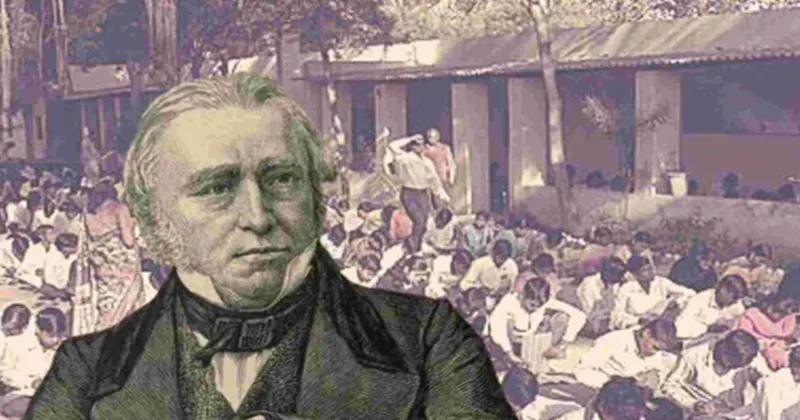
Dharampal, one of his disciples, later visited the British museum and looked through the records and reports. He wrote a book titled “The Beautiful Tree” in which this topic is covered in great detail. The British had been destroying our school system’s funding for almost twenty years by 1820. However, the Bharatiyas continued to maintain their educational system. The British therefore made the decision to learn more about this system’s complexities. As a result, the British district collectors were tasked with conducting a survey in 1822. According to the survey, there were one lakh village schools in the Bengal presidency, every village in Madras had a school, and every village in Bombay had a school if its population was close to 100. These schools had teachers and pupils from various castes.
Between 7 per cent and 48 per cent of teachers were Brahmins, with the remaining teachers in each district coming from other castes. Additionally, every child received an education in their mother tongue. The equivalent of the present day primary education lasted 4 to 5 yrs. We are all aware that universal primary education—rather than just a select few receiving higher education—is essential to advancing the country. The commitment and skill of the Bharatiya teachers were appreciated by the British administration. By the time the students came out of the schools they had acquired the capacity to be competitive, and to understand and have proper insight into their own culture. The Bharatiya educational system was brought back to England by a Christian missionary named Mr. Bell from Madras. He began educating the general public in England while, up to that point, only the children of the nobility had an education there. Thus, we deduce that the British adopted the mass education method from Bharat.
Some of these Gurukuls gradually evolved into what we now call universities. The reasons could range from the dissemination of their popularity far and wide to students coming to these well-known locales, resulting in the establishment of universities. These served as advanced learning centers or institutions. The Vedic culture, particularly the early Vedic society, was highly liberal and egalitarian in nature. Sages imparted knowledge in Gurukuls, and both boys and girls received education there.
The academic matter and content of education were determined by an individual’s Varna status. Historical evidence suggests that women such as Apala and Lopamudra produced Vedic hymns. Women who studied their entire lives were known as brahmavadini. There are few more names knowledgeable women in the later Vedic period, such as Gargi and Maitri. Yes, women went to gurukuls and few trained at home during the Vedic period. Girls were trained in battle and all Vedas, just like boys, but not every girl.
It was based on individual merit and interest. For example, Kaikeyi, King Dashrath’s wife, and Chitrangada, Arjun’s wife received martial training and were skilled fighters. Kaikeyi also learned charioteering. Satyabhama received martial training and accompanied Krishna in his war against Narakasura. Draupadi was in charge of the empire’s treasury and finances. she states in Vanaparva that she was taught in Drupad’s palace before her marriage. Look up the walls of ancient temples like the Khajuraho Temple; there are Gurukul scenes where a Rishi is teaching children, and girls are sitting and standing among them with bags and slates, writing.
We must free our educational system from its Macaulayian characteristics and gain a fresh and unadulterated knowledge of our beliefs, which have held us together for nearly ten thousand years. Then present them to younger generations for further inquiry, so that if they are absorbed, they are conveyed with feelings that grow stronger, nobler, and grander throughout time. Time to implement NEP 2020 across nation sincerly and speedily.