‘Sindh will always be ours’: Rajnath Singh invokes Indus legacy, hints at future reunification
July 15, 2026
  • Read Ecopy
  • Circulation
  • Advertise
  • Careers
  • About Us
  • Contact Us
Android AppiPhone AppArattai
Organiser
  • ‌
  • Bharat
    • Assam
    • Bihar
    • Chhattisgarh
    • Jharkhand
    • Maharashtra
    • View All States
  • World
    • Asia
    • Europe
    • North America
    • South America
    • Africa
    • Australia
  • Editorial
  • International
  • Opinion
  • RSS @ 100
  • More
    • Op Sindoor
    • Analysis
    • Sports
    • Defence
    • Politics
    • Business
    • Economy
    • Culture
    • Special Report
    • Sci & Tech
    • Entertainment
    • G20
    • Azadi Ka Amrit Mahotsav
    • Vocal4Local
    • Web Stories
    • Education
    • Employment
    • Books
    • Interviews
    • Travel
    • Law
    • Health
    • Obituary
  • Subscribe
    • Subscribe Print Edition
    • Subscribe Ecopy
    • Read Ecopy
  • ‌
  • Bharat
    • Assam
    • Bihar
    • Chhattisgarh
    • Jharkhand
    • Maharashtra
    • View All States
  • World
    • Asia
    • Europe
    • North America
    • South America
    • Africa
    • Australia
  • Editorial
  • International
  • Opinion
  • RSS @ 100
  • More
    • Op Sindoor
    • Analysis
    • Sports
    • Defence
    • Politics
    • Business
    • Economy
    • Culture
    • Special Report
    • Sci & Tech
    • Entertainment
    • G20
    • Azadi Ka Amrit Mahotsav
    • Vocal4Local
    • Web Stories
    • Education
    • Employment
    • Books
    • Interviews
    • Travel
    • Law
    • Health
    • Obituary
  • Subscribe
    • Subscribe Print Edition
    • Subscribe Ecopy
    • Read Ecopy
Organiser
  • Home
  • Bharat
  • World
  • Operation Sindoor
  • Editorial
  • Analysis
  • Opinion
  • Culture
  • Defence
  • International Edition
  • RSS @ 100
  • Magazine
  • Read Ecopy
Home Bharat

‘Sindh will always be ours’: Rajnath Singh invokes Indus legacy, hints at future reunification

In a powerful statement invoking history, civilisational memory and geopolitical reality, Defence Minister Rajnath Singh said that although Sindh is not a part of India today, “borders can change,” and the region may “return to India again.” His remarks came during an event honouring the Sindhi community in New Delhi

WEBDESKWEBDESK
Nov 24, 2025, 11:00 am IST
in Bharat
Follow on Google News
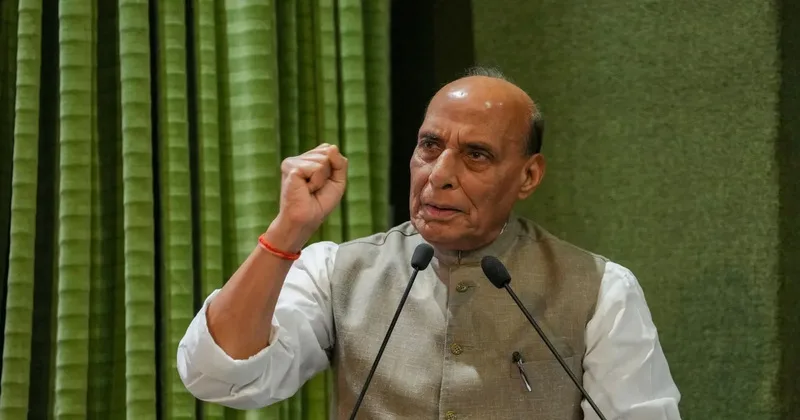
Defence Minister Rajnath Singh(File Photo)

Defence Minister Rajnath Singh(File Photo)

FacebookTwitterWhatsAppTelegramEmail

Defence Minister Rajnath Singh on Sunday (Nov 24) made one of his most direct civilisational references yet on India’s historical geography, saying that the region of Sindh, now a province of Pakistan, may return to India in the future. Speaking at a programme organised in honour of the Sindhi community in New Delhi, the minister said that Sindh may not be part of India’s current political map, but it remains an inseparable part of India’s cultural consciousness.

“Today, the land of Sindh may not be a part of India, but civilisationally, Sindh will always be a part of India,” Singh said, recalling the deep emotional ties shared by the Sindhi community with the Indus River and the land they were forced to leave behind during the traumatic Partition of 1947.

In a remark that has quickly gained national attention, Singh added: “As far as land is concerned, borders can change. Who knows, tomorrow Sindh may return to India again.”

His comment underscores a broader sentiment within sections of the Indian political spectrum that certain territories, bound by cultural and historical linkages, remain part of India beyond the realm of modern borders.

Sindh, located along the Indus River, was among the worst-affected regions during the violence of 1947. Home to a large number of Sindhi Hindus who considered the Indus sacred, the region was merged into Pakistan after Partition. The upheaval forced lakhs of Sindhis to migrate to India, where they rebuilt their lives from scratch.

Singh highlighted this legacy, noting the community’s contribution to modern India: “After the brutal Partition, Sindhis had to start from zero. But their courage, hard work and entrepreneurial spirit helped them establish new dimensions of success,” he told the gathering. He added that the community has become a driving force in India’s economic growth, business innovation and social service sectors.

The Defence Minister also cited former Deputy Prime Minister and veteran Sindhi leader LK Advani, recalling that Advani’s generation never came to terms with the separation of Sindh from India.

Quoting Advani, Singh said: “Many Muslims in Sindh also believed that the water of the Indus was no less sacred than the Aab-e-Zamzam of Mecca.”

Rajnath Singh’s comment that “borders can change” carries geopolitical significance. While he did not reference any diplomatic or military context, the statement hints at the belief that political boundaries are not immutable, especially when civilisational bonds transcend them.

The minister reiterated that the Sindhi community, dispersed across continents yet deeply rooted in India’s civilisational identity, will always be regarded as part of the nation.

“No matter where they are, they will always be ours,” he said, drawing applause from the audience.

His remarks also mirror sentiments expressed earlier by him regarding Pakistan-occupied Kashmir (PoK), another region that was part of the pre-Partition princely state of Jammu and Kashmir and continues to be a political and emotional flashpoint.

Singh’s latest statement comes just two months after his assertion in Morocco that PoK would eventually reunite with India without any military action. Addressing the Indian diaspora, he had said: “PoK will be ours on its own. Demands have started being made in PoK; you must have heard the sloganeering.”

He recalled a 5-year-old speech delivered in the Kashmir Valley, where he told soldiers that the day was not far when the people of PoK themselves would declare, “Main bhi Bharat Hoon,” signalling their desire to integrate with India.

The event in Delhi, where Singh addressed members of the Sindhi community, was a celebration of their heritage and contributions. He described the community as a symbol of India’s cultural identity and resilience, saying: “Sindhi society is a symbol of India’s cultural identity and self-respect.”

He praised Sindhi entrepreneurs, philanthropists and professionals who have excelled globally despite the adversity of forced displacement. Their success, Singh noted, is not just a story of survival but of unwavering determination and national commitment.

Rajnath Singh’s remarks come at a time when India-Pakistan relations remain strained, and debates on historical territories continue to shape the political discourse. While his statement may not indicate any immediate policy direction, it reinforces a narrative that India’s identity extends beyond present-day boundaries.

In recent years, conversations about Bharat’s ancient geography, from Gandhar to Sindhu to Kashi, have become central to public rhetoric. Singh’s emphasis that “civilisationally Sindh will always be a part of India” fits within this broader ideological trend.

It also echoes a long intellectual tradition that views the Indian subcontinent as a single cultural sphere, fragmented artificially by colonial borders. Many historians argue that regions like Sindh, Baluchistan and parts of Afghanistan were historically part of India’s cultural ambit, even if not always politically united.

Rajnath Singh’s statement that “Sindh may return to India again” is likely to spark conversations across political and public spaces. While the Defence Minister did not elaborate on the circumstances under which such a reunification might occur, the comment reinforces the idea that borders, especially those shaped by traumatic historical events, can evolve with time.

For now, the remark serves as a reminder of India’s shared civilisational history with Sindh and the unbroken emotional connection maintained by the Sindhi community worldwide.

Topics: Civilisational IdentityBorders Can ChangeSindhRajnath SinghPoKlk advaniIndus riverIndia-Pakistan Partition
ShareTweetSendShareSend
✮ Subscribe Organiser YouTube Channel. ✮
✮ Join Organiser's WhatsApp channel for Nationalist views beyond the news. ✮
Previous News

Generic Medicine Revolution in India: How Jan Aushadhi push triggered a 177-fold surge in sales in 11 years

Next News

1990 IAF Personnel killings case: Two witnesses identify Yasin Malik as shooter in TADA court

Related News

Xi builds, Sharif stays silent. The Indus tells the real story

Selective Outrage? China’s Indus Dam exposes Pakistan’s double standards on water security

Amid rising global conflicts and uncertainty, the idea of ‘Swa’ offers Bharat a foundation for self-reliance, resilience, and civilisational confidence

The Geopolitics of Selfhood: Why the idea of ‘Swa’ is emerging as Bharat’s strategic compass in a turbulent world

Defence Minister Rajnath Singh with his Vietnamese counterpart, General Phan Van Giang, in Hanoi on 19 May 2026

Arming Partnerships, Expanding Influence: How India is expanding its defence footprint across the world

Union Defence Minister Rajnath Singh

Uttar Pradesh: Defence land goes green; Rajnath Singh clears 250 MW solar project in Sitapur

Pakistan Prime Minister Shehbaz Sharif face the brunt as Punjab draws excess water from Indus basin and Sindh suffers from scarcity

Pakistan: Indus water drifts to Punjab & erupts political rift; Acute crisis in Dadu canal & drought in Sindh

Hypocrisy of Pakistan Exposed: Politically dominant Punjab gets undue water share while Sindh suffers acute scarcity

Load More

Latest News

Rudram-1

Rudram-1 in Action: Bharat’s first indigenous missile to hunt and destroy enemy radars

Indian Railways is facing a growing encroachment challenge, with over 1,068 hectares of land under encroachment

RTI Exposes Massive Rail Land Grab: Over 1,068 hectares of Indian Railways land encroached

Madhya Pradesh's Uniform Civil Code draft proposes mandatory registration of live-in relationships

Madhya Pradesh: UCC draft proposes mandatory registration of live-in relationships, divorce & inheritance laws

Devotees gather in large numbers in Puri for Mahaprabhu Jagannath's Nabajaubana Darshan

Odisha: Mahaprabhu Jagannath appears in divine Nabajaubana form after 15-day anasara, thousands gather in Puri

India's Udyam Registration and Udyam Assist platforms are formalising MSMEs and driving inclusive entrepreneurial growth

How Udyam Registration and Udyam Assist are transforming India’s MSME and entrepreneurial ecosystem

Maoist Ravindra Ganjhu (Source: OpIndia)

Jharkhand: Maoist commander Ravindra Ganjhu with bounty of Rs 20 lakh arrested after 16 years

Gyanvapi Complex

Gyanvapi Row: Hindu side demands Mosque premises be vacated, Muslim side rejects mediation; Both seek court verdict

Union Minister Piyush Goyal (Left) and European Commissioner for Agriculture and Food, Christophe Hansen (Right)

India-EU FTA legal scrubbing nears completion; Trade pact set to become operational in early 2027

World Youth Skills Day 2026

World Youth Skills Day 2026: Equipping young people for a shared future in an AI-driven world

Kalyan Banerjee Blames Abhishek Banerjee’s ‘Camac Street Ecosystem’, I-PAC for TMC’s 2026 Poll Defeat

‘Camac street finished TMC’: Kalyan Banerjee blames Abhishek Banerjee, I-PAC for Bengal poll debacle and party split

Load More
  • Privacy
  • Terms
  • Cookie Policy
  • Refund and Cancellation
  • Delivery and Shipping

© Bharat Prakashan (Delhi) Limited.
Tech-enabled by Ananthapuri Technologies

  • Home
  • Search Organiser
  • Bharat
    • Assam
    • Bihar
    • Chhattisgarh
    • Jharkhand
    • Maharashtra
    • View All States
  • World
    • Asia
    • Africa
    • North America
    • South America
    • Europe
    • Australia
  • Editorial
  • Operation Sindoor
  • Opinion
  • Analysis
  • Defence
  • Culture
  • Sports
  • Business
  • RSS @ 100
  • Entertainment
  • More ..
    • Sci & Tech
    • Vocal4Local
    • Special Report
    • Education
    • Employment
    • Books
    • Interviews
    • Travel
    • Health
    • Politics
    • Law
    • Economy
    • Obituary
  • Subscribe Magazine
  • Read Ecopy
  • Advertise
  • Circulation
  • Careers
  • About Us
  • Contact Us
  • Policies & Terms
    • Privacy Policy
    • Cookie Policy
    • Refund and Cancellation
    • Terms of Use

© Bharat Prakashan (Delhi) Limited.
Tech-enabled by Ananthapuri Technologies