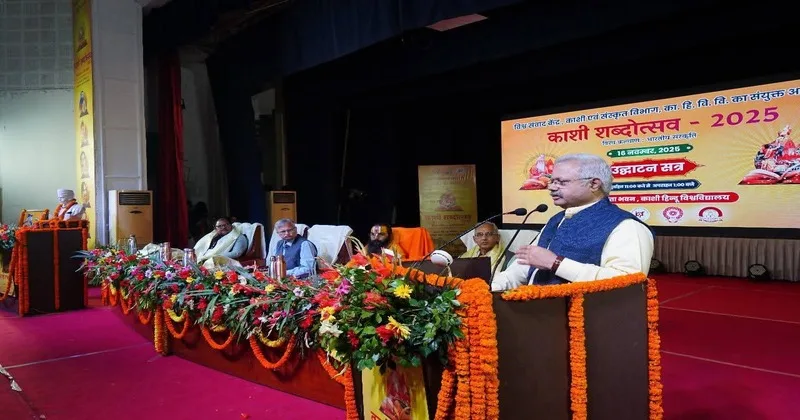
KASHI: This unique confluence of modernity and the Bharatiya knowledge tradition visible in Kashi is a symbol of the true strength and vision of our nation. In Bharat’s cultural stream, novelty and tradition have never been contradictory; rather, re-evaluating ancient knowledge according to new circumstances has always been the nature of our tradition. No matter how much time changes, Bharat has always held the vision that the old and the new are not separate, but two dimensions of the same flow. For this very dialogue, the ‘Kashi Shabdotasav’ is being organised in Kashi which will offer a mantra for the welfare of the modern world, said Akhil Bharatiya Prachar Pramukh of the Rashtriya Swayamsevak Sangh (RSS), Sunil Ambekar at the third edition of the annual literary conclave ‘Kashi Shabdotasav’ held at the Swatantrata Bhavan auditorium of Banaras Hindu University on November 16, 2025.
This same spirit was central during the establishment of Banaras Hindu University to build an integrated education system by linking Bharat’s traditional knowledge with modern science and technology arriving from any corner of the world. This harmony infused new energy into the national education movement across the country, leading to the establishment of national schools and colleges in many regions, including Maharashtra, he said.
The founder of the Rashtriya Swayamsevak Sangh, Dr Hedgewar, himself was part of this national education tradition. After being expelled from Nagpur’s City School for saying “Vande Mataram,” his education continued at the National School in Yavatmal. Later, he studied at the National Medical College in Kolkata, where Bharat’s tradition and the world’s newest knowledge converged. This demonstrates that Bharat, while embracing the world’s new knowledge, never abandoned its own knowledge stream; instead, it enriched it further, he further said.
It is due to this integrated vision that many branches of knowledge in Bharat survived even during foreign invasions and difficult circumstances. If these efforts had not existed, the conspiracy of Western imperialist forces, who wished to completely destroy Bharatiya knowledge and culture would have succeeded. But due to the strength of our tradition, the flow of Saraswati revived, and even today we are its beneficiaries. BHU stands as a powerful carrier of this unbroken tradition, he said.
He further added that, “Today the world has entered the era of highly advanced technologies, especially artificial intelligence. Over the past three hundred years, technology, machines and markets have brought convenience to human life, but in many places they have also weakened the sensitivity between humans and nature. In numerous countries, ‘family structures, social relationships, and the environment’ are undergoing severe crises. The essential question of human life is not merely technological advancement, but this, ‘who will control technology?’ Will humans choose technology, or will technology and markets decide the course of human life? This is the most important question for the coming century.”
Bharat faces the challenge of adopting modern science and technology while maintaining its ‘cultural values, purity, compassion, Vasudhaiva Kutumbakam, and a balanced life.’ In our tradition, the union of strength and purity makes life welfare-oriented. Strength without purity leads to destruction; but when strength is used with morality, restraint, and the intention of universal welfare, it becomes the foundation of creation. Bharat presented a an example of this during the COVID-19 pandemic. While many powerful and prosperous nations viewed vaccines from the lens of markets and profit, Bharat made them available to the world from the perspective of service and humanity. This was the outcome of our cultural ethos, , he said.
Sunil Ambekar said that “Bharat is moving towards becoming the world’s third-largest economy. There is continuous progress in science, technology, research and innovation. But along with economic progress, it is essential to build a new development model- one that is not merely GDP-based, but rooted in culture, environment, family, ethics and humanity. Many Western nations made the mistake of believing that economic advancement is the ultimate goal of life, and today they are suffering the consequences. Bharat must not repeat this mistake.”
He added that ,”For thousands of years, our ancestors upheld both prosperity and culture together. Today we are receiving the same opportunity once again. This opportunity can be meaningful only when we connect technological progress with Bharatiya life values. In this process, character-building is paramount. Characterlessness destroys the unity of any society, organisation or nation. The building of virtuous character, like any other skill, also requires practice beginning from childhood and continuing through life.”
Bharat remained united for thousands of years despite its diversities because its people possessed high character and ethics. If today tension, division and deceit are visible in society, the fundamental reason is the decline of character and cultural values. Therefore, ‘the character of the individual and devotion to the nation’ go hand in hand.
The joint project on AI and Indian Knowledge Tradition underway at IIT Mumbai is proof that Bharat has the capacity to integrate modern technology with cultural vision. Understanding religion and culture in modern context is equally necessary today. Bharatiya culture is not based on binary or divisive thinking. We believe not in confrontation, but in complementary perspectives. City–village, man–woman, tradition–modernity, science–spirituality, language — these are not contradictions but diverse expressions of one continuous culture.
He said that dialogue is the very foundation of our culture. Without dialogue, neither family, society nor nation can endure. Today’s international institutions seek only political balance. But the real basis of peace is dialogue, understanding and empathy. Linguistic disputes, regional politics, caste divisions, all these are conspiracies against Bharat’s unity. Initiatives like the Kashi–Tamil Sangam show that through dialogue and culture, Bharat’s unity and integrity can be further strengthened.
Therefore, viewing modern development and Bharatiya culture as separate would be a grave error. Only by integrating the two, Bharat can present a new humane, balanced and welfare-oriented development model to the world. In this direction, this festival of Kashi, bringing Bharatiya thought, culture, dialogue and modern vision onto one platform offers guidance and reminds us that Bharat’s future will be shaped not merely by its economy, but by culture, character and integrated knowledge.
The chief guest of the inaugural session and Peethadheeshwar of Ayodhya Hanumannivas, Acharya Mithileshanandini Sharan, said that Bharatiya culture “breathes through words.” Any society preserves its identity by preserving its words. Referring to Kabir and Ramananda, he said that through them, the message of harmony flowed from Kashi. Today’s younger generation often does not give words the importance they deserve. Every word carries its own warmth and coolness, and Shabdotasav helps one re-experience these subtleties.
BHU Vice Chancellor Prof Ajit Kumar Chaturvedi said that this festival is an important step towards the revival and advancement of Bharatiya culture. Referring to the works of renowned Odia writer Upendra Bhaj, he said society today needs cultural seers. From such dialogues will emerge the next Kabir and the next Shankaracharya, who will guide and enlighten future generations. He said that Shabdotasav deeply connects society with words, ideas and Bharat’s eternal cultural heritage.
The convenor of the programme, Dr Harendra Kumar Rai, welcomed all dignitaries on the dais. The programme began with mangalacharan, lamp lighting, and the singing of the BHU Kulgeet by university students. The event was conducted by D Shuchita Tripathi.
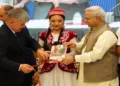
Books published by Lokhit Prakashan, Lucknow “Kritiroop Sangh Darshan,” along with “Hindu, Hindutva aur Bharatiya Sanskriti,” Prof Uday Pratap Singh’s “Bhakt Kaleen Sahitya aur Chittimulak Vimarsh,” Prof Rachna Sharma’s “Azaadi ke Ranbankure aur Kashi,” and Dr Lahiriram Meena’s “The Hope I Left With” were released.