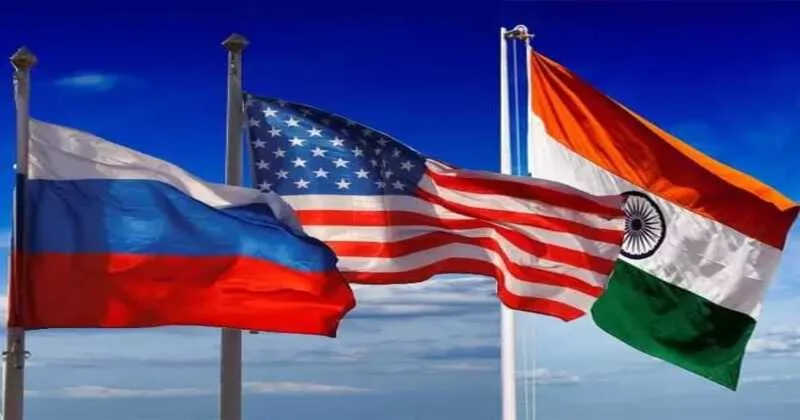
US President Donald Trump is taking a harder line against Russia, which continues its war-driven posture despite global isolation and sanctions. Trump said that Republican lawmakers are preparing a bill to impose harsh sanctions on countries that maintain trade ties with Russia, which has shown no willingness to end its invasion of Ukraine. Early indications suggest that the bill could include tariffs as high as 500 per cent.
Iran will also be included in the proposed legislation. This means that nations conducting trade with Iran would face similar punitive action. When asked by the media whether such a bill was indeed being prepared, Trump confirmed it directly. “Yes, I said we need a bill. Any country that does business with Russia will face serious sanctions. I have said to include Iran,” he clarified. Trump has already imposed a total tariff of 50%, including a 25 per cent punitive duty, on several country’s crude oil imports from Russia. He later placed sanctions on Russia’s largest oil companies, including Rosneft and Lukoil—measures that have caused significant economic disruptions in Russia. Trump is reportedly frustrated by President Vladimir Putin’s refusal to halt the war or participate in peace talks.
As a result of the cumulative sanctions and economic backlash, Russia is facing an acute financial crisis. GDP growth has declined, revenues for major oil companies have eroded sharply, and government income has weakened. Many firms are approaching bankruptcy. Inflation and high interest rates are weighing heavily on households and businesses. In response, the Putin administration has increased various taxes to stabilise government finances.
India ranks second in Russian oil imports
Meanwhile, India remained the second-largest importer of Russian oil in October. According to the Helsinki-based Centre for Research on Energy and Clean Air (CREA), India purchased Russian oil worth $2.5 billion (approximately Rs 22,100 crore) last month. This comes despite Trump’s announcement of sanctions on two major Russian oil exporters just weeks earlier.
India’s October imports were carried out under pre-existing contracts that were signed before sanctions came into effect. Similar shipments are expected to reach India in November as well. China continued to be the top buyer of Russian crude, importing $3.7 billion (Rs 33,000 crore) worth of oil during the same period. India’s total fossil fuel imports from Russia—including crude oil—stood at $3.1 billion (Rs 27,500 crore). China’s fossil fuel imports reached $5.8 billion (Rs 51,400 crore), while Turkey, a US ally, ranked third with $2.7 billion (Rs 24,000 crore). Similarly, the European Union remained fourth with $1.1 billion (Rs 9,800 crore), reflecting a contradictory position of enforcing sanctions while still purchasing Russian crude and liquefied natural gas.
China also retained its position as the largest importer of Russian coal, followed by India and Turkey. India imported coal worth Rs 351 million (Rs 3,100 crore) in October, along with additional petroleum products worth Rs 222 million (Rs 1,950 crore). Turkey was the largest buyer of refined petroleum products from Russia, with monthly imports of Rs 957 million (Rs 8,500 crore), half of which consisted of diesel. EU countries, despite implementing measures against Russia, purchased Russian LNG worth Rs 7,300 crore and crude oil worth Rs 2,700 crore last month. South Korea ranked fifth globally, importing Russian fossil fuels worth approximately Rs 3,500 crore.
However, India stands out as the only country subjected to punitive tariffs by the United States on Russian oil imports. Trump imposed an additional 25 per cent tariff exclusively on India, claiming that India’s sharp increase in purchases helps fuel Russia’s war efforts. After the start of the Ukraine war, Russia offered steep discounts on crude oil to India and China. India capitalized on this opportunity and expanded its imports significantly, causing Russia’s share in India’s oil basket to surge from 1 per cent before the war to nearly 40 per cent at its peak.
The Government of India has repeatedly clarified its position, stressing that the country depends on imports for 85–90 per cent of its oil needs. It has asserted that Indian refiners purchased discounted Russian oil to protect consumers from volatile global markets. According to the government, had India not increased its purchases from Russia, international oil prices would have climbed above $150 per barrel. Instead, prices have remained relatively stable at around $60–65 for a prolonged period.
Japan fever and AI anxiety shake global markets
Trump’s push for sweeping sanctions on Russia and its trade partners is expected to create economic pressure on multiple nations. India, China, Turkey, and several European economies continue to maintain commercial ties with Russia, extending beyond crude oil to other commodities.
Meanwhile, global stock markets are being rattled by two dominant forces, mounting concerns surrounding artificial intelligence investments and turbulence linked to Japan’s weakening economic indicators. Japan’s GDP contracted by 0.4 per cent in the July–September quarter, which, although negative, was less severe than the -0.6% forecast by analysts. The country’s annual growth rate stands at -1.8%, also less severe than the expected -2.5 per cent. Japan’s manufactured exports fell by 1.2%, compared to a 2.3 per cent drop in the previous quarter. Adding to the economic shifts, Trump’s decision to reduce import tariffs on Japanese goods from 25 per cent to 15 per cent came into effect on August 7, and its benefits are expected to reflect in the upcoming months.
Despite these factors, Japan’s Nikkei index fell by 0.63%, and the Topix index dropped by 0.44 per cent following the GDP announcement. Growing tensions between China and Japan over Taiwan, along with China’s travel warnings, caused declines in tourism-related stocks. Hong Kong’s stock index dropped 0.51 per cent, while Shanghai lost 0.66 per cent. South Korea’s KOSPI, in contrast, surged by 1.78 per cent. Australia’s ASX200 slipped 0.26 per cent. In the United States, concerns are rising about the enormous investments technology firms are pouring into artificial intelligence (AI) development. Despite the global rush to embrace AI, investors are worried about whether these massive expenditures will generate sustainable returns. This uncertainty is prompting widespread selling of tech stocks.
While the recent US government shutdown scare has receded, its lingering effects still weigh on investor confidence. Moreover, the Federal Reserve’s decision to step back from its earlier signals of interest rate cuts has dampened market sentiment. In the futures market, the Dow Jones slipped by 58 points (-0.1 per cent), while the S&P 500 and Nasdaq showed minimal changes. The Nasdaq Composite fell 0.5 per cent last week, impacted by declines in major technology companies including Alphabet, Amazon, Meta, and Broadcom. Nvidia’s upcoming earnings report, expected mid-week, is also anticipated to exert pressure on markets.
India poised for growth amid trade deal expectations
In India, market attention is centred on the progress of the India–US trade agreement. Both Trump and Indian officials have suggested that a deal may soon materialise. The National Democratic Alliance’s recent victory in Bihar has also bolstered the central government’s confidence. Early morning trade indicated optimism, with Gift Nifty rising 51 points, pointing to a potentially positive opening for the Sensex and Nifty. Trump is reportedly considering reducing tariffs on Indian goods from 50 per cent to 15–20 per cent. India is pushing for tariff rates to be lowered to around 12–15 per cent and is also considering boosting imports of crude oil and LPG from the United States.
In the corporate sector, Karnataka Bank has appointed Raghavendra S. Bhatt as its new Managing Director and CEO. Maruti Suzuki has issued a recall for 39,506 units of its Grand Vitara model to address possible issues related to the fuel level indicator. Max Healthcare reported a robust 74.3 per cent rise in profits during the last quarter, accompanied by a 25 per cent increase in revenue.
On the global commodities front, the strengthening of the US dollar and Treasury bond yields, following diminished expectations of a rate cut, has had ripple effects across markets. Gold prices climbed by $16 per ounce to reach $4,090 in international markets. A slight variation in gold prices is expected in India today. Crude oil prices, however, declined, with WTI slipping 0.92 per cent to $59.54 and Brent falling 0.85% to $63.84.