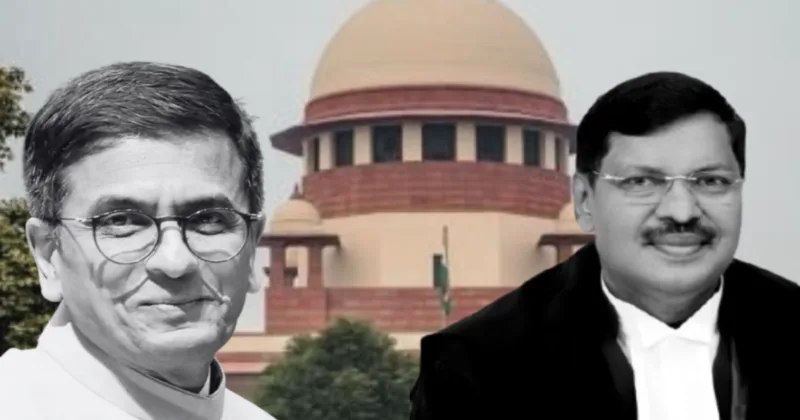
A recent article published in The Wire, titled ‘Two Chief Justices and a Militant Idea of Fraternity’, contends that the remarks of former CJI, DY Chandrachud, in an interview given by him to the News Laundry that the very erection of the disputed structure was a “fundamental act of desecration”, and the shoe- attack on the incumbent CJI, BR Gavai, are symptomatic of an emergent militant idea of fraternity rooted in Hindutva worldview that is inimical towards Muslims, Dalits, and Buddhists. The article not only draws an erroneous connection between rather disparate incidents, but also grossly misrepresents the Hindutva idea of fraternity.
Fraternity as a Civilizational Value
In the Hindutva paradigm fraternity is not just a constitutional value, but a civilizational one. It is a categorical imperative intrinsic to the Hindu ‘way of life’ and a bedrock principle of Bhartiya Rashtravaad. Hindutva ideologues like Ranga Hari and Ram Madhav trace the intellectual origins of Indian nationhood to the Vedic idea of Rashtram, or a fraternity bounded by a spiritual-emotional unity among those who saw themselves as children of Mother Earth. The inherent universality of this idea is depicted in popular Vedic sayings like ‘Vasudhaiva Kutumbakam’ (The World is One Family) and ‘Mata Bhumi Putroham Prithivyah’ (The Earth is My Mother, and I Her Son).
On the practical side of things, the Vedas inspired people to develop a common outlook towards life. For instance, Rig Veda 10.191.1 goes ‘saṃgacchadhwaṃ saṃvādadhwaṃ saṃ vo manāṃsi jānatām (Walk together, speak together, let your minds be in agreement). This common outlook came to be centred around ‘Dharma’, a righteous code of conduct, or as Deendayal Upadhyaya would call it, the ‘moral sovereign’ of Indian Civilization.
A key tenet of Dharma was its respect for a pluralistic way of life, which is essentially captured in the Vedic saying ‘Ekam Sat Vipra Bahuda Vadanti’ (Truth is one, but the wise speak of it in many ways). This pluralism, in turn, engendered a degree of catholicity in the Indian Civilization which could absorb within itself the group cultures of multitudes of immigrants, settlers, refugees, and invaders alike – Indo-Greeks, the Shakas, the Parthians, the Kushanas, the Hunas, the Persians, the Jews and so on – and still maintain its civilizational continuity.
Buddhists and Dalits are Integral to Hindutva
This pluralism in Indian Civilization also manifested itself through the emergence of heterodox spiritual movements like Ajivika, Charvaka, Jainism, and Buddhism. Eminent political theorist Bhikhu Parekh argues that Buddhism did not represent a radical departure from the Hindu tradition. Although it found greater acceptance among the Sudras and Vaishyas because of the absence of a rigid caste-system that had come to characterize Hinduism – a case of moral degeneration of the originally meritocratic varna- vyavastha according to former RSS Sarsanghachalak Balasaheb Deoras – however, Buddhism continued to share core Hindu beliefs like – eschewal of material desires, life after death, karma, and dharma. Correspondingly, even caste Hindus hold Buddha in reverence as an incarnation of Lord Vishnu and pay homage to him by visiting Buddhist pilgrimage centres. Buddha statues adore Hindu households as symbols of peace and good luck. The RSS’ Ekatmata Stotra, or hymn for unity, also venerates Buddha among other saints.
Further, the charge made out in the said article that Savarkar considered Buddhists and Ashoka as ‘enemies’ of the nation cannot be any further from the truth. In his seminal work, ‘Essentials of Hindutva’ that had come out in 1923, Savarkar states:
“We yield to none in our love, admiration and respect for the Buddha-the Dharma-the Sangh. They are all ours. Their glories are ours and ours their failures. Great was Ashoka, the Devapriya, and greater were the achievements of Buddhistic Bhikkus”.
This passage, among many others in the said work, points out that Savarkar held Buddhism in high regard. His definition of ‘Hindu’ as those who shared their fatherland (pitrbhu) and holyland (punyabhu) included the Buddhists. That said, Savarkar did critique Buddhism for its other-worldliness and the cult of pacifism that it had helped foster which made India susceptible to foreign invasion from the Shakas and the Hunas. He writes:
“Buddhism has conquests to claim but they belong to a world far removed from this matter-of- fact world where feet to clay do not stand long, and steel could be easily sharpened and trishna- thirst is too powerful and real to be quenched by painted streams that flow perennially in heaven”.
This, though, is not language of hate, but a reiteration of timeless Kautilyan wisdom against treating poison with nectar. One must also bear in mind that Savarkar had come up with his thesis against the backdrop of a perceived threat from radical pan-Islamism.
Likewise, the assertion that Hindutva is anti-Dalit goes against its very premise as a movement for sangathan or Hindu consolidation. On the contrary, the uplift of Dalits has been an integral part of the Hindutva movement since its inception. For instance, Savarkar was critical of untouchability and caste-system and thought of them as leading causes of a divided Hindu society that was lent vulnerable to foreign domination. He founded the Ratnagiri Hindu Sabha during the period of his house arrest that promoted inter-caste dining and marriages and mixed-caste schooling. The RSS shares similar views. It discourages using caste-markers, such as surnames, among its swayamsevaks; regularly organizes sahbhojs (or inter-caste dinners) at its shakhas; has persistently advocated equal access to temples, water sources, and crematoriums; has identified samajik samrasta (or social harmony) as one its five priorities; the seva karyas of its affiliates like Seva Bharti and Vanvasi Kalyan Ashrams cater to the health and educational requirements of Dalits and Vanvasis even in remote hills and rural hamlets. The RSS has also helped construct temples for the folk deities worshipped by these communities. Kameshwar Chaupal, the man who laid the first brick at the Ayodhya’s Ram Mandir, is also a swayamsevak and a Dalit.
Thus, the Hindutva idea of fraternity is pluralistic and assimilative, and not militant. Attempts to link this stray, yet unfortunate, attack on the CJI with Hindutva ideology are mere stratagems of left- liberal academics to raise a bogey of Hindu militancy.
The Acts of Desecration
Coming to DY Chandrachud’s statement that the very erection of the disputed structure constituted an act of desecration despite the Ayodhya Verdict being inconclusive on whether a temple was actually destroyed to build a mosque. Here, the former CJI might have strayed from the findings in the judgement, however, he flagged a much larger concern, and not just a Hindutva concern, that the Indian state (including the judiciary) should not be apathetic, as it has been until recent years, to the historical injustice carried out against the Hindus by Islamic rulers.
Ayodhya example aside, one can hardly dispute that acts of desecration, forced conversions, and religious persecutions were carried out against the Hindus by, not a few, Islamic invaders and rulers. More than anything else, the memories of this historical insult has precluded the progressive development of fraternal ties between the Hindus and the Muslims. Dr. Ambedkar’s views in his ‘Pakistan or the Partition of India’ are illustrative in this regard:
“The methods adopted by the invaders have left behind them their aftermath. One aftermath is the bitterness between the Hindus and the Muslims which they have caused. This bitterness, between the two, is so deep-seated that a century of political life has neither succeeded in assuaging it; nor in making people forget it. As the invasions were accompanied with destruction of temples and forced conversions, with spoliation of property, with slaughter, enslavement and abasement of men, women and children, what wonder if the memory of these invasions has ever remained green, as a source of pride to the Muslims and as a source of shame to the Hindus?”
The post-colonial Indian state, working under the shadow of Nehruvian secularism, instead of remedying genuine Hindu grievances regarding the status of their places of worship, chose to efface these acts of sacrilege by sanitizing the history of this period. The Hindus were thus expected to acquiesce to this ‘new past’ and ‘collective forgetfulness’ of the kind that Ernest Renan had found almost essential to development of nationhood. However, ethnic memory has a life of its own and, as ethno- symbolic researches into studies of nationalisms have found, they tend to persist even in the face of civicized institutional repression.