The British Broadcasting Corporation (BBC), long accused of pushing ideological propaganda under the guise of impartial journalism, is battling one of the gravest crises in its 102-year history. Two of its most senior executives, Director General Tim Davie and Head of News Deborah Turness, resigned after explosive revelations of editorial manipulation, institutional bias, and a leaked internal memo triggered an international backlash.
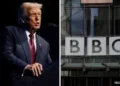
The crisis escalated dramatically when U.S. President Donald Trump threatened to file a $1 billion lawsuit against the BBC for “deliberate misrepresentation.” The outrage followed the broadcaster’s Panorama documentary, which spliced two separate portions of Trump’s January 6, 2021, speech, the day his supporters stormed the U.S. Capitol, in a way that created the false impression he had incited violence.
The BBC apologised for what it called an “editing error,” but many outsiders and now even its own insiders see this as part of a broader pattern of manipulation that has long defined the organisation’s editorial stance.
As per a Reuters report, the controversy has sparked fierce infighting inside the BBC, exposing ideological fractures that could reshape Britain’s public broadcasting landscape for years to come.
The leaked memo that shattered BBC’s credibility
The ongoing crisis stems from the leak of an internal memo by Michael Prescott, a former Sunday Times political editor and adviser to the BBC’s Editorial Guidelines and Standards Committee. In the confidential note, Prescott accused the broadcaster of “systemic left-wing bias,” listing multiple editorial failings in its coverage of Donald Trump, the Israel-Hamas conflict, and transgender rights.
Obtained by The Daily Telegraph, the memo has shaken the foundation of what was once considered Britain’s most trusted media institution. Prescott detailed how editorial decisions were routinely guided by ideological sympathies rather than journalistic balance, a claim that echoes years of criticism from both domestic and international observers.
“The BBC no longer reports, it interprets,” Prescott reportedly wrote. “And its interpretation increasingly reflects the worldview of a narrow liberal elite.”
The memo was immediately seized upon by the broadcaster’s long-time critics, including former employees, rival networks, and right-leaning commentators who have accused the BBC of functioning as a “liberal echo chamber.” The fact that the organisation took nearly a week to issue an official response only reinforced the perception of internal paralysis and denial.
Infighting and institutional rot
Inside Broadcasting House, the mood has been described as mutinous. According to insiders quoted in multiple British outlets, including Reuters, BBC newsroom managers and board members were sharply divided over how to handle the crisis.
Senior presenter Nick Robinson revealed that the dispute centred on whether the corporation should simply apologise for the manipulated Trump footage or address deeper, structural concerns about its institutional bias.
He directly pointed to Robbie Gibb, a board member and former spokesperson for ex-Prime Minister Theresa May, as the one who flagged a series of editorial failings that had gone unaddressed.
Former North America editor Jon Sopel added fuel to the fire when he revealed on his podcast that Gibb had actively pursued cases of left-wing bias but not a single case of right-wing distortion, a reflection, Sopel said, of the selective accountability that has plagued the BBC for years.
The BBC’s press office declined to respond to media queries, heightening speculation that the crisis is far from contained. Many argue that the real problem lies in the broadcaster’s deep-rooted ideological culture, one that resists scrutiny, shuns dissent, and masks activism as journalism.
Chair’s defence fails to convince
Amid the growing uproar, BBC Chair Samir Shah attempted damage control. Writing to British lawmakers, Shah called it “fanciful” to suggest that the board had engineered the resignations of Davie and Turness. He insisted that the corporation had long taken steps to address bias, through published corrections, disciplinary actions, and revised guidelines.
But Shah’s statement did little to calm critics. Even as he downplayed Prescott’s memo as “partial,” he admitted that a review of the BBC’s Standards Board was already underway, an implicit acknowledgement that systemic issues persist.
Many see this as a desperate attempt to contain the fallout before it reaches the government’s pending review of the BBC’s charter and funding model.
Government to reconsider BBC’s funding model
Compounding the crisis, the British government has announced a comprehensive review of how the BBC is funded. The broadcaster currently relies on a television licence fee, a mandatory payment for all TV-watching households in the UK. In the 2024-25 fiscal year, the fee brought in £3.8 billion ($5.1 billion), while commercial ventures lifted total revenue to £5.9 billion.
However, with public trust eroding and viewers migrating to streaming platforms like Netflix and Amazon Prime, the BBC’s licence-based funding has come under intense scrutiny. The number of paying households has plummeted from 25.3 million in 2022 to 23.8 million in 2024, a steep decline that could threaten the financial stability of the century-old institution.
Many argue that, the taxpayers should not be forced to subsidise what they call “a politically compromised media empire.” Conservative MPs have even floated the idea of transforming the BBC into a subscription-based model, a move that would fundamentally alter its role as a public service broadcaster.
Public trust and polarisation
For decades, the BBC prided itself on being Britain’s most trusted news source. But in recent years, its image as a beacon of neutrality has dimmed.
A July Ofcom report found that while the BBC still reaches 67 percent of adults across television, radio, and digital platforms, its reach has fallen by 11 percentage points since 2019. A YouGov survey released this week revealed a nation split down the middle: half of Britons believe the BBC is politically biased. Of these, 31 percent said it leans left, while 19 percent said it leans right.
The statistics mirror a global perception shift. From India to Israel, and Brexit to Trump, the BBC has been repeatedly accused of manipulating narratives to suit liberal sensibilities. In India, the BBC drew outrage for its documentary questioning Prime Minister Narendra Modi’s leadership during the 2002 Gujarat riots, a production New Delhi slammed as “colonial propaganda.” In the Middle East, the broadcaster has been accused of downplaying Hamas atrocities while framing Israel’s response as disproportionate.
Such patterns, say many, are no longer anomalies, they are emblematic of a newsroom where ideological activism overshadows journalistic balance.
The hunt for a new director general
With the resignation of Tim Davie, the task of restoring credibility now falls on the BBC’s 14-member board, which includes five government appointees. The board will oversee the appointment of a new Director General, with names like Charlotte Moore, Jay Hunt, Alex Mahon, Carolyn McCall, and Jane Turton emerging as leading contenders.
All are seasoned media executives, but critics argue that leadership changes alone cannot fix what they call the BBC’s “institutional bias problem.”
“Changing faces won’t help if the mindset remains the same,” said a former editor who left the broadcaster after two decades. “The BBC’s crisis isn’t about one documentary, it’s about a culture that confuses liberal activism with journalism.”
A pattern of propaganda
The BBC’s troubles are not new. Over the past two decades, it has faced numerous accusations of bias, from its coverage of the Iraq War and the 2016 Brexit referendum to its sympathetic framing of Islamist extremism and identity politics.
In 2023, the network came under fire for referring to Hamas fighters as “militants” instead of “terrorists” even after the October 7 massacre in Israel. Earlier, in India, the Modi government banned a controversial BBC documentary seen as a “hatchet job,” calling it a direct attack on the country’s sovereignty.
Such repeated controversies have eroded the BBC’s claim to impartiality, leaving many to question whether it has become a propaganda outlet under the banner of public service.
What began as a so-called “technical editing error” has ballooned into the BBC’s greatest existential crisis. Once viewed as the gold standard of global journalism, the broadcaster now finds itself accused of spreading ideological propaganda, manipulating facts, and betraying the public trust it was built upon.
As the world watches and Trump’s billion-dollar lawsuit looms, the BBC stands at a defining crossroads. Will it reform its editorial culture and restore public confidence, or will it continue its descent into partisan irrelevance?
For a broadcaster that once prided itself on the motto “Nation Shall Speak Peace Unto Nation,” the irony is bitter, today, the BBC seems unable to speak truth even unto itself.