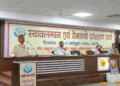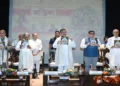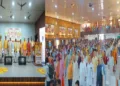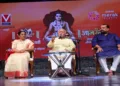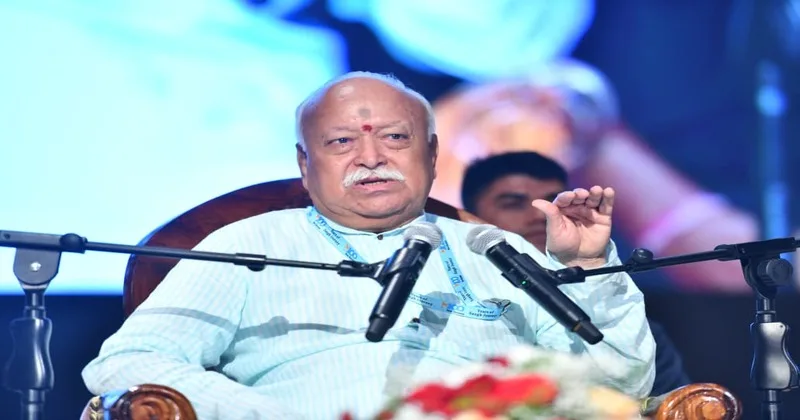
Bengaluru, November 9, 2025: The concluding day of the two-day lecture series of RSS Sarasanghachalak Dr. Mohan Bhagwat in Bengaluru interacted in an Question & Answer session attended by dignitaries and invitees. The Sarasanghachalak was joined on the dais by RSS Sarkaryavaha Dattatreya Hosabale, Dakshin Madhya Kshetra Sanghachalak Dr. P. Vaman Shenoy, and Karnataka Dakshin Prant Sanghachalak Umapati G.S.
The session commenced with the offering of flowers to the photo of Bharat Mata followed by the singing of Vande Mataram. A total of 470 questions from 284 invitees were received, grouped into 18 categories. Additionally, 81 suggestions and feedback points were submitted by attendees of the first day’s sessions.
Dr. Bhagwat began by addressing questions on organisational policies and legal matters. On why the RSS is not a registered organisation, he explained that the Sangh is a legally recognised organisation functioning within constitutional parameters and does not require registration. “Many things are not registered, even Hindu Dharma is not registered,” he observed. On the vision and mission of the Sangh over the next 20 years, he said that its aim remains to organise Hindu society, which in turn will strengthen the nation.
Responding to whether Muslims are allowed in the Sangh, he clarified that anyone can join the shakha irrespective of religion, as all are sons of Bharat Mata. The Sangh identifies individuals as Hindus beyond denominational lines. “Individual identities—be it Brahmin, Muslim, or Christian—are dissolved in the shakha,” he said. The Sangh’s outreach focuses on enabling neglected sections to uplift their own communities, as Sangh’s core work is shakha and man-making to make individuals self-reliant.
On how the Sangh plans to reach Generation Z in the age of AI and protect them from wokeism, he said the younger generation has always faced distractions, and the Sangh will befriend and bring them to the shakha, adapting to the needs of the times. Responding to a question on transgenders, he stated that the Sangh does not discriminate based on gender and welcomes anyone who offers pranams to Bharat Mata. On the participation of women, he explained that women have been part of Sangh work since 1933 through the Rashtra Sevika Samiti. Except for the daily shakha, men and women work together in other Sangh activities such as sewa and women’s empowerment.
Addressing the adoption of the Bhagwa Dhwaj instead of the National Flag, he clarified that the Bhagwa was chosen as the Guru because people are fallible. “It is not Bhagwa versus Tricolour, but Bhagwa with Tricolour,” he said, adding that the Sangh has safeguarded and even sacrificed for the national flag.
On entrepreneurship and employment generation, Dr. Bhagwat said the Sangh engages with all sections, including business communities, and promotes district-level efforts to generate employment. He cited Laghu Udyog Bharati and Swavalambi Bharat Abhiyan as examples and noted that tech entrepreneurs and MSMEs have major roles in building a self-sustaining Bharat. The Sangh supports policies guided by the Swadeshi principle.
Addressing media criticism, he said that the Sangh has always faced opposition but responds only to genuine and honest criticism. On political involvement, he reiterated that the Sangh unites society and does not engage in politics but supports policies beneficial to the nation. “We support rashtra neeti, not rajneeti,” he said, adding that RSS supports all parties working for Bharat’s welfare.
Dr. Bhagwat described shakhas as kiosks for the people, where issues are recognised and addressed. The Sangh grows through personal contact, not propaganda. “The team benefits from every individual; everybody is important and nobody is indispensable,” he said. There are currently around 3,700 pracharaks, with 500–550 youth joining annually and 200–250 continuing permanently. Of the 60 lakh swayamsevaks, about 30 lakh are grihasthas. “Sangh is an organisation of grihasthas, not ascetics,” he noted.
On India-Pakistan relations, Bhagwat said that Bharat always desires peace, but Pakistan repeatedly harms itself by attempting to harm Bharat. “Whenever it attacks, we must give a befitting reply,” he said.
Addressing wealth inequality, he stated that centralised economies have concentrated resources among a few, and the Bharatiya model advocates “production by the masses” rather than mass production. “It is not survival of the fittest, but the fittest helping others survive,” he remarked.
On illegal infiltration and Rohingya issue, he said that borders must be secured while considering local people’s views. Speaking on religious conversions and vote-bank politics, he said the division among Hindus by caste makes them vulnerable. “We must reform and educate ourselves so politics cannot divide us. Our unity has ensured our survival as a civilisation.”
Regarding caste issues and inter-caste marriages, he said, “What exists today is not caste system but caste confusion.” He emphasised overcoming caste influence through mutual love and respect. “Caste-based politics prevents unity,” he added. Discrimination can be removed through affection and cooperation, as practiced in shakhas. He said that reservation should continue until full equality is achieved.
On brain drain, Dr. Bhagwat said that it will end only when youth realise their role in nation-building and their talents are utilised in Bharat.
Addressing love jihad, Bhagwat said the focus should be on strengthening sanskaras at home. “Do not put every Muslim in one bracket. Many Muslims disapprove of such acts,” he said. The Muslim community too must educate its own members. “We neither want to convert anyone nor divide any community, but we must keep our house strong.”
On Hinduism and Hindutva, Mohan Bhagwat said, “We must decolonise our minds. ‘Ism’ means ‘vad’ and is exclusive; ‘tva’ means ‘ness’ and is inclusive.” He emphasised that Hindutva is inclusive and that the Sangh aims to unite all Hindus under one umbrella. “Act on truth, be compassionate, keep your heart and mind pure, and whatever you do, do it for the nation,” he said.
He noted that India was secular long before the Western model. “Our constitution makers were Hindus and hence made the state secular. Pakistan and Bangladesh did not,” he said. A person cannot be secular; only the state can. “We are already a Hindu Rashtra. Even those following other ideologies practice Hindu festivals and rituals. Motherland and Bharat Mata are Sanatan constructs, not post-colonial ideas,” he said. “Akhand Bharat can be realised the very instant every Hindu realises this truth.”
On technology and AI, he said, “We cannot stop evolution, but we can regulate its use.” He urged parents to set examples in gadget use and build discipline through dialogue with children. “Once discipline is instilled, any technology can serve humanity,” he said. On healthy practices and yoga, he said harmful habits must be avoided and good practices cultivated through example. “Before preaching, we must practice. Children imitate what they see,” he said, urging guardians to guide youth with love and understanding.
On environment protection, Mohan Bhagwat said swayamsevaks conduct Paryavaran Gatividhi programmes involving water conservation, plastic removal, and tree planting. “Environmental damage arises from wrong habits. Change in public attitude will influence policy,” he said, adding that the Bharatiya model of sustainability meets needs, not greed.
Answering questions on gender issues, Bhagwat said men and women are intellectually and mentally equal and complementary. “Without women’s participation, Bharat’s emancipation is impossible. The mother is the first teacher,” he said, quoting Swami Vivekananda: “Allow women to explore themselves, and they will do everything.” He said alienation from Bharatiya values arises from extreme individualism, stressing that families and grihasthas sustain society.
On politics, he said that all political parties have differing opinions but must work honestly towards a national goal. “Good politics is possible only with a good society. Corruption begins in the mind,” he said, emphasising honesty as a product of sanskaras and social atmosphere.
On education and foreign influence, he said that the Panch Shiksha Kosha system will soon be implemented to integrate traditional values in education. He advised strengthening Indian systems and taking only what benefits us. “The Left has lost ideology; it’s now only power politics,” he said, urging awareness against alien ideologies like wokeism and calling for networking among sants and organisations to take Bharat’s values to the world.
On India-China relations, he said, “Policy is never stationary. We want friendship with everyone, but China cannot digest a strong Bharat. While being polite, we must safeguard our sovereignty.”
Regarding media narratives, he said awareness is key. “Wikipedia was once dominated by one ideology, but now there are other platforms like Grokipedia and ChatGPT,” he said, adding that swayamsevaks are working in this field. “Media is expected to educate people, but the commercial aspect focuses on thrilling the audience, but I am hopeful of positive change.”
On judicial reforms, he said meaningful changes are still awaited despite the Chief Justice’s call for reform. “Several suggestions from Sangh-inspired Adhivakta Parishad have been submitted, but they must be acted upon,” he said.
He added that one can leave the rat race only by submitting to a higher cause for the nation. On aligning professional life with the Sangh’s vision, he said, “If you do anything good for society, you are an unofficial member of the RSS.” He invited citizens to participate in nation-building by connecting with swayamsevaks and local shakhas. “After 100 years, Sangh offers everyone an opportunity to contribute according to their capacity and time.”
Concluding the session, Dr. Bhagwat said, “Everything in Sangh happens through swayamsevaks. The Sangh’s work is to create karyakartas, and their work is for the nation.” He emphasised that the Sangh’s purpose is man-making and selfless service. “No person or organisation alone can bring about the nation’s upliftment – only society can.”
He urged the audience to understand the Sangh by direct experience: “You can understand Sangh only through shakha. Understanding Sangh is a continuous process. Form your opinion of RSS based on experience and facts, not on perception or hearsay.”
RSS Sah Sarakaryavah Mukunda CR, Akhil Bharatiya Vyavastha Pramukh Mangesh Bhende, Akhil Bharatiya Sampark Pramukh Ramlal, SahSampark Pramukh Ramesh Pappa, Sunil Deshapande, Bharat Bhushan, Akhil Bharatiya Prachar Sunil Ambekar, Sah Prachar Pramukh Pradeep Joshi, Narender Kumar, Akhil Bharatiya Sah Bouddhik Pramukh Sudhir, other senior Functionaries were present.
The event was attended by over 1200 delegates from various walks of life.