In the year 1770, the British soldiers of East India Company shot hundreds of Sanyasis in Bengal. The Sanyasis from present day Eastern Uttar Pradesh, Bihar, Assam and Bengal raised the banner by waging a struggle against the Firanghis that lasted for almost 42 years – famous as the Sanyasi Uprising led by Mohan Giri and supported by not just the peasants like Dheeraj Narayan or Devi Chaudharani but also by the Fakirs like Majnu Shah. The slogan of this great struggle, the war cry, was “Vande Mataram”. And since then, Vande Mataram inspired the revolutionaries and freedom fighters in their struggles to liberate the motherland.
The Revolutionary Role
Vande Mataram was a Stuti of Kali that Bankim Chandra Chatterjee found in a temple at Lalkot in the records of the Pujari. The small Zamidar of Lalkot had supported the struggle of Sanyasis what the British termed as a rebellion. Thanks to Bankim who had discovered this while he was posted there as a British official but who emphasised Vande Mataram’s significance as a devotional war cry against the British rule by penning the great novels Ananda Math and Devi Chaudharani. Since this was a period when the distorted history of Bharat was taught by the British, Bankim had found his way through novels to take the real history to the people and thus, create an awakening to carry forward the struggle. After the publication of Ananda Math in 1882, Vande Mataram became the most popular slogan – particularly in Bengal.
We do not find references to Vande Mataram during the first war of Independence in 1857 but it is worth mentioning that the Sanyasis and Sadhus had played a major role in the planning, creating awareness, taking secret messages and fighting the British and the worship of Kali was prevalent in every cantonment of the East India Company among the Bharatiya soldiers who raised the banner of freedom by taking the blessings of Maa Kali. We also find the speech given by a priest to the Bharatiya soldiers just before the attack on Kashmiri Gate at Delhi in September 1857 as follows:
“No white-face can move out, therefore advance your batteries without fear. The camp shall be destroyed like Lunka by fire, increase the number of your guns. By the grace of Bulbhudder and Ramchunder, the camp shall be annihilated. Fight without intermission day and night, protect from injury our mother the cow. Offer sacrificial food to Joala Maee and Bhovanee, and distribute it among the Brahmins. Present daily an offering of fourteen cows. I have scrutinised the leaves of the book, Nirput Jee Jurria, and ascertain that Suneechur (the god of vengeance) has descended upon the heads of the English. Offer sacrifices to Suneechur, see what a moment will bring forth.”
Throughout the freedom struggle, religion and religious texts remained a great motivator to fight out the British and their local supporters including the Brown Sahebs.
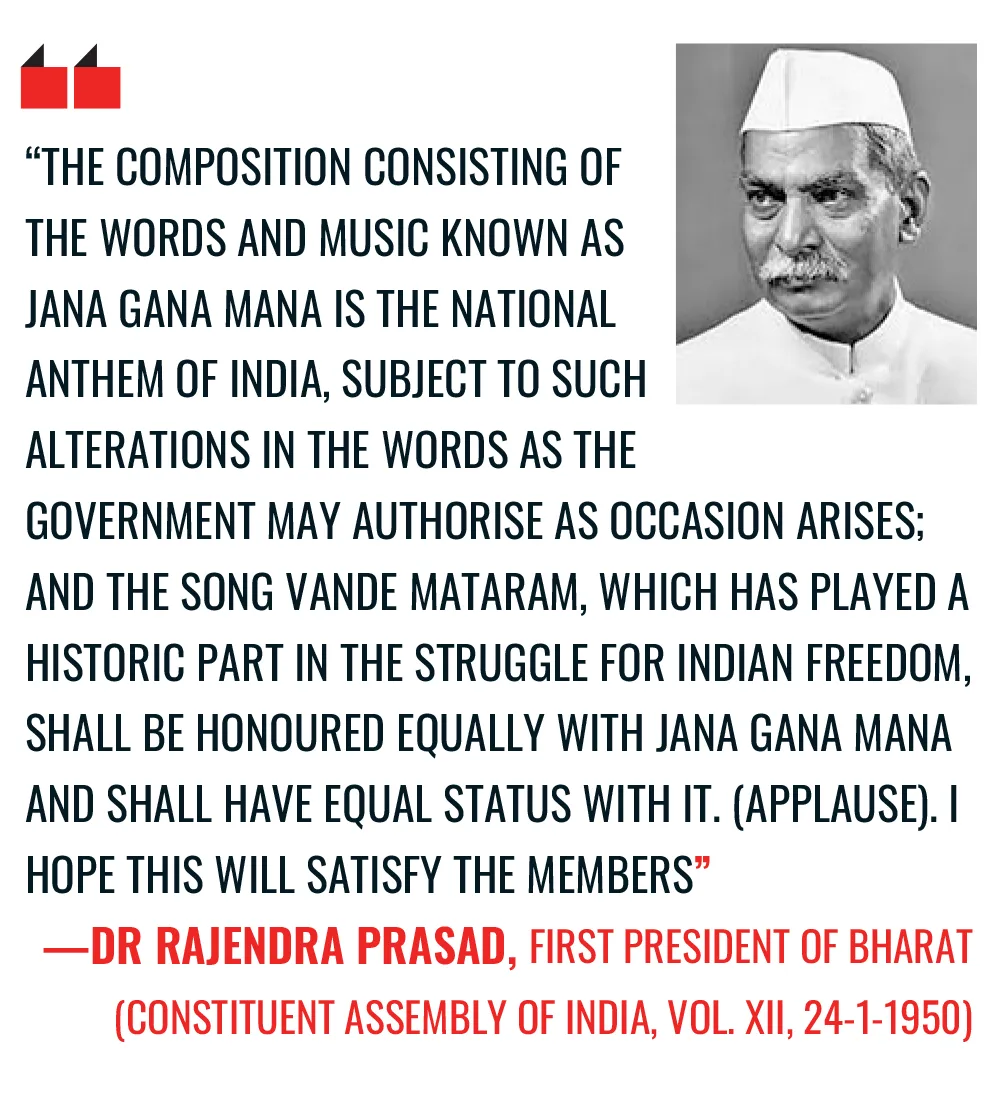
In 1896, Rabindranath Tagore composed the music for Vande Mataram and sang it at the Calcutta Congress Session. No doubt, this was a unique event for the Congress always used to hoist the Union Jack in its sessions along with singing of the English National Anthem, “God Save the King”. But we must remember here that in the mid 1890’s the moderates in the Congress were being challenged by leaders like Bal Gangadhar Tilak, Bipin Chandra Pal, and Lala Lajpat Rai.
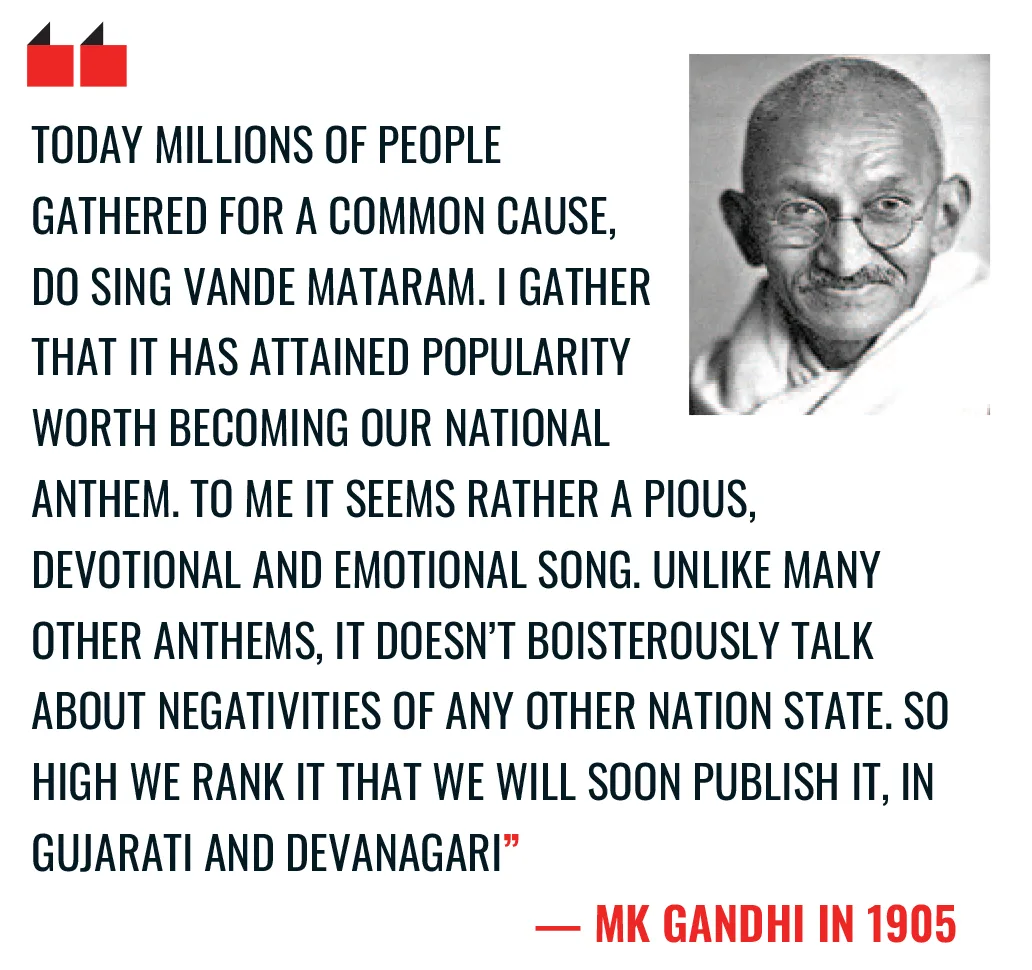
When in 1905, Viceroy Curzon partitioned Bengal on communal lines, once again the slogan of Vande Mataram was at the forefront to awaken and mobilise the people. Singing Vande Mataram to gain strength for fighting against the British had now become a regular event at all the rallies. Bipin Chandra Pal and Lala Lajpat Rai made this song a rallying point in the struggle for Independence and Lala Ji popularised it in Punjab also.
In fact, though the concept of Matrabhumi (motherland) had a long tradition in Bharat, the worship and significance of Bharat Mata emerged from Vande Mataram. It is not only a prayer to the mighty mother praising her virtues but also an ardent appeal to her to save and free through her blessings, all the millions who have taken swords in their hands.
The revolutionaries were not only inspired by Vande Mataram but effectively practiced the message therein. Aurobindo Ghosh not only translated it in English describing it as a powerful political and spiritual motivator but also as the vision of a free motherland that inspires the freedom struggle.
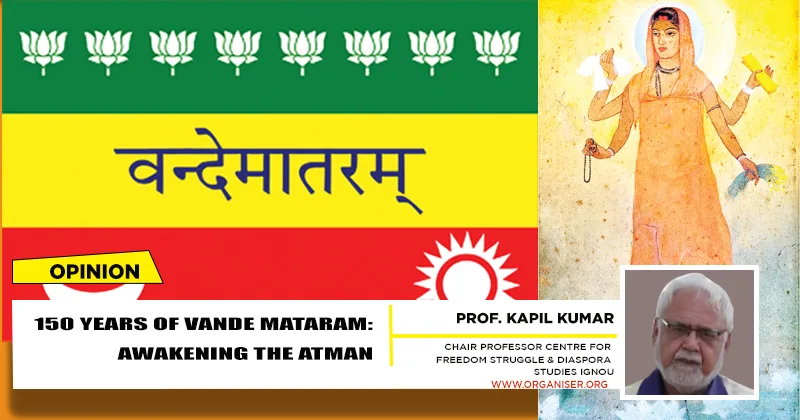
The significance of Vande Mataram echoed in foreign lands too, where the Bharatiya Revolutionaries were struggling against the British and generating awareness for the liberation of Motherland. Bhikaji Cama, a great revolutionary woman unfurled the flag of Bharatiya Independence at the International Socialist Conference in Stuttgart, Germany on August 22, 1907. ‘Vande Mataram’ was prominently written in Sanskrit on this flag.
The Gadar Party prominently displayed Bharat Mata in chains on its pamphlets and literature along with the slogan Vande Mataram. Bhikaji Cama’s flag was adopted in 1914 by the Berlin Committee which later on became the Indian Independence Committee.
(“Bande Mataram” written at the top left and right)
Significance Of The Song
There were many revolutionaries who kissed the hanging noose singing ‘Vande Mataram’. The names of Khudiram Bose and Surya Sen are prominent among them who were tortured for singing the song. Vande Mataram was on the lips of Matangini Hazra who was shot while holding the Bharatiya flag in 1942 Movement. In 1943, the British hanged the Azad Hind Fauj braves in the Madras Central Jail on the charges of spying and all the four Vakkom Abdul Khader, Satyen Bardhan, Anandan, and Fauja Singh walked to the hanging noose raising the slogan Vande Mataram.
Schools Of Maharashtra Join In The Fervour
The School Education and Sports Department, Government of Maharashtra, on October 27, 2025, has issued a directive to all schools in the state to organise the singing of the complete Vande Mataram and to display an exhibition on the history of the song between October 31 and November 7, 2025.
According to the government communication (No. Sankirn-2025/Pr. No. 308/SD-4) dated October 27, 2025, the directive follows a letter dated February 18, 2025, from Smt Radha Bhide, Treasurer, Rajmata Jijabai Trust, District Thane.
The letter notes that the composition of Vande Mataram, written by Bankim Chandra Chattopadhyay, completes 150 years on October 31, 2025, corresponding to Kartik Shuddha Navami as per the lunar calendar, and on November 7, 2025, as per the Gregorian calendar.
At present, only the first two stanzas of Vande Mataram are sung in schools. However, on the occasion of the 150th anniversary, it has been requested that the complete song be sung in all schools and that an exhibition explaining its history be displayed in the school premises.
The School Education Department has requested all education authorities to inform schools under their jurisdiction to ensure the implementation of the directive across all mediums and managements.
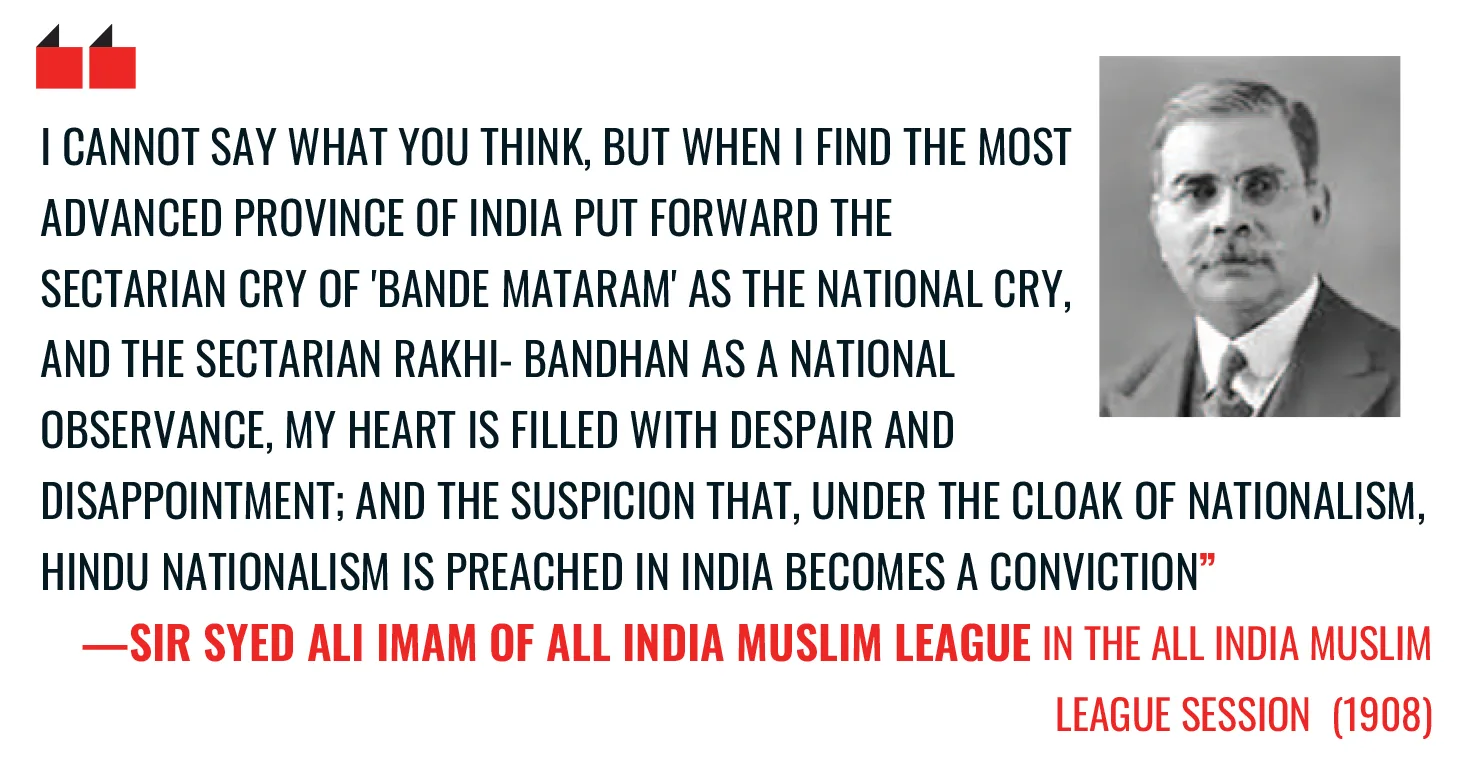
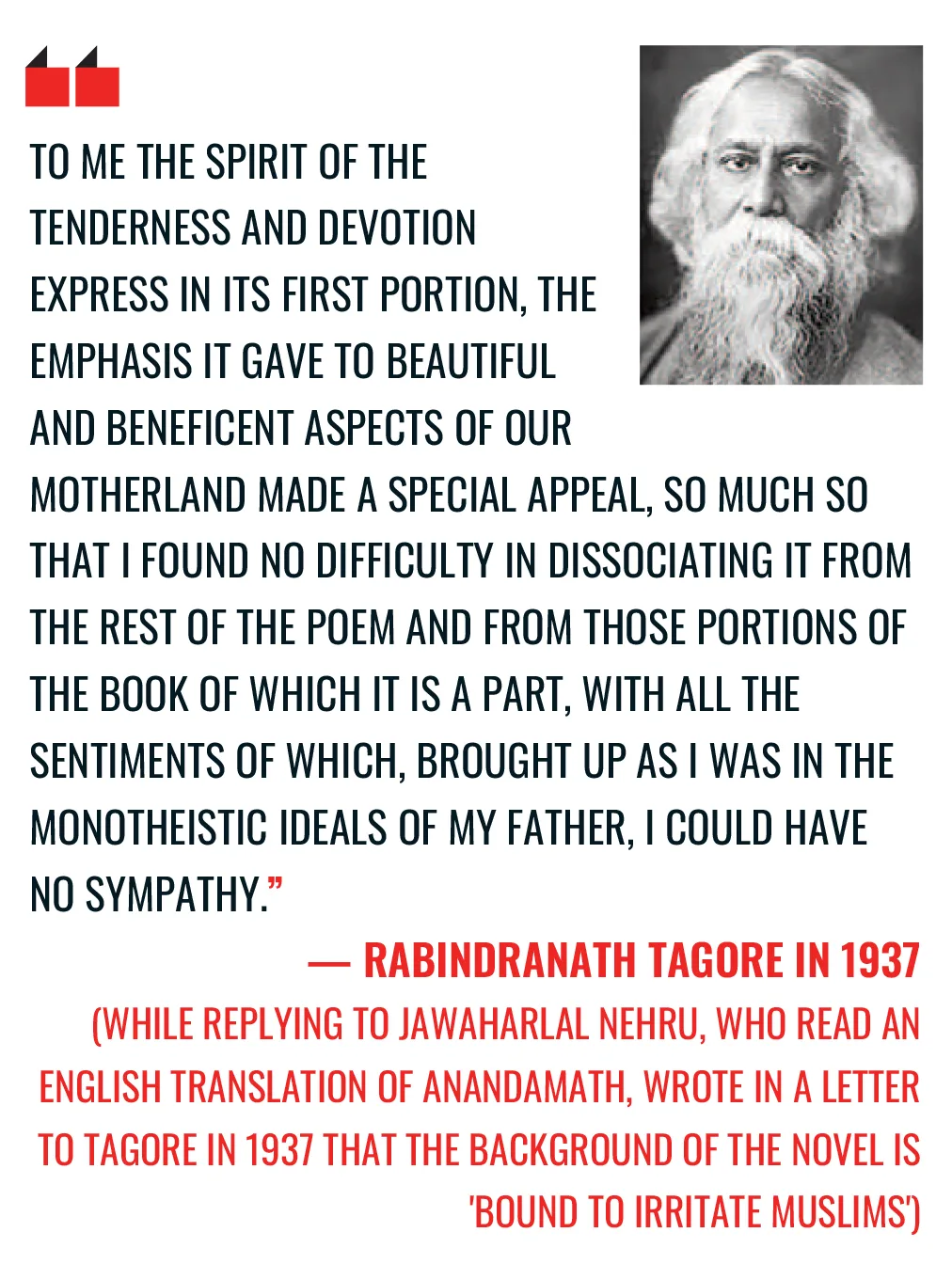
It would be interesting for many to note that till 1937, Jinnah had not opposed the singing of Vande Mataram and he himself had been present at the dias on many occasions in the Congress Sessions being fully aware of its meaning and significance. But once he drifted to entirely fanatic communal politics, Vande Mataram became an eyesore for him, his Muslim League and their followers. Afterwards, the Muslim League was ousted. Having lost heavily in the elections in 1937, Jinnah raised his cry against the singing of Vande Mataram in the Legislative Councils by the victorious Congress Legislators. Nehru took serious note of this opposition and sought the advice of Rabindranath Tagore and Subhas Chandra Bose. Bose, while stressing on the issue of Hindu Muslim unity, wrote to Nehru on October 17, 1937:
“Communal Muslims are in the habit of raising bogeys from time to time – sometimes it is music before mosques, sometimes inadequate jobs for Muslims and at present, it is ‘Bande Mataram’. ‘Bande Mataram’ has suddenly sprung into importance probably because it was sung in Legislature thereby demonstrating Congress victory. While I would gladly try to meet all doubts and difficulties raised by nationalist Muslims, I do not feel inclined to attach much importance to what the communalists say. If you give them the fullest satisfaction on the question of ‘Bande Mataram’ today, they will not be long in bringing up other questions tomorrow, simply in order to pander to communal feeling and embarrass the Congress.”
The Politicisation Of Song
However, it was Nehru who ultimately decided, as the Congress President, that only the first two stanzas of Vande Mataram will be sung and since then, it became a practice among the Congressmen. Nehru had consciously conceded to a communal demand in spite of the warning by Subhas Bose. Undoubtedly, three years later, came the demand of Pakistan. How relevant Bose’s observations were, can be judged in the contemporary scenario, where the fanatic Islamists keep finding opportunities to attack Vande Mataram today.
The significance of Vande Mataram echoed in foreign lands too, where the Bharatiya Revolutionaries were struggling against the British and generating awareness for the liberation of Motherland
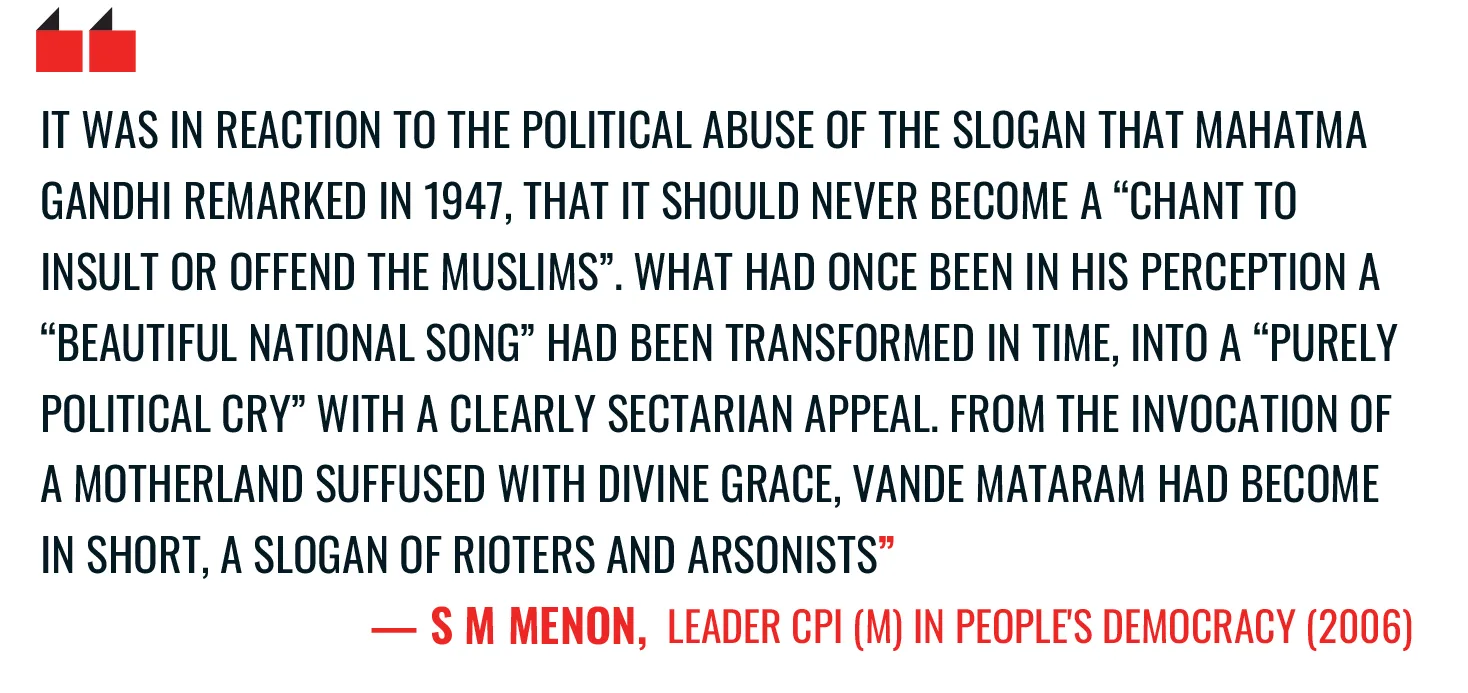
We do have evidences that Maulana Azad admired Vande Mataram after listening to the renowned singer Krishna Kumar on January 1, 1952 at Delhi. Azad described it as graceful and inspiring, mentioning the names of many great leaders and freedom fighters who used to sing it. There are names of certain others like Rafi Ahmad Kidwai, Aruna Asaf Ali and others who enthusiastically sang the Vande Mataram, the echoes of which were heard throughout the 1942 Movement, during the Naval Uprising of 1946 and the massive protests against the trial of Azad Hind Fauj soldiers and officers during 1945-46. Yet today, we again find the so called secularists, lutyens, many Congressmen and opposition leaders along with the Fanatic Islamists and Communists raising a hue and cry against the singing of Vande Mataram.
The same Communists who, for their vote bank politics, would leave no stone unturned to use Kali worship as a tool for their mobilisation, vehemently oppose Vande Mataram – the prayer to Goddess Kali. The political opportunists may attempt or shout, there is no doubt that among the common people of Bharat, Vande Mataram not only represents a prayer to Maa Kali but also an inspiration to save the motherland, to fight for the motherland and to work for the motherland. The braves of our defence forces who guard our territorial integrity, our democracy and Constitution serving the nation 24 hours away from their loved ones enthusiastically raise the slogans of Vande Mataram. There is no doubt that when one listens to this great patriotic song or even the slogan of Vande Mataram, one feels being gripped with national feelings. The scenes from the movie Ananda Math come before my eyes where Devi Chaudharani is leading the forces against the British singing Vande Mataram.
The Communists denounce religion as the “opium of the masses” conveniently avoiding a reference to the other words that it is “The heart of a heartless society”. At the same time, though they acknowledge that Vande Mataram is a prayer of Kali, they totally oppose its singing or sloganeering. However, they aggressively utilise the Durga Puja only as a tool for political mobilisation in Bengal. They are also opposed to Bharat Mata being a symbol to defend the country and firmly believe that any reference to Bharat Mata is against the Islamists and thereby provide credibility to the utterances and attacks by fanatics on the Hindus.