India has long endured relentless brutalities in the name of religion, yet kept its ancient tradition and religious inclusivity alive to this day. The inhabitant Hindus were, time and again, butchered, enslaved, and forced to renounce their faith. Countless invasions by Muslim rulers turned cities into killing fields. Historians state countless examples of barbarities of Muslim rulers, to mention a few—Muhammad Bakhtyar Khilji conquered Bihar, and he put to the sword about one hundred thousand Brahmans, and burnt a valuable library of ancient Sanskrit works. Emperor Firoz Shah Tughlak destroyed all Hindu temples in the city of Bhilsa in Bhopal, took away their idols, and had them daily bathed publicly with the blood of a thousand Hindus. Such barbarities continued for centuries.
However, the legacy that shaped India’s destiny and its belief in inclusiveness was embodied by luminous souls who emerged from the era of such horrors, the incarnation of Baba Farid, Sant Kabir, Sant Namdev, Sant Ravidas, and Sant Ramanand, who fearlessly preached the oneness of God, pluralism, and coexistence, opposing tyranny and violence. Muslim rulers, back then, did not want coexistence with others; therefore, they weaponised Islam to spread terror and barbarism. Even saints like Kabir, Namdev, and Ravidas were persecuted for spreading the message of oneness of God.
It is said that whenever the hour becomes darkest, somewhere, someone is born who brings light to the world. In this part of the world, to dispel the centuries of darkness, Nanak was born. It is said on the birth of Nanak:
Satgur Nanak Pragatya
Miti Dhundh Jag Chanan Hoya
It means Nanak was born as a light that lit the world from the darkness. The birth of Nanak was a step towards restoring the holy sanctity and purity of religions.
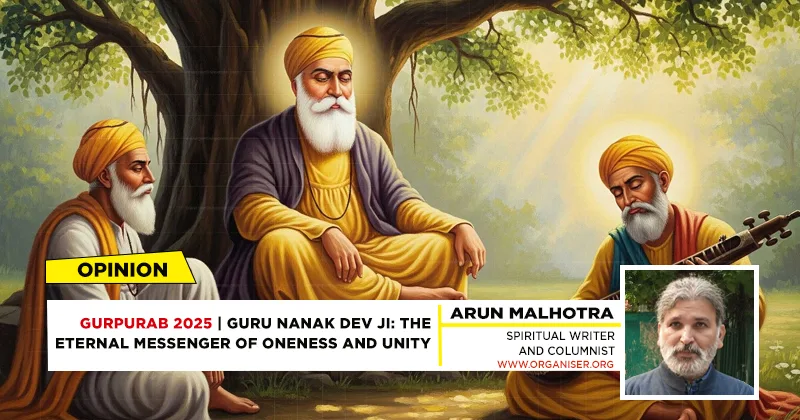
The core message of Guru Nanak is about ‘the oneness of God’. The profound truth that Guru Sahib introduced is ‘Ek Onkar Sat Nam’ there is only one oneness, and that is the true name. Guru Sahib explains ‘That-which-is’ and calls it ‘oneness’. Ek Onkar. God is oneness. God is suchness. That suchness is the oneness. And that name is the truth—Sat Nam. Ek Onkar is Nanak’s way to unite the world and to ignite realisation that beneath every division of religion, sect or tradition—lies one common thread of Divinity—The True Name—Sat Nam.
In Banaras, when Chatur Das, a professor, bragged of knowing fourteen types of sciences challenging Guru Sahib, Nanak said that his knowledge is nothing compared to and said the following profound truth:
Oṅkār ne Brahma upāiā, Oṅkār kiā sabh bōdh. Oṅkār parbat parie, Oṅkār ne sabh lōh.
Oṅkār veda utpai, Oṅkār sabh jīat. Oṅkār kiā rājā thāpīai, Oṅkār bah mel.
Oṅkār ne sādhu upāiā, Oṅkār kiā dhyān. Oṅkār kiā jogī jog, Oṅkār kiā bhāg.
Oṅkār kiā bānī., Oṅkār kiā sabh jug. Oṅkār ne bāk mūk, Oṅkār bakh hai so.
“Onkar created Brahma. Onkar introduced us to wisdom. Onkar made mountains established. Out of Onkar came all ages and Vedas were created. All living live by Onkar, and kings are installed and assemblies gathered by it. Holy men are created by it and Onkar is meditated upon. Under Onkar, does Yogis perform? Onkar emanated speech, and Onkar brought all ages (jugs). Onkar gives a speech to the dumb and it is a gift to Humanity.” Today, cosmology and quantum theory accept the role of primordial vibration (The Onkar) from which the universe arises.
From early on, the young Guru Nanak denounced violence, and he also saw the root cause of violence lay in the hypocrisy of religious dogmatism and orthodoxy.
Guru Nanak stands as the most courageous, revolutionary and visionary leader in all of religious history. Guru Sahib continued to raise questions against falsehood, empty orthodoxy, hypocrisy of religious dogmas, practices, priestly incapacity, religious fundamentalism and institutional misunderstanding. In his journeys across India and distant lands, His luminous questioning exposed Rulers, Qazis, Mullahs, Kings and self-styled Saints who misused religion as an instrument of pride, power, and control over others. When the rulers were immensely ruthless, their political system immeasurably corrupt, and Priests and Qazis (judges) wielded extreme religious authority, Guru Sahib’s burst against them was selfless and fearless and on every occasion, His prophetic voice carried the light of the absolute truth, and he stood up against the religious deceit and hypocrisy.
Guru Sahib would articulate ‘truth’ eye to eye, witnessing the bloodshed unleashed by Babur he called Babur Zabar(the tyrant invader). The Guru thus describes the Muhammadan rulers and the state of India in his time:–
Chorasi jug chauri churi. Raja kasai dharam pankh udri.
Koor raat si galeh pohu. Sat chandarman nikalya na hoi.
Khojdiyan mein paya nahin. Andher andar panth na paai.
Haumai vadi kar kar roi. Kiven chuttiye chuttiye hoi.
This age is a knife, kings are butchers; justice has taken wings and fled.
In this completely dark night of falsehood the moon of truth is never seen to rise.
I have become perplexed in my search; In the darkness I find no way.
Devoted to pride, I weep in sorrow; How shall deliverance be obtained?
Guru Nanak would continue to shatter the falsehood of religious elites. Guru Sahib’s historic encounter with Sidhs (the accomplished ones), known as Sidh Goshti, took place at the Gorkhmata Temple, where Gurdwara Sri Nanak Matta Sahib is located in the Pilibhit district today. The Sidhs asked, ‘O youth, you become a Jogi, and adopt the dress of our order, so how will you find the true way and obtain the merits of religion?’ Guru Sahib shattered their belief and replied by singing this hymn:–
Dharam na janai jataa kaprā dhotī bhekh āsan nāthā.
Dharam na janai mon malak tilak dīp gaun kathāthā.
Such hīn phirai pardesī.
Dharam na janai pākhaṇḍ ghanere.
Dharam na janai nāṛī dhare.
Dharam na janai mundar mūṇḍe.
Panthī vājā phukde jhaṇḍe.
Dharam na janai kūṛ bol.
Tant kīe paunai chol.
Man kapat vashṭ lai avagun chīn.
Mat tholī kasumbh dhaṛīn.
Āpe nadar kare dayāl.
Nanak says in abrupt truthfulness, rendering those questioning him speechless, that “the religion is neither in a patched coat, nor in a Jogi’s staff, nor in ashes smeared over the body. Nor in earrings worn, nor a shaven head, nor in the blowing of conch shells. He says religion is not in mere mantra chanting or in waving religious flags, but abiding in the pure self amid the impurities of the world and with His gracious glance, one becomes truly compassionate.”
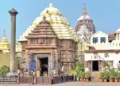
When Guru Sahib visited Jagannath Puri, Bhagwan Jagannath Arti (Prayers) were being offered with great devotion on platters(thaals) studded with flowers, pearls and incense and lamps all around the temple illuminating every corner of the temple. When the priest asked Guru Sahib to offer prayers to Bhagwan Jagannath, Guru Sahib looked into the sky and said there was an eternal prayer (aarti) that is being performed eternally and sang this hymn:
Gagan Mein Thaal Rav
Chand Dipak bane,
Tarika Mandal Janak Moti,
Dhoop Malyanlo Pavan Chavro Kare
Sagal Banray Phulant Joti,
Kaisi Arti Hoye Bhav
Khandna Teri Aarti.
The sky is the platter (Puja Thaal) for prayers (for arti); the sun and moon are the lamps; the stars in the constellation are the jewels and pearls. The sandal-wood fragrance and wind is the celestial fan to spread fragrance, and all the rows of blooming forests are flowers, O Lord of light. What wonderful worship this is, O, the Destroyer of fear—this is your Aarti!
Guru Sahib says true religion makes you compassionate. Guru Sahib stood as an uncompromising voice against the misuse of religion for power, greed, violence and self-righteousness and twisted faith as a tool for exploitation, control and oppression through empty rituals, conversion for profit and justifying violence. Rather than blind rituals, he emphasised on experiencing the divine and cutting the veils of dogmas. One can clearly see that Guru Sahib went to distant lands thousands of miles across India, Arabia, Tibet, Persia and beyond in an age when travel was unsafe.
In his journey to the Arab world, Guru Nanak continues to surprise us. The question arises, why did Guru Sahib go to Mecca, where people of other faiths were not allowed?
In Mecca, Qazi Ruknuddin posed 360 questions to Guru Sahib, and after that he fell to Guru Sahib’s feet. He asked:
Puchhan phol kitaab no, Hindu vada ki Musalmanoi?
“Open and search your book and tell us who is a great Hindu or a Muslim?”
Guru Sahib replied in point-blank precision, rendering the questioner speechless:
Baba aakhe haajian, subh amla baajho dono roi.
Hindu Musalmaan due dargeh andar lahan na dhoi.
Guru Sahib replies that without good deeds, both will have to cry in God’s court.
Both Hindus and Muslims will not find acceptance simply based on their religion.
When Qazi inquired why did he sleep with his feet towards the Mecca. And Guru Sahib said, ‘point my feet to where God is not present’. After that Guru Sahib replied quoting The Holy Quran that when the God addressed Mohammad Sahib and said ‘Nakhan Akarth Wa Alahay Min Habul Vareed’–“I am closer to every human nearer than the jugular veins”. Guru Sahib said that the God cannot be restricted to one direction or place and is present everywhere and within every heart.
Then Qazi said, “singing and music is forbidden in Islam”, to which Guru Sahib said “it is written in Hadees that Prophet Mohammad went to a wedding and seeing Mohammad Sahib girls stopped singing & dancing, but Mohammad Sahib said that they should sing folk songs and God will bestow respect on them.
Then Nanak sang this prayer in Persian :
Yak araj gufṯam pes ṯo ḏar gos kun karṯār.
Hakā Kabīr karīm ṯū be-aib parvarḏagār.
Ḏunī▫ā mukāme fānī ṯėhkīk ḏil ḏānī.
Mam sar mū-e ajrā-īl girafṯėh ḏil hecẖ na ḏānī.
Jan pisar paḏar birāḏarāʼn kas nes ḏasṯaʼngīr.
Ākẖir bi-afṯam kas na ḏāraḏ cẖūʼn savaḏ ṯakbīr.
Sab roj gasṯam ḏar havā karḏem baḏī kẖi-āl.
Gāhe na nekī kār karḏam mam īʼn cẖinī ahvāl.
Baḏbakẖaṯ ham cẖo bakẖīl gāfil benajar bebāk.
Nānak bugoyaḏ jan ṯurā ṯere cẖākrāʼn pā kẖāk.
Nanak says: “I offer this one prayer to You; please listen to it, O Creator Lord. You are true, great, merciful and spotless, O Cherisher Lord. The world is a transitory place of mortality – know this for certain in your mind. Azraa-eel, the Messenger of Death, has caught me by the hair on my head, and yet, I do not know it at all in my mind. Spouse, children, parents and siblings – none of them will be there to hold your hand. And when at last I fall, and the time of my last prayer has come, there shall be no one to rescue me. Night and day, I wandered around in greed, contemplating evil schemes. I never did good deeds; this is my condition. I am unfortunate, miserly, negligent, shameless and without the Fear of God. Says Nanak, I am Your humble servant, the dust of the feet of Your slaves.”
As the legend says, this prayer became the only prayer of Qazi Ruknuddin, and he was finally stoned to death for following Nanak and becoming his disciple. In his last words, Qazi said before leaving his body: ‘Rubanian Khatiba el imme hazra Nanak ma, Akallamehu ina feehay musle mun’. “The spiritual sermon of the revered Imam Nanak has indeed been delivered to you all muslims”
Guru Nanak has successfully laid the foundation for spiritual ethos in ‘oneness of God’. and ‘oneness of religions’. Guru Sahib’s vision lives in all of us. If one truly lives one’s religion wholeheartedly, one tends to respect the religion of others wholeheartedly. When we don’t, we follow the authority of self-serving priests and blind adherence to rituals, distance ourselves from authentic message. Guru Sahib says the divine is not in mechanical recitations, pilgrimages or external forms, but by constant remembrance of God through (Naam Japo) and earning an honest living (Kirat Karo) and sharing with others (Vand Chhako).
References:
1. ‘Guru Nanak at Mecca’
During Guru Nanak’s journeys in the Middle East a local author. Taajudin Naqshbandhi Joined Guru Nanak and documented his time in great detail. Four centuries later, a young man from Kashmir Syed Mushtaq Hussain chanced upon Taajudin’s handwritten manuscript and this changed his life and he converted into Sikhism and went on to become Sant Syed Prithipal Singh. Mushtaq Hussain took notes from Taajudin’s manuscripts and another book Twarikh-e-Arab written by Khwaja Jainul Abdin, a Muslim author who also accompanied Guru Nanak during his travels to Mecca. Mushtaq’s notes later formed the basis of the Punjabi Book, Baba Nanak Di Baghdad Pheri. This book was later translated and published as ‘Guru Nanak at Mecca’ in English.