Karnataka Congress views on RSS:  Irrational, Arrogant and Undemocratic
June 23, 2026
  • Read Ecopy
  • Circulation
  • Advertise
  • Careers
  • About Us
  • Contact Us
Android AppiPhone AppArattai
Organiser
  • ‌
  • Bharat
    • Assam
    • Bihar
    • Chhattisgarh
    • Jharkhand
    • Maharashtra
    • View All States
  • World
    • Asia
    • Europe
    • North America
    • South America
    • Africa
    • Australia
  • Editorial
  • International
  • Opinion
  • RSS @ 100
  • More
    • Op Sindoor
    • Analysis
    • Sports
    • Defence
    • Politics
    • Business
    • Economy
    • Culture
    • Special Report
    • Sci & Tech
    • Entertainment
    • G20
    • Azadi Ka Amrit Mahotsav
    • Vocal4Local
    • Web Stories
    • Education
    • Employment
    • Books
    • Interviews
    • Travel
    • Law
    • Health
    • Obituary
  • Subscribe
    • Subscribe Print Edition
    • Subscribe Ecopy
    • Read Ecopy
  • ‌
  • Bharat
    • Assam
    • Bihar
    • Chhattisgarh
    • Jharkhand
    • Maharashtra
    • View All States
  • World
    • Asia
    • Europe
    • North America
    • South America
    • Africa
    • Australia
  • Editorial
  • International
  • Opinion
  • RSS @ 100
  • More
    • Op Sindoor
    • Analysis
    • Sports
    • Defence
    • Politics
    • Business
    • Economy
    • Culture
    • Special Report
    • Sci & Tech
    • Entertainment
    • G20
    • Azadi Ka Amrit Mahotsav
    • Vocal4Local
    • Web Stories
    • Education
    • Employment
    • Books
    • Interviews
    • Travel
    • Law
    • Health
    • Obituary
  • Subscribe
    • Subscribe Print Edition
    • Subscribe Ecopy
    • Read Ecopy
Organiser
  • Home
  • Bharat
  • World
  • Operation Sindoor
  • Editorial
  • Analysis
  • Opinion
  • Culture
  • Defence
  • International Edition
  • RSS @ 100
  • Magazine
  • Read Ecopy
Home Politics

Karnataka Congress views on RSS:  Irrational, Arrogant and Undemocratic

To cosy himself to Gandhi family like his father, Priyank Kharge recently took an unethical stand by trying to restrict RSS’s activities near Govt institutions during Path Sanchalans during Vijayadashami. This irrational move by Karnataka Minister was not just an ideological stance but echoes Congress’s familiar anti-Sangh diatribe

Saathwik ShettySaathwik Shetty
Nov 3, 2025, 09:00 pm IST
in Politics, Analysis
Follow on Google News
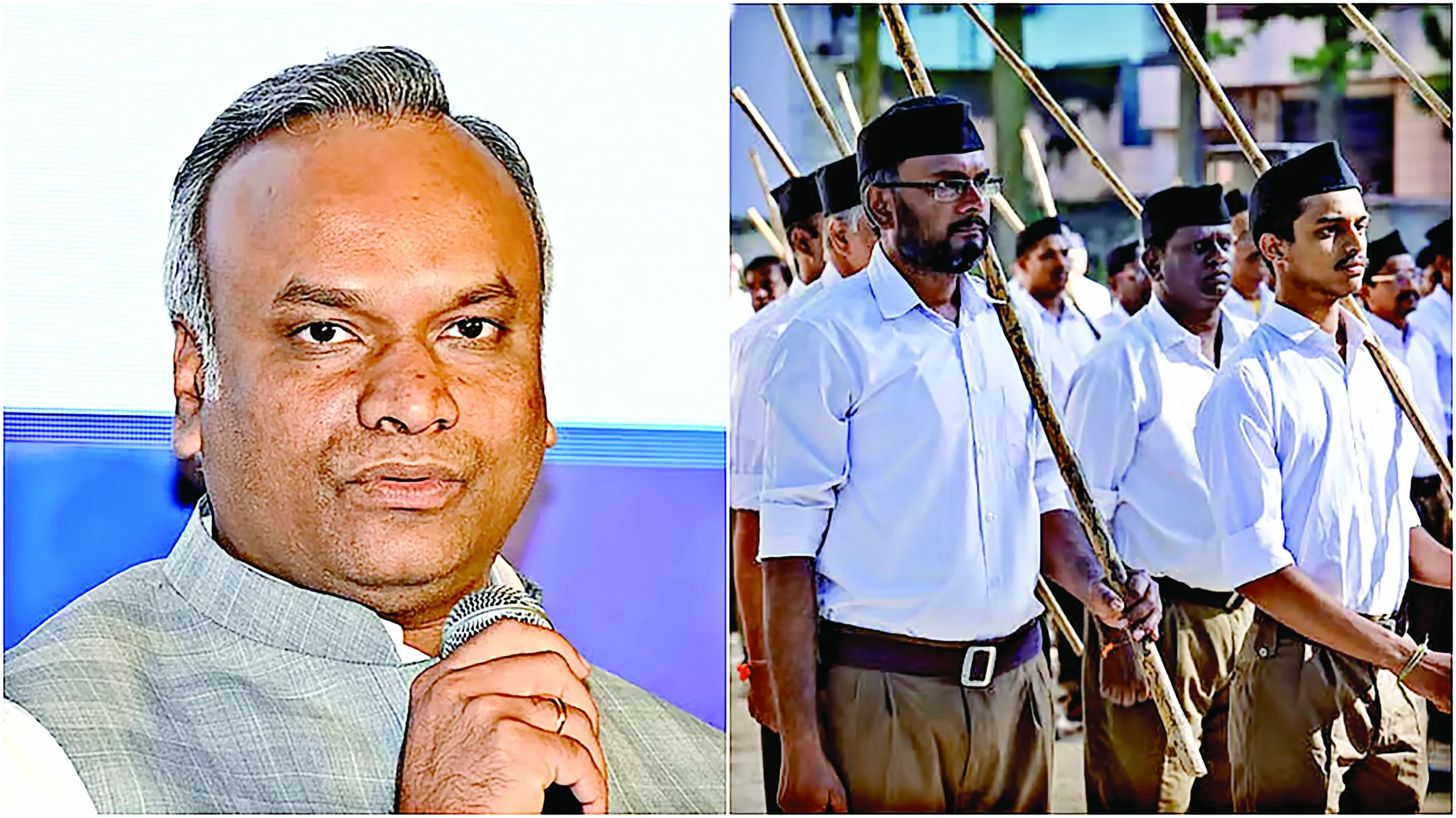
Priyank, son of Mallikarjun Kharge, took action against State employees attending Path Sanchalans during Vijayadashami in a bid to position himself as the Gandhi camp’s loyalist in Karnataka’s fractured Congress ecosystem

Priyank, son of Mallikarjun Kharge, took action against State employees attending Path Sanchalans during Vijayadashami in a bid to position himself as the Gandhi camp’s loyalist in Karnataka’s fractured Congress ecosystem

FacebookTwitterWhatsAppTelegramEmail

Karnataka has increasingly become the epicentre of political theatrics – policies designed more to distract than to deliver. The State’s newest political spectacle comes from Priyank Kharge, who recently sought to restrict RSS activities near Government schools and take action against State employees attending Path Sanchalans during Vijayadashami. The move, couched as an ideological stance, echoes Congress’s familiar anti-Sangh narrative. It’s a convenient strategy that keeps debates alive while masking the party’s governance shortcomings. Yet, this attempt to reignite old ideological fires may say less about principles and more about ambition.

Priyank: New Loyalist to Gandhi Family

For Priyank, son of Mallikarjun Kharge, it appears to be a calculated bid to position himself as the Gandhi camp’s loyalist in Karnataka’s fractured Congress ecosystem.

As the Government crosses its mid term mark, Karnataka’s political landscape remains clouded by uncertainty. The tug-of-war between Chief Minister Siddaramaiah and his Deputy DK Shivakumar has paralysed administrative cohesion. Power equations shift weekly, and whispers of a leadership change refuse to die down. Congress’s internal strife has created a leadership vacuum that ambitious younger leaders are eager to fill. In this flux, Priyank Kharge sees an opportunity to carve a niche as the ideological face of the party in the State. His aggressive anti-RSS stance offers a differentiator from Siddaramaiah’s corruption-tainted image and Shivakumar’s ambiguous flirtation with soft Hindutva. But it also exposes him to backlash from both within and outside the party.
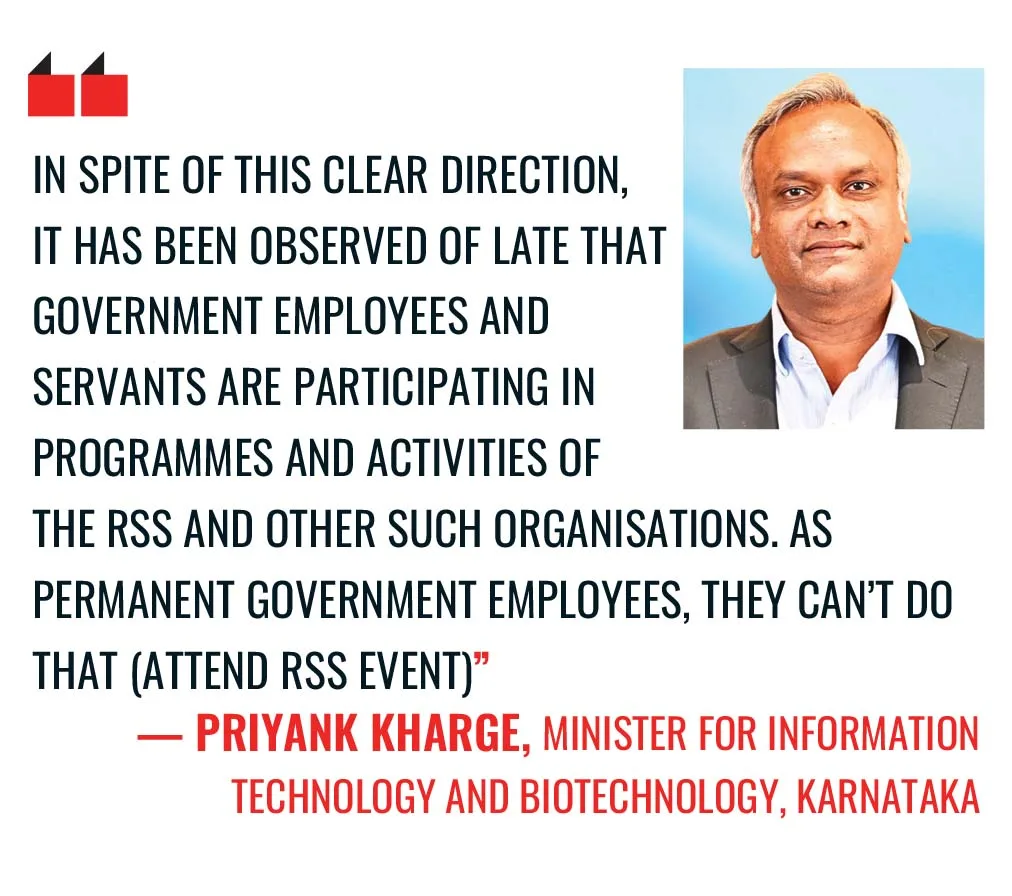
Kharge’s recent directive against RSS gatherings was intended as a bold assertion of ideological clarity. Instead, it backfired spectacularly. Public outrage was swift, and even within Congress, murmurs of dissent surfaced. The Karnataka High Court’s decision to stay the Government order, which required prior permission for public gatherings of more than ten people, underscored the legal and political overreach. What was meant to project Kharge as a fearless ideological warrior has instead reinforced perceptions of political immaturity. His attempt to capture the anti-Sangh mantle, long a loyalty marker for those courting the Gandhi family, has revealed its limits in a state where ideological polarisation is no longer a vote-winner. Karnataka’s voters are more concerned about jobs and infrastructure than rhetorical crusades.

Kharge Jr’s Ideological Theatre

Priyank Kharge’s troubles extend beyond ideological theatrics. As the IT and BT Minister, his track record invites uncomfortable scrutiny. Karnataka, once India’s undisputed tech hub, has watched major investments drift elsewhere. Google’s $15 billion commitment to Andhra Pradesh’s Vizag for an AI and data centre, and the decision of semiconductor firms to prefer Gujarat and Assam, have sparked questions about Bengaluru’s diminishing appeal. Instead of drawing investment headlines, Priyank now finds himself in controversy – his remarks dismissing Assam’s youth talent triggered backlash nationwide. His loud ideological posturing appears to serve as a cover for weak administrative results. For a minister expected to champion innovation and industry, the optics of antagonising both investors and ideological opponents have not helped his standing within the Government or the party.

Priyank Kharge’s anti-RSS rhetoric may achieve neither ideological clarity nor political gain. It exposes a deeper malaise within Karnataka Congress – a reliance on symbolism over substance, and narrative over governance. His attempt to channel Rahul Gandhi’s ideological line might win temporary favour in Delhi, but it offers little relief to a state weary of political gimmickry and policy paralysis. As the Government’s halfway mark passes, the electorate’s patience wears thin. If Congress continues to trade real progress for performative politics, even its most ambitious heirs may find themselves out of step with the people they claim to represent.

Congress’s 2023 electoral victory in Karnataka was built on its much-hyped “five guarantees” – a populist formula that promised relief but delivered fiscal strain. The scheme’s success in securing votes inspired the party to replicate it nationally, only to watch the model collapse elsewhere. Even within Karnataka, these guarantees have turned from triumph to burden. The promises drained State coffers, leaving little room for developmental spending. Ministers and MLAs now grapple with the consequences of populism without progress. Instead of course correction, the Congress Government in Karnataka has leaned into distractions – targeting religious institutions and Hindu leaders under the guise of accountability. From the politically motivated SIT probe into the Dharmasthala case to attacks on figures like Dr Prabhakar Bhat, the State’s narrative has shifted from governance to grievance.

Historical conflict with RSS

Since Independence, the Congress regarded the RSS as its principal ideological and organisational challenge. In the aftermath of the Gandhi assassination, the Congress Government banned the Sangh in 1948, despite commissions later clearing the Sangh of involvement, illustrating how the Congress leadership equated the Sangh with a threat to its control of the new state. Though the ban was lifted in 1949, yet the antagonistic relationship endured: the Sangh’s grassroots presence and independent social network remained a constant corrective to Congress’s dominance.

Congress’s confrontation with Sangh intensified during Emergency

During that phase, the Congress government sought to suppress not only political opponents but civil society networks, including the Sangh, which the Congress perceived as a bulwark opposing its centralising and authoritarian impulses. Meanwhile the Sangh, by its account, portrayed itself as defender of democratic norms and national identity, and in the decades since it has moved from the fringes to substantial societal acceptance, among urban elites, grassroots villagers and remote rural areas alike. In this context, internal Congress manoeuvres, such as Priyank Kharge’s alignment with Rahul Gandhi, are being analysed by observers as signs of a party repositioning around its first-family narrative in response to the Sangh-driven societal shift. This can also be viewed as Priyank Kharge seeking to project himself as part of a new loyal cohort, filling the space left vacant as the senior and older leadership fades away.

Topics: Congress’s familiar anti-Sangh narrativeRSSMallikarjun KhargeCongress’sKharge Jr’s Ideological TheatrePriyank Kharge’s troublePath Sanchalans during Vijayadashami
ShareTweetSendShareSend
✮ Subscribe Organiser YouTube Channel. ✮
✮ Join Organiser's WhatsApp channel for Nationalist views beyond the news. ✮
Previous News

President Droupadi Murmu’s visit to Sabrimala:  Action speaks louder than words

Next News

Tharoor attacks dynastic dominance in Congress, internal dissent rises as family rule debate hits election season

Related News

(Left) Petrol bomb hurled at BJP leader’s clinic opposite newly inaugurated RSS office in Bhatinda (Right) BJP leader Dr Tarsem Garg

Punjab: Petrol bomb hurled at BJP leader’s clinic opposite newly inaugurated RSS office in Bhatinda

Functionaries of Akhil Bharatiya Rashtriya Seva Bharati on the stage release Rashtriya Seva Sadhana–2026

Tamil Nadu: Seva Bharati reviews service initiatives, charts roadmap for future expansion

PM Modi Pays Homage to Jan Sangh Founder Syama Prasad Mookerjee

Balidan Diwas: PM Modi pays tribute to Jan Sangh founder Syama Prasad Mookerjee, hails his nationalist legacy

(Left) Dr. Shyama Prasad Mookerjee (Right) of Dr Keshav Baliram Hedgewar

Bengal and the Sangh: The historical bond forged by Dr Keshav Baliram Hedgewar and Shyama Prasad Mookerjee

Remembering Dr Shyama Prasad Mookerjee on his death anniversary – A great Nationalist and architect of political vision

Book Review | Swayamsevak: Insightful accounts to decipher RSS

Load More

Latest News

Kamakhya Mandir

Kamakhya Mandir’s Ambubachi Mela: The ancient tradition that honours the menstruation of mother Earth

Amazon in dock for mocking Hindu Gods

Amazon File: From Ganesha to Aryabhata-Has Amazon India become a platform for Anti-Hindu narratives?

The West Bengal Budget 2026–27 aims to drive growth through infrastructure, industry, innovation and welfare

Reimagining Bengal: How the West Bengal Budget 2026–27 seeks to balance growth, welfare & economic transformation

Pratiraksha is Gujarat Police's Aadhaar-based verification platform designed to identify illegal workers and prevent identity fraud in industrial sectors

Pratiraksha: How Gujarat police uses Aadhaar verification to secure industrial workforce against identity fraud

Israel-Iran crisis has highlighted not only shifting dynamics of West Asia but also growing confidence of India's foreign policy

India, Israel and the rise of strategic autonomy in an era of global geopolitical realignment

Saleem and Jaleel arrested in forced religious conversion case

Karnataka Conversion Case: Forced conversion of Hindu woman and minor son sparks outrage; Saleem and Jaleel arrested

Bareilly Cantonment Emerges as Model for Sustainable Urban Development in India (Image Source X)

Uttar Pradesh: Bareilly Cantonment becomes India’s first carbon-negative cantonment

CM Yogi Adityanath making industry, investment and the connectivity revolution in Eastern Uttar Pradesh

The Purvanchal Growth Story: How industry, infrastructure, tourism & exports are fueling development in eastern UP

(Left) Fire at the coaching centre in Lucknow (Right) Members of ABVP extending all possible help

Lucknow Coaching Centre Fire tragedy is heartbreaking and deeply unfortunate: ABVP seeks action against culprits

Andhra Pradesh Minister and TDP National General Secretary Nara Lokesh

Nara Lokesh dismisses rumours of TDP sabotaging Modi government, reaffirms unconditional NDA support

Load More
  • Privacy
  • Terms
  • Cookie Policy
  • Refund and Cancellation
  • Delivery and Shipping

© Bharat Prakashan (Delhi) Limited.
Tech-enabled by Ananthapuri Technologies

  • Home
  • Search Organiser
  • Bharat
    • Assam
    • Bihar
    • Chhattisgarh
    • Jharkhand
    • Maharashtra
    • View All States
  • World
    • Asia
    • Africa
    • North America
    • South America
    • Europe
    • Australia
  • Editorial
  • Operation Sindoor
  • Opinion
  • Analysis
  • Defence
  • Culture
  • Sports
  • Business
  • RSS @ 100
  • Entertainment
  • More ..
    • Sci & Tech
    • Vocal4Local
    • Special Report
    • Education
    • Employment
    • Books
    • Interviews
    • Travel
    • Health
    • Politics
    • Law
    • Economy
    • Obituary
  • Subscribe Magazine
  • Read Ecopy
  • Advertise
  • Circulation
  • Careers
  • About Us
  • Contact Us
  • Policies & Terms
    • Privacy Policy
    • Cookie Policy
    • Refund and Cancellation
    • Terms of Use

© Bharat Prakashan (Delhi) Limited.
Tech-enabled by Ananthapuri Technologies