Labbaik Uprising: How pro-Gaza march turned into battle for power
June 23, 2026
  • Read Ecopy
  • Circulation
  • Advertise
  • Careers
  • About Us
  • Contact Us
Android AppiPhone AppArattai
Organiser
  • ‌
  • Bharat
    • Assam
    • Bihar
    • Chhattisgarh
    • Jharkhand
    • Maharashtra
    • View All States
  • World
    • Asia
    • Europe
    • North America
    • South America
    • Africa
    • Australia
  • Editorial
  • International
  • Opinion
  • RSS @ 100
  • More
    • Op Sindoor
    • Analysis
    • Sports
    • Defence
    • Politics
    • Business
    • Economy
    • Culture
    • Special Report
    • Sci & Tech
    • Entertainment
    • G20
    • Azadi Ka Amrit Mahotsav
    • Vocal4Local
    • Web Stories
    • Education
    • Employment
    • Books
    • Interviews
    • Travel
    • Law
    • Health
    • Obituary
  • Subscribe
    • Subscribe Print Edition
    • Subscribe Ecopy
    • Read Ecopy
  • ‌
  • Bharat
    • Assam
    • Bihar
    • Chhattisgarh
    • Jharkhand
    • Maharashtra
    • View All States
  • World
    • Asia
    • Europe
    • North America
    • South America
    • Africa
    • Australia
  • Editorial
  • International
  • Opinion
  • RSS @ 100
  • More
    • Op Sindoor
    • Analysis
    • Sports
    • Defence
    • Politics
    • Business
    • Economy
    • Culture
    • Special Report
    • Sci & Tech
    • Entertainment
    • G20
    • Azadi Ka Amrit Mahotsav
    • Vocal4Local
    • Web Stories
    • Education
    • Employment
    • Books
    • Interviews
    • Travel
    • Law
    • Health
    • Obituary
  • Subscribe
    • Subscribe Print Edition
    • Subscribe Ecopy
    • Read Ecopy
Organiser
  • Home
  • Bharat
  • World
  • Operation Sindoor
  • Editorial
  • Analysis
  • Opinion
  • Culture
  • Defence
  • International Edition
  • RSS @ 100
  • Magazine
  • Read Ecopy
Home World

The Labbaik Uprising: How Pakistan’s islamist movement turned a pro-Gaza march into a battle for power

The goal of Tehreek-e-Labbaik Pakistan (TLP) is to corner the state: force it to make concessions or risk backlash. For the government, allowing TLP to enter Islamabad freely would signify a loss of authority; on the other hand, heavy-handed suppression could lead to increased unrest

Vedika ZnwarVedika Znwar
Oct 14, 2025, 10:00 pm IST
in World, South Asia
Follow on Google News
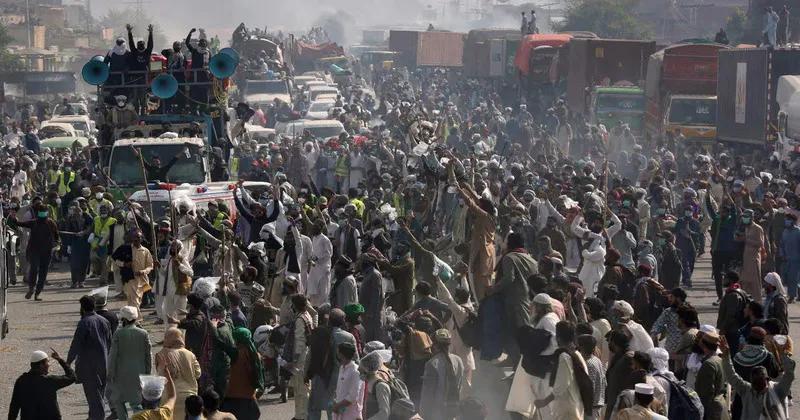
The goal of TLP is to force state to make concessions. For government, allowing TLP enter Islamabad freely would signify a loss of authority

The goal of TLP is to force state to make concessions. For government, allowing TLP enter Islamabad freely would signify a loss of authority

FacebookTwitterWhatsAppTelegramEmail

The recent outbreak of violence in Lahore, Muridke and the approach to Islamabad, sparked by protests from Tehreek-e-Labbaik Pakistan (TLP), represents one of the most intense confrontations in Pakistan in the recent years. What started as a march to support Palestinians has turned into a fierce conflict between an Islamist populist group and state authority. To grasp why these protests turned violent and the current situation, it is important to understand what TLP is and what it aims to achieve, as well as how the state felt compelled to respond.

TLP is not a new entity in Pakistan’s complicated landscape of religion and politics. Founded in 2015 by Khadim Hussain Rizvi, a controversial cleric who advocated for strict blasphemy laws, TLP gained traction by tapping into public outrage over perceived insults to Islam and the Prophet. Under Rizvi’s leadership, the party organized disruptive protests and enforced moral codes, forcing governments to respond to its demands. After violent protests in 2020 led to a formal ban, the group regained legal standing due to its ability to mobilize religious feelings. Following Khadim Rizvi’s death, his son Saad Hussain Rizvi took over as leader, intensifying the party’s confrontational approach and incorporating pro-Palestinian imagery and rhetoric to broaden its support base.

In early October 2025, TLP initiated the “Labbaik Ya Aqsa Million March,” intending to travel from Lahore to Islamabad to protest Israeli actions in Gaza and call for a stronger stance from the Pakistani government. The group planned a demonstration outside the U.S. Embassy, merging its religious message, which emphasized defending Muslims worldwide, with anti-imperialist politics. However, the government viewed this march as a direct challenge to its authority and a potential source of unrest.

In preparation for the protests, the authorities took preventive actions. They blocked key roads into Islamabad and Rawalpindi, suspended mobile internet services and imposed Section 144, a ban on public gatherings, in sensitive areas. While these measures were justified as necessary for maintaining law and order, they highlighted the government’s anxiety over the potential success of the march.

When TLP supporters tried to advance, violence erupted. Protesters faced tear gas, baton charges, and eventually live fire. Police reported that demonstrators used stones, petrol bombs, and firearms against security forces. At least three TLP members were confirmed dead and a police station house officer was also killed. Many law enforcement personnel and civilians sustained injuries. The police claimed protesters set fire to around 40 vehicles, while TLP alleged that many more of its supporters were killed, accusing authorities of using excessive and indiscriminate force.

The police operation began early in the morning, lasting about six hours starting around 3 a.m. to disperse protesters camped in Muridke. Authorities defended their actions as necessary to uphold state authority, framing TLP’s defiance as a move toward treason and terrorism. Legal groups condemned the violence, stating that unarmed protesters and TLP leaders were shot at and demanding legal action and the release of detainees.

Live videos from the protests captured gunfire, billowing smoke, burning vehicles, and frantic crowds caught in tear gas. In one video, Saad Rizvi is heard telling supporters, “Arrest is not a problem, bullets are not a problem; martyrdom is our destiny”. This defiant message highlights how much TLP’s appeal relies on themes of sacrifice, persecution and unwavering religious commitment.

By Monday, police reported having cleared the Muridke encampment and reestablished stricter control over routes linking Lahore, Islamabad, and surrounding motorways. Dozens of protesters were detained, and mobile data services were restored in parts of Rawalpindi and Islamabad. Schools in Islamabad closed early amid fears of new unrest. Currently, while large-scale marches toward the capital have been blocked, the government and TLP are reportedly in discussions for a possible resolution.

However, the outcome remains uncertain. During the turmoil, rumors emerged that Saad Rizvi had been fatally shot; the government has neither confirmed nor denied this, likely to avoid making him a martyr. The significant presence of Pakistan Rangers and paramilitary forces indicates that the state is not just trying to contain the situation but seeks to deter TLP. The government’s approach has included closing the roads, suspending communications, and arresting activists. It shows its readiness to use considerable force against what it perceives as a destabilizing force.

Also Read: Sharia or Discrimination? Row erupts as girls excluded from mosque’s ‘all-inclusive’ race

These clashes reveal deeper divides in Pakistani society: between religious populist movements and a state asserting control over violence, between public support for the Palestinian cause and the limits of protest and between political legitimacy and coercive authority. TLP’s goal is to corner the state: force it to make concessions or risk backlash. For the government, allowing TLP to enter Islamabad freely would signify a loss of authority; on the other hand, heavy-handed suppression could lead to increased unrest.

If the current standoff ends in a compromise then perhaps a limited release of detainees and some easing of protests, Pakistan may weather this storm. But if either side miscalculates, violence could escalate further and TLP could emerge as a significant player in future struggles over religion, identity and political legitimacy in Pakistan.


Topics: PakistanViolent ProtestTehreek-e-Labbaik Pakistan (TLP)
ShareTweetSendShareSend
✮ Subscribe Organiser YouTube Channel. ✮
✮ Join Organiser's WhatsApp channel for Nationalist views beyond the news. ✮
Previous News

AI for inclusive societal development: NITI Aayog roadmap to empower its informal workforce

Next News

“Pakistan must look at itself in the mirror”: BJP MP Nishikant Dubey rebukes Islamabad at UNGA

Related News

Illegally constructed mosque in Japan

The Threat of Islamisation: A Japanese case study

7 killed and 3 injured in a twin blast at Khyber Pakhtunkhwa

Pakistan: 7 killed, 3 injured in twin blasts in Wazir sub-division of Khyber Pakhtunkhwa

Government employess of Balochistan begin indefinite strike against Pakistan

Balochistan on Boil: Govt employees start indefinite strike against Pakistan; 400 LPG bowsers stranded in Tuftan

Prestige Denim Mills' $20 million project marks India's industrial entry into one of Africa's fastest-growing textile hubs

India enters Egypt’s textile battlefield, challenging Chinese, Turkish and Pakistani dominance in Africa

Elderly caretaker Sikh couple killed inside the Gurdwara in pakistan

Pakistan: Elderly caretaker Sikh couple shot dead inside gurdwara at Mardan in Khyber Pakhtunkhwa province

PoJK Protests: 2 JAAC activists killed, 8 injured in Rawalakot; Pakistani security forces crackdown on civilians

Load More

Latest News

Kamakhya Mandir

Kamakhya Mandir’s Ambubachi Mela: The ancient tradition that honours the menstruation of mother Earth

Amazon in dock for mocking Hindu Gods

Amazon File: From Ganesha to Aryabhata-Has Amazon India become a platform for Anti-Hindu narratives?

The West Bengal Budget 2026–27 aims to drive growth through infrastructure, industry, innovation and welfare

Reimagining Bengal: How the West Bengal Budget 2026–27 seeks to balance growth, welfare & economic transformation

Pratiraksha is Gujarat Police's Aadhaar-based verification platform designed to identify illegal workers and prevent identity fraud in industrial sectors

Pratiraksha: How Gujarat police uses Aadhaar verification to secure industrial workforce against identity fraud

Israel-Iran crisis has highlighted not only shifting dynamics of West Asia but also growing confidence of India's foreign policy

India, Israel and the rise of strategic autonomy in an era of global geopolitical realignment

Saleem and Jaleel arrested in forced religious conversion case

Karnataka Conversion Case: Forced conversion of Hindu woman and minor son sparks outrage; Saleem and Jaleel arrested

Bareilly Cantonment Emerges as Model for Sustainable Urban Development in India (Image Source X)

Uttar Pradesh: Bareilly Cantonment becomes India’s first carbon-negative cantonment

CM Yogi Adityanath making industry, investment and the connectivity revolution in Eastern Uttar Pradesh

The Purvanchal Growth Story: How industry, infrastructure, tourism & exports are fueling development in eastern UP

(Left) Fire at the coaching centre in Lucknow (Right) Members of ABVP extending all possible help

Lucknow Coaching Centre Fire tragedy is heartbreaking and deeply unfortunate: ABVP seeks action against culprits

Andhra Pradesh Minister and TDP National General Secretary Nara Lokesh

Nara Lokesh dismisses rumours of TDP sabotaging Modi government, reaffirms unconditional NDA support

Load More
  • Privacy
  • Terms
  • Cookie Policy
  • Refund and Cancellation
  • Delivery and Shipping

© Bharat Prakashan (Delhi) Limited.
Tech-enabled by Ananthapuri Technologies

  • Home
  • Search Organiser
  • Bharat
    • Assam
    • Bihar
    • Chhattisgarh
    • Jharkhand
    • Maharashtra
    • View All States
  • World
    • Asia
    • Africa
    • North America
    • South America
    • Europe
    • Australia
  • Editorial
  • Operation Sindoor
  • Opinion
  • Analysis
  • Defence
  • Culture
  • Sports
  • Business
  • RSS @ 100
  • Entertainment
  • More ..
    • Sci & Tech
    • Vocal4Local
    • Special Report
    • Education
    • Employment
    • Books
    • Interviews
    • Travel
    • Health
    • Politics
    • Law
    • Economy
    • Obituary
  • Subscribe Magazine
  • Read Ecopy
  • Advertise
  • Circulation
  • Careers
  • About Us
  • Contact Us
  • Policies & Terms
    • Privacy Policy
    • Cookie Policy
    • Refund and Cancellation
    • Terms of Use

© Bharat Prakashan (Delhi) Limited.
Tech-enabled by Ananthapuri Technologies