The 21st edition of the International Education Show 2025 commenced at the Expo Centre Sharjah on October 8, offering four days of intensive academic networking, career guidance, and educational exchange. Organised by Expo Centre Sharjah in collaboration with the Sharjah Chamber of Commerce and Industry (SCCI), the Ministry of Education, Government of India, and the UAE’s Ministry of Higher Education and Scientific Research, this year’s event has emerged as one of the most influential platforms for students and educators seeking global opportunities.
Over 100 prestigious universities and academic institutions from 16 countries, including the United Kingdom, Spain, Germany, Hungary, the United States, Georgia, Malaysia, and India, are participating, underlining the fair’s growing stature in the Middle East’s education landscape.
India pavilion draws global attention
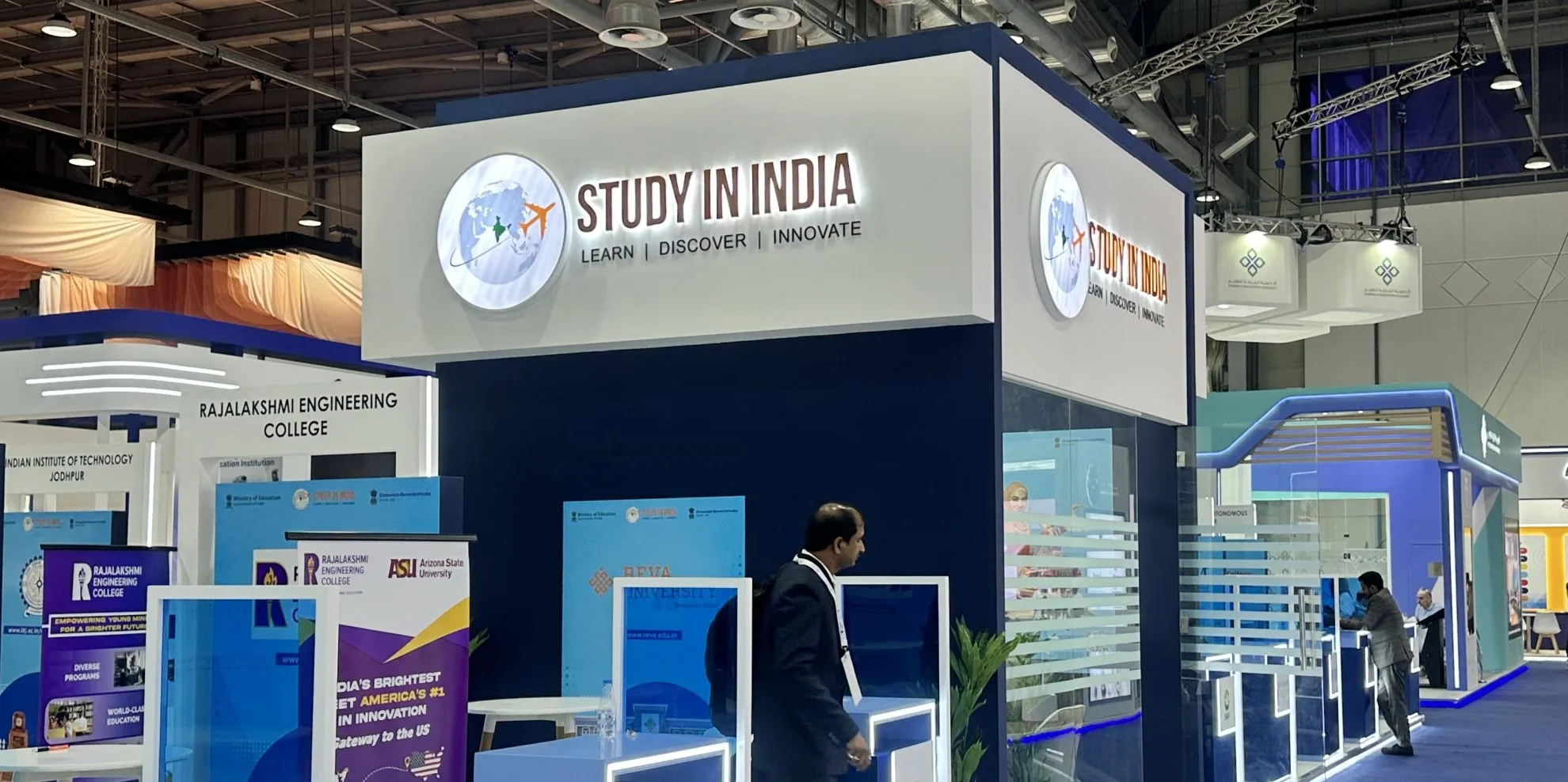
At the heart of this year’s exhibition is the India Pavilion, which has become a hub of attraction for international students and educationists alike. Mounted by EdCIL (India) Ltd., a Central Public Sector Enterprise under the Ministry of Education, the pavilion features 16 of India’s top educational institutions. Among the notable participants are IIT Delhi, BITS Pilani, Symbiosis International University, SRM University, IIM Lucknow, SP Jain Institute of Global Management, and Amity University.
The pavilion was inaugurated by Satish Kumar Sivan, Consul General of India in Dubai, who lauded India’s deepening educational ties with the Gulf region and its growing recognition as a centre of academic excellence.
In his remarks, K.K. Gautam, Deputy General Manager of EdCIL (India) Ltd., underlined the success of the Study in India programme, the Ministry of Education’s flagship initiative launched in 2018 to attract international students to Indian universities.
“This marks almost eight years since we began implementing the Study in India programme,” Gautam said. “It is a comprehensive initiative that encourages students from across the globe to experience India’s vast and diverse higher education ecosystem. This year, we’ve upgraded the programme portal with several student-friendly features, including the integration of the e-Visa facility and e-Foreigners Regional Registration Office (e-FRRO) Module. The portal now serves as a one-stop platform for students to register, explore universities, and seek assistance through a 24×7 AI chatbot and helpdesk.”
Study in India: Bharat with its role as Vishwaguru
India’s participation in the show is more than just a display of academic excellence; it reflects a broader civilisational vision. The Study in India initiative represents Bharat’s aspiration to reclaim its ancient identity as a Vishwaguru, rooted in the timeless philosophy of Vasudhaiva Kutumbakam.
For centuries, ancient Indian universities like Takshashila, Nalanda, and Vikramashila attracted scholars from across Asia and beyond. The current drive to promote Indian higher education globally can be seen as a continuation of that legacy, a reaffirmation that India’s pursuit of knowledge remains inclusive, universal, and spiritually grounded.
Today, India stands as the second-largest higher education system in the world, offering more than 10,000 courses across 1,000 universities and 51,000 colleges, with over 200,000 seats available to foreign students. Through the Study in India programme, these institutions are not only promoting academic excellence but also cultural exchange and mutual understanding among nations.
Global recognition and scholarships
The Study in India programme has gained traction due to India’s rising global academic reputation. Forty-six Indian universities feature in the QS World University Rankings, while institutions like IIT Madras, IIT Kanpur, and IISc Bengaluru have led groundbreaking international collaborations and joint degree programmes with top global universities.
Moreover, the Government of India has made education in India more accessible through scholarship programmes and financial aid initiatives. The Indian Council for Cultural Relations (ICCR) offers scholarships across 21 disciplines, while the Direct Admission of Students Abroad (DASA) scheme facilitates easier entry for foreign nationals. Together, these initiatives position India as an affordable yet world-class education destination.
Sharjah’s international education show
Over the years, the International Education Show has established itself as one of the UAE’s premier education fairs, attracting tens of thousands of visitors, including students, parents, and academic experts, seeking to explore higher education opportunities worldwide. The 2025 edition has expanded its focus to include emerging educational technologies, digital learning platforms, and AI-driven career guidance systems.
Visitors can engage directly with university representatives, seek admission guidance, and learn about scholarship options. The show also offers hands-on workshops on career planning, technical training, and entrepreneurship education, reflecting a holistic approach to academic growth.
Bharat’s education diplomacy is strengthening global ties
India’s strong presence in Sharjah this year signals the growing importance of education diplomacy as a pillar of India’s international engagement. By strengthening educational exchanges with countries in the Gulf Cooperation Council (GCC) and beyond, India is reinforcing people-to-people ties while contributing to the UAE’s vision of becoming a global education hub.
Officials noted that Indian institutions are increasingly attracting students not just from Asia and Africa, but also from Europe and the Americas, thanks to India’s unique blend of academic rigor, cultural inclusivity, and affordable education.
Vasudhaiva Kutumbakam in action
The Indian Pavilion at the Sharjah Education Show stands as a living embodiment of the Vasudhaiva Kutumbakam ethos, a message of harmony, inclusivity, and intellectual exchange. By welcoming foreign students into its academic ecosystem, India is nurturing a new generation of global citizens who will carry forward the ideals of peace, cooperation, and sustainable development.
As the world looks for models of inclusive education and ethical innovation, India’s message resonates: knowledge is not the privilege of a few, but the shared heritage of humanity. In the words of Prime Minister Narendra Modi, India’s vision is to transform its universities into “centres of global learning and cultural integration”, where education goes beyond degrees to build bridges between civilisations.
Bharat’s return as Vishwaguru
The 21st International Education Show is not merely a global fair; it is a reflection of how India is reclaiming its place as a Vishwaguru in the 21st century. Through initiatives like Study in India, Bharat is reviving its timeless tradition of education that once illuminated the world.
By merging ancient wisdom with modern innovation and guided by the philosophy of Vasudhaiva Kutumbakam, India’s educational outreach is transforming global learning into a shared journey of discovery, proving once again that when Bharat teaches, the world listens.