
On the festival day of Vijayadashami, when Hindus celebrate the triumph of good over evil, a vast assembly of men stood in disciplined rows across India. Right palms placed supine over their chests, swayamsevaks of the Rashtriya Swayamsevak Sangh (RSS) stood silently in prayer. Before them, saffron flags fluttered, conch shells sounded, and sacred weapons were ritually worshipped in the annual Ayudh Puja.
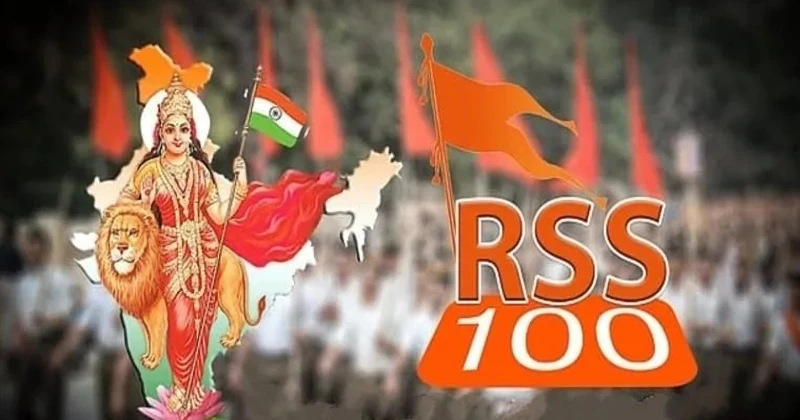
But this year, the observance carried extraordinary weight. The moment marked the centenary of the RSS, a cultural organisation that began as a small gathering in Nagpur in 1925 and has since left an indelible mark on modern India’s politics, society, and identity.
The coincidence of the Sangh’s 100th year with Ayudh Puja was not incidental. For the RSS, which thrives on discipline, symbolism, and ritual, the festival’s worship of Astra-shastras, mirrors its conviction that instruments, when sanctified by dharma, become vehicles of national renewal.
This time, however, the weapons were not only swords, lathis, or household blades tucked away in families’ trunks. Swayamsevaks offered flowers to swords, khukhris, and modern shastras—symbols of continuity with tradition yet adapted to modern life. At the heart of the ceremony, RSS leaders framed the centenary not as a conclusion but as a prologue: the beginning of a new chapter, and a proclamation of India’s civilisational destiny.
The RSS was founded on 27 September 1925, coinciding with Vijayadashami, by Dr. Keshav Baliram Hedgewarji, a physician and nationalist who had participated in the Indian freedom struggle. By 1920, Dr Hedgewar had already declared his discontent with the limited political vision of the Congress. At the Nagpur session that year, he pressed the Congress to adopt Purna Swarajya (complete independence) as its goal, years before the demand became mainstream. But for him, freedom from British colonialism was only the beginning. Political independence meant little without cultural unity and moral regeneration.
“Total independence must be our goal,” Dr. Hedgewar declared, “and an independent Bharat must liberate other nations from capitalist bondage.”
That conviction, that India’s destiny was both national and global has remained central to the Sangh’s ethos for a century. Successive leaders, from Hedgewar to his successor MS Golwalkar (known as Guruji), to Balasaheb Deoras, and now Sarsanghchalak Dr Mohan Bhagwatji, have carried the same flame: to build character, unite Hindu society, and dedicate collective strength to Bharat Mata.
What began as a meeting of about 17 men in a doctor’s home in Nagpur has grown into the world’s largest voluntary cultural organisation, with millions of swayamsevaks in tens of thousands of shakhas across India and affiliates in over 50 countries.
The festival of Ayudh Puja, performed on the ninth day of Navaratri, has deep cultural and historical roots. In ancient times, warriors sanctified their swords, artisans their tools, farmers their ploughs, and students their books. The Mahabharata tells of Arjuna, who, on this day, retrieved his weapons hidden in a Shami tree after years of exile to prepare for the great battle of Kurukshetra. In Tamil Nadu and Karnataka, kings consecrated their armies’ weapons before campaigns, while in homes across India, householders even today garland sewing machines, motorbikes, and computers as part of the ritual.
Ayudh Puja symbolises the fusion of shakti (strength) and bhakti (devotion), affirming that power must remain anchored in righteousness. For the RSS, the ritual is deeply metaphorical. It sanctifies not only physical weapons but also the instruments of discipline, service (seva), and organisation (sangathan).
Every Vijayadashami has marked the Sangh’s foundation day since 1925. Yet this year’s centenary carried a sense of epochal transition. The RSS has expanded from a handful of men in khaki shorts meeting on dusty fields to a nationwide cultural force influencing service, education, politics, and even India’s global diaspora. The Bharatiya Janata Party (BJP), widely seen as its political arm, governs India with a strong parliamentary majority. Dozens of affiliated organisations; working in trade unions, schools, women’s groups, farmers’ associations, tribal development, and more extend the Sangh’s reach into almost each and every sector of Indian society.
The centenary also aligns with India’s broader transformation. As the country projects itself as the world’s fastest-growing major economy, a space power, and a global cultural hub, the Sangh seeks to position itself as the guardian of India’s moral trajectory.
he RSS has always stressed the simplicity of its culture. This underscored three practices seen as the bedrock of its daily routine:
• Shakha: The daily assembly where physical drills, games, and prayers instill discipline and camaraderie.
• Baithak (Meeting): Where members gather to discuss ideas, plan service, and build ideological clarity.
• Bhojan and Vishram (Meal and Rest): Even eating and resting are collective, symbolizing equality, fraternity, and balance between body and mind.
What appear as humble routines are, in the Sangh’s imagination, instruments for societal renewal: habits that cultivate equality, dissolve hierarchy, and strengthen shared identity.
The Triad of Transformation
The Sangh articulated three long-term shifts shaping its role:
1. Sangathan Vistaar (Expansion of Organisation): What began in 1925 with a small group of committed men in Nagpur has today become a vast and disciplined movement. In its formative years, the Sangh focused on spreading its presence across India, giving rise to the unique concept of the Pracharak—a selfless worker who renounces personal ambitions to dedicate life to the nation. Through their tireless efforts, the Sangh expanded from villages to districts and to the national stage. Today, it is difficult to find a region without Sangh Swayamsevaks, as its influence extends not only across India but also throughout the world.
2. Satta Parivartan (Transformation of Power): While officially non-political, the Sangh’s sway on India’s political life is undeniable. The rise of the BJP as a majoritarian force reflects the mainstreaming of the Sangh’s cultural nationalism.
3. Vyavastha Parivartan (Systemic Change): Beyond politics, the Sangh stresses deep reforms—whether in education, social service, or civic responsibility—aimed at structural change rather than cosmetic adjustments.
Panch Parivartan: A Blueprint for Renewal
Among the highlights of the centenary was the unveiling of Panch Parivartan, five areas where transformation is seen as essential for Bharat’s renaissance:
1. Self-Reliant Lifestyle (Swa-aadharit Jeevan Shaili): Encouraging simplicity, local economies, Swadeshi industries, and reduced dependence on imports.
2. Environmental Protection (Paryavaran Sanrakshan): From tree planting to river rejuvenation, stressing harmony with nature as dharmic duty.
3. Social Harmony (Samajik Samrasta): Eradicating caste divisions and affirming unity across Hindu society.
4. Unity in family structure (Kutumb Prabodhan): Strengthening the family as the unit of cultural values, bridging generational divides.
5. Civic Duty (Nagrik Kartavya): Promoting cleanliness, discipline, and national responsibility in everyday life.
Together, these five goals outline a moral-social framework for the Sangh’s second century.