“What did the RSS do for India’s freedom?”, This question, often flung across Parliament floors and media debates, carrying the sting of accusation and the weight of ignorance. It’s a question that has haunted the Rashtriya Swayamsevak Sangh (RSS) for decades— sometimes asked with genuine curiosity, but more often with political malice. Yet, behind the silence lies a story of quiet sacrifice, cultural resilience and a vision of Bharat that refused to die.
The pain of being forgotten
India’s independence was not a moment—it was a movement. A movement that spanned centuries, soaked in blood, tears and the unyielding spirit of its people. While the Congress Party and its leaders are rightly celebrated for their role, the narrative has often excluded others who fought differently, quietly and sometimes invisibly.
Founded in 1925 by Dr. Keshav Baliram Hedgewar, the RSS was never meant to be a political party. It was a cultural and nationalist force, designed to unite Hindus and instill discipline, character and patriotism. Hedgewar himself was a revolutionary, jailed twice—once during the Khilafat Movement and again during Gandhi’s Civil Disobedience campaign. His vision was clear: India needed not just freedom from the British, but freedom from internal division.
RSS and the Quit India Movement
The Quit India Movement of 1942 was a watershed moment. While the Congress led the charge, many organizations—including the RSS—played supporting roles. In Chimur, Vidarbha, RSS volunteers led by Ramakant Deshpande clashed with British forces. The protest turned violent and British officials were killed. This uprising, known as the Chimur Ashti rebellion, saw RSS swayamsevaks shot dead while unfurling the national flag.
RSS also provided shelter to freedom fighters. Aruna Asaf Ali, a prominent Congress leader, was hidden by RSS leader Lala Hansraj in Delhi for over ten days during a major protest. She later acknowledged this in a 1967 interview. Despite its non-political stance, RSS shakhas celebrated Congress’s 1929 declaration of ‘Purna Swaraj’ by hoisting the national flag on January 26, 1930. Every swayamsevak took a pledge to “free the country,” a quiet but powerful commitment.
The cultural compass: Bharat awakens
While India surged economically post-independence, a deeper awakening stirred in its soul. The name “India,” derived from the Indus River and popularized during British rule, was never truly ours. It was a label imposed by outsiders. The real name—Bharat—echoes through the Rig Veda, through the tales of King Bharata, through the soil and spirit of this land.
The Mughal era called it Hindustan. The British called it India. But the people never forgot Bharat. It lived in our prayers, our poetry, our pride. In 2023, a renewed push to reclaim “Bharat” gained momentum. Prime Minister Narendra Modi emphasized shedding colonial vestiges and embracing indigenous identity. The shift wasn’t just semantic—it was symbolic. It was about reclaiming history, restoring dignity and reviving pride.
The colonial narrative and its aftermath
The British were masters of divide and rule. They feared mass mobilization, especially one rooted in cultural unity. The RSS’s emphasis on Hindu solidarity was seen as a threat—not just by the British, but later by secular political forces who viewed cultural nationalism with suspicion.
After independence, the RSS was banned thrice: in 1948 after Gandhi’s assassination (despite no association with Nathuram Godse and the incident ), during the Emergency in 1975, and after the Babri Masjid demolition in 1992. Each time, it emerged stronger, more organized and more determined.
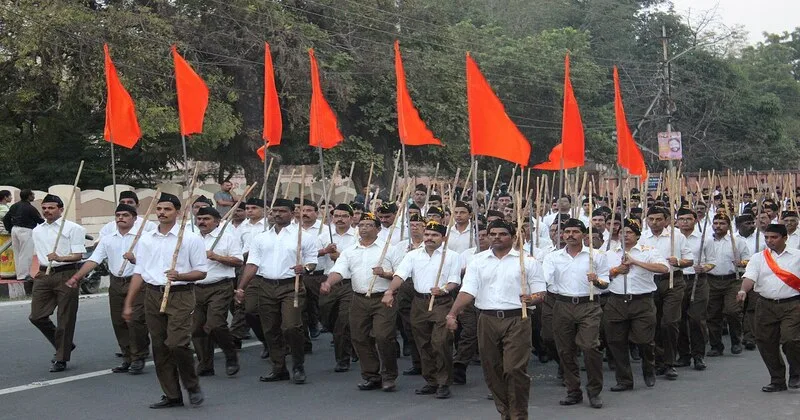
Today, the RSS has over 73,000 shakhas and nearly 4 million swayamsevaks. It runs thousands of schools, charities and social service programs. Its influence spans politics, education, disaster relief and cultural revival.
Nation building beyond Independence
Post-1947, RSS volunteers were instrumental in refugee rehabilitation during Partition. They built shelters, distributed food and helped restore dignity to those uprooted by violence. In 1951, the Bharatiya Jana Sangh was formed—RSS’s first formal political expression, which later evolved into the BJP.
RSS-affiliated organizations like Vidya Bharati (education), Vanvasi Kalyan Ashram (tribal welfare) and Seva Bharati (social service) have transformed lives across rural and urban India. During disasters like the 2001 Gujarat earthquake and 2013 Uttarakhand floods, RSS volunteers were among the first responders.
Intellectual and cultural renaissance
RSS’s revival wasn’t just physical—it was philosophical. Thinkers like Dattopant Thengadi and Deendayal Upadhyaya shaped economic and political thought rooted in Indian ethos. Upadhyaya’s “Integral Humanism” offered an alternative to Western capitalism and socialism, emphasizing harmony between individual and society.
RSS promoted Sanskrit, Vedic studies and indigenous knowledge systems. It encouraged pride in Indian heritage, countering colonial narratives that painted India as backward.
Addressing criticism and misconceptions
Critics often accuse RSS of being communal or exclusionary. But its work in tribal areas, disaster zones, and slums tells another story. It has supported Dalit upliftment, women’s empowerment, and interfaith dialogue—often away from the media glare.
RSS’s refusal to seek political credit has led to its erasure from mainstream narratives. But silence is not absence. It is the quiet strength of those who build without banners.
The Bharat renaissance
Changing “India” to “Bharat” is more than a name change. It’s a revival of identity. It’s a declaration that we are no longer defined by colonial narratives but by our own legacy. सत्यमेव जयते, phrase mentioned in Mundaka Upanishad means, “Truth alone triumphs”.
RSS’s vision of Bharat is not about exclusion—it’s about civilizational pride. It’s about remembering who we are, where we came from, and what we stand for.
The silent architects of Bharat
From survival to revival, the journey of India → Bharat is a saga of pain, pride, and perseverance. RSS may not have marched with banners, but it built the foundation of a resilient Bharat. It trained minds, healed wounds and preserved culture when others forgot. As we step into a new era, let us remember: Bharat is not rising because of one voice—it is roaring because of millions who never stopped believing. Bharat is rising. Bharat is leading.